Key takeaways
- Muscle grows when you lift hard enough, often enough, and a bit more over time. Heavy or light loads both work when sets end close to failure (Lopez et al., 2021).
- Start with about 6–10 hard sets per muscle per week and build up. More weekly sets give more growth, with diminishing returns (Schoenfeld et al., 2017; Pelland et al., 2026).
- Train each muscle at least twice a week. A 3-day full-body program does this with the least planning (Schoenfeld et al., 2016).
- Stop most sets with 1–3 reps in reserve. Going to all-out failure on every set adds little (Refalo et al., 2023).
- Eat about 1.6 g of protein per kg of body weight a day and a small calorie surplus; gains above that protein intake were not detectable in a large meta-analysis (Morton et al., 2018).
- Sleep at least 7 hours. One night without sleep lowered muscle protein synthesis by 18% the next day (Lamon et al., 2021).
If you are new to lifting, the internet makes building muscle look complicated: dozens of splits, rep schemes, supplements and “rules”. The research says something much simpler. A handful of things do almost all of the work: lifting with enough effort, doing enough sets, adding a little load or a few reps over time, eating enough protein and sleeping enough.
This guide explains those few things in plain language, shows what the studies actually found, and gives you a complete 3-day program you can start this week. It is the starting point of our Science section. When you want more depth, each part links to a full guide, and our pillar on every training split shows how programs are built.
Evidence in one line: progressive, reasonably hard training with enough weekly sets, plus enough protein and sleep, builds muscle in almost everyone; the details matter much less than doing those things consistently for months.
Who this is for. Adults who have lifted for less than about a year, or who have trained without a plan. If you have a medical condition, an injury, are pregnant or are under 18, talk to your doctor or a qualified coach before you start.
Key terms
- Rep (repetition): one lift of the weight. A set is a group of reps done without a break.
- Hard set: a working set that ends close to failure (not a warm-up).
- RIR (reps in reserve): how many more reps you could have done when you stopped. 2 RIR means you stopped with about two good reps left. See training to failure vs RIR.
- 1RM (one-rep max): the most weight you can lift once with good form.
- Progressive overload: gradually making training harder, by adding load, reps or sets. See progressive overload.
- Hypertrophy: muscle growth.
- MPS (muscle protein synthesis): the process of building new muscle protein; it rises for hours after training and after protein-rich meals.
What actually builds muscle
Mechanical tension is the main signal
When a muscle contracts hard against a load, its fibres sense the tension. That signal switches on the machinery (via mTORC1) that raises muscle protein synthesis. A review of the mechanisms concluded that mechanical signals are the prime candidates for starting muscle growth, while muscle damage is probably not essential and the role of metabolic stress (the “pump” and burn) rests on indirect evidence (Wackerhage et al., 2019). Our guide to how muscle grows explains the biology in detail.
What this means for you: you do not need to chase soreness or a pump. You need sets that are hard for the muscle you are training.
Load matters less than effort
Many beginners think they must lift very heavy to grow, or that light weights only “tone”. Neither is true. A network meta-analysis of 28 studies with 747 healthy adults compared low loads (more than 15 reps per set), moderate loads (9–15 reps) and high loads (8 reps or fewer), all taken to failure. Muscle growth did not differ between loads, but strength improved more with heavier loads (Lopez et al., 2021).
The same holds in trained lifters. In a 12-week trial, 49 resistance-trained men did either 20–25 reps per set with about 30–50% of their 1RM or 8–12 reps with about 75–90% of 1RM, all to failure. Both groups gained similar lean mass and fibre size. The short rise in hormones such as testosterone after training was not related to how much muscle anyone gained (Morton et al., 2016).
Practical rule: use mostly 6–15 reps per set for the big lifts and 10–20 reps for small isolation exercises. That range is comfortable, safe to learn and easy to judge for effort. See our guide to the best rep range for hypertrophy for the full evidence.
Progressive overload keeps you growing
Your body adapts to what you ask of it. To keep growing you must keep asking for a bit more: more reps with the same weight, or more weight for the same reps. Both work. In an 8-week trial, 43 lifters with at least a year of lower-body training either added load while keeping reps the same or added reps while keeping the load the same. Muscle growth and strength gains were similar in both groups (Plotkin et al., 2022).
That is why the program below uses double progression: add reps first, then add weight.
How much to train
Weekly sets per muscle: the main dial
Volume (how many hard sets you do per muscle each week) is the training variable with the clearest dose-response for growth.
- A meta-regression of 15 studies (34 groups) found that each extra weekly set was linked with a 0.37% larger gain in muscle size on average, and higher-volume groups gained more than lower-volume groups (Schoenfeld et al., 2017). The analysis compared fewer than 5, 5–9 and 10 or more sets per muscle per week.
- A 2026 meta-regression of 67 studies and 2,058 participants confirmed that muscle growth keeps increasing as weekly sets rise, but with diminishing returns. Strength showed much stronger diminishing returns (Pelland et al., 2026).
- The 2026 American College of Sports Medicine position stand, an overview of 137 systematic reviews with more than 30,000 participants, found that hypertrophy was enhanced by higher volumes of 10 or more sets per week (Currier et al., 2026).
For a beginner: start at roughly 6–10 hard sets per muscle per week. That is enough to grow well while you learn the lifts, and it leaves room to add sets later. After 8–12 weeks, if you recover well, add 1–2 sets per muscle per week, up to around 10–15. Our full guide on sets per week for muscle growth shows how to count sets and where the upper limit seems to be. (The 6–10 starting range is our coaching convention; the studies show “more is better” on average, not an exact beginner number.)
Frequency: train each muscle at least twice a week
A meta-analysis of 10 studies that matched total volume found that training a muscle twice a week produced more growth than once a week (effect size 0.49 vs 0.30). Whether three times beats twice was not clear (Schoenfeld et al., 2016). Newer and larger analyses suggest that once volume is the same, frequency itself matters little for growth but helps strength (Pelland et al., 2026).
In practice, higher frequency is mainly a tool for spreading your sets out so each session stays short and productive. In a 10-week trial in 36 trained men (28 finished), a 4-day split training each muscle twice a week and a 3-day full-body routine training each muscle three times a week, with equal volume, produced similar gains in strength and muscle size (Lasevicius et al., 2019). For a beginner, 2–3 sessions per muscle per week is a sensible default. See training frequency.
Effort: how close to failure
“Failure” means you can’t complete another rep with good form. You do not need to go there on every set:
- A meta-analysis of 15 studies found only a trivial advantage for training to failure over stopping short (effect size 0.19), and no significant advantage when studies used a strict definition of momentary failure (Refalo et al., 2023).
- A series of meta-regressions suggested that muscle growth does increase as sets end closer to failure, while strength gains were similar across a wide range of RIR. The authors called the analysis exploratory because RIR had to be estimated (Robinson et al., 2024).
The middle ground: end most sets with 1–3 RIR. Take the last set of an isolation exercise (curls, lateral raises, leg extensions) to failure if you like. Keep 2–3 RIR on squats, deadlifts and presses while you learn them. Beginners usually underestimate how many reps they have left, so once in a while do a test set to true failure on a safe exercise (for example a machine or dumbbell exercise) to calibrate.
Rest between sets
Rest long enough that the next set is good: about 2–3 minutes on big compound lifts and 1–2 minutes on small isolation exercises. Rushing rest usually means fewer reps and less total work. Our guide to rest times between sets has the details.
Picking a first program
The best first program is one that trains every major muscle 2–3 times a week, uses a few basic lifts you can learn well, and fits your schedule. Two options cover almost everyone:
| Option | Days per week | Each muscle trained | Best for |
|---|---|---|---|
| Full-body | 3 (e.g. Mon/Wed/Fri) | 3× per week | Most beginners; busy schedules; learning the lifts fast |
| Upper/lower | 4 (e.g. Mon/Tue/Thu/Fri) | 2× per week | Beginners who like 4 shorter sessions, or after 3–6 months of full-body |
Both work. Pick the one you are most likely to follow for the next three months. If you are unsure, answer three questions in our split finder, or read the guides to full-body training and the upper/lower split.
The 3-day beginner program
Three different full-body days, done on non-consecutive days (for example Monday, Wednesday, Friday). Each session takes about 50–70 minutes including warm-up. Do 1–3 warm-up sets with lighter weights before the first exercise for each body part; see warm-up sets.
Day 1
| Exercise | Sets × reps | Effort | Rest |
|---|---|---|---|
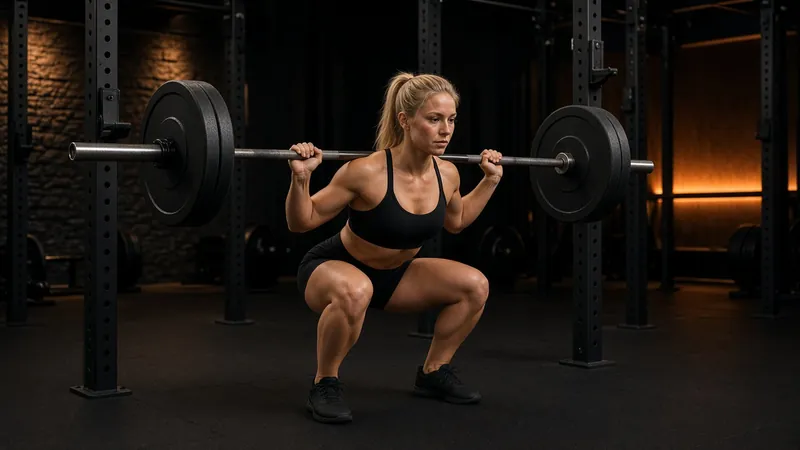
| Back squat | 3 × 6–10 | 2–3 RIR | 2–3 min |
| Bench press | 3 × 6–10 | 2 RIR | 2–3 min |
| Seated cable row | 3 × 8–12 | 1–2 RIR | 2 min |
| Leg curl | 2 × 10–15 | 1–2 RIR | 1–2 min |
| Biceps curl | 2 × 10–15 | 0–2 RIR | 1–2 min |
Day 2
| Exercise | Sets × reps | Effort | Rest |
|---|---|---|---|
| Romanian deadlift | 3 × 8–10 | 2–3 RIR | 2–3 min |
| Overhead press | 3 × 6–10 | 2 RIR | 2–3 min |
| Lat pulldown | 3 × 8–12 | 1–2 RIR | 2 min |
| Leg extension | 2 × 10–15 | 0–2 RIR | 1–2 min |
| Overhead triceps extension | 2 × 10–15 | 0–2 RIR | 1–2 min |
| Standing calf raise | 2 × 10–15 | 0–2 RIR | 1–2 min |
Day 3
| Exercise | Sets × reps | Effort | Rest |
|---|---|---|---|
| Leg press | 3 × 10–12 | 1–2 RIR | 2–3 min |
| Incline dumbbell press | 3 × 8–12 | 1–2 RIR | 2 min |
| Barbell row | 3 × 8–10 | 2 RIR | 2 min |
| Leg curl | 2 × 10–15 | 1–2 RIR | 1–2 min |
| Lateral raise | 3 × 12–20 | 0–2 RIR | 1 min |
Volume audit
Weekly hard sets per muscle. “Direct” counts exercises that mainly train that muscle; “indirect” counts compound lifts where it helps (counted as half a set, the “fractional” method that fit the data best in Pelland et al., 2026).
| Muscle | Direct sets | Indirect sets (½ each) | Weekly total |
|---|---|---|---|
| Quads | 8 (squat 3, leg extension 2, leg press 3) | — | 8 |
| Hamstrings | 7 (leg curl 4, RDL 3) | — | 7 |
| Glutes | 9 (squat, RDL, leg press) | — | 9 |
| Chest | 6 (bench 3, incline 3) | — | 6 |
| Back (lats, upper back) | 9 (cable row, pulldown, barbell row) | — | 9 |
| Side delts | 3 (lateral raise) | 3 (overhead press) | 4.5 |
| Triceps | 2 | 9 (all presses) | 6.5 |
| Biceps | 2 | 9 (rows, pulldown) | 6.5 |
| Calves | 2 | — | 2 |
Every major muscle lands in the 6–10 set starting range. Calves are low by design; add 2 sets of calf raises on Day 1 or Day 3 if calves are a priority. After 8–12 weeks, move toward 10–15 sets for the muscles you most want to grow (see “After three months” below).
How to progress (double progression)
- Pick a weight you can lift for the bottom of the rep range with the planned RIR.
- Each session, try to add 1 rep to some or all sets.
- When you hit the top of the range on all sets at the planned RIR, add the smallest weight jump available next time: about 2.5 kg on lower-body barbell lifts, 1–2.5 kg on upper-body lifts, or the next dumbbell or machine plate. Then work back up through the rep range.
- Write every set down. Our free training log does this for you.
When you stall: if you fail to add a rep or weight on a lift for two or three sessions in a row, first check sleep, food and stress. Then drop the weight by about 10%, build back up over two weeks and you will usually pass the old best. If many lifts stall at once and you feel run down, take a lighter week with half the sets; see when and how to deload. (These stall rules are our coaching conventions, not tested protocols.)
Home or minimal-equipment swaps
| Gym exercise | Home swap (same pattern) |
|---|---|
| Back squat / leg press | Goblet squat or Bulgarian split squat with dumbbells |
| Romanian deadlift | Dumbbell Romanian deadlift |
| Bench press / incline press | Dumbbell floor press, push-ups (feet raised to make them harder) |
| Cable row / barbell row | One-arm dumbbell row |
| Lat pulldown | Pull-ups or band-assisted pull-ups (pull-up) |
| Leg curl | Sliding leg curls, Nordic curl negatives |
| Leg extension | Split squats with a forward knee; slow step-ups |
Keep the rep ranges and effort the same. If the weights are light, use the top of the rep range and stop closer to failure (0–1 RIR on safe exercises).
After three months
Most beginners can keep progressing on this program for 3–6 months. When progress slows:
- Add sets to the muscles you most want to grow: 1–2 more sets per week at a time, up to about 10–15.
- Move to 4 days with an upper/lower split if sessions get too long.
- Swap one or two exercises for close variations if a lift feels stale; see exercise variation.
Exercise selection and technique basics
You don’t need dozens of exercises. Each session in the program covers:
- a squat or leg press pattern (quads, glutes),
- a hip hinge (Romanian deadlift) or hamstring curl,
- a horizontal or incline press (chest, front delts, triceps),
- a row or pulldown (lats, upper back, biceps),
- plus 1–3 small exercises for arms, side delts, calves or hamstrings.
Technique rules for beginners:
- Full, controlled range of motion. Lower the weight under control and use the range you can own. Training at long muscle lengths seems especially useful for growth; see range of motion.
- Same form every rep. If form breaks down, the set is over, even if you could grind out another ugly rep.
- Learn the barbell lifts with lighter loads first. Spend the first 2–4 weeks at 3 RIR on squats, Romanian deadlifts and presses. Machines are fine; research suggests machines and free weights build muscle similarly.
- Film a set now and then from the side. It is the quickest way to spot depth, bar path or back-rounding problems.
Each linked exercise page shows setup, steps, cues and common mistakes.
Eating for growth
Protein: about 1.6 g per kg a day
A meta-analysis of 49 trials with 1,863 participants found that protein supplementation during resistance training increased gains in muscle mass and strength, and that gains in fat-free mass levelled off at about 1.62 g of protein per kg of body weight per day. Older age reduced and training experience increased the benefit (Morton et al., 2018). One author has received funding from the US dairy industry, which also supported some included trials.
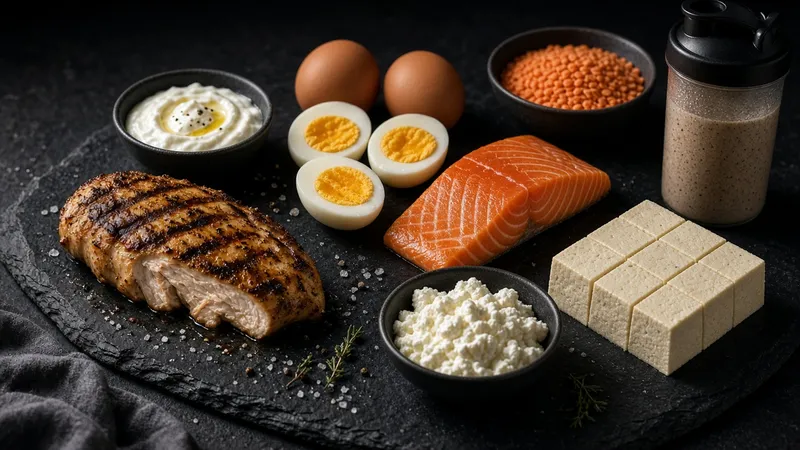
What to do: eat 1.6 g/kg/day as your target. For an 80 kg person that is 128 g a day. If you’re very lean, dieting, or simply want a safety margin, go up to 2.2 g/kg (176 g for 80 kg). A review of off-season bodybuilding nutrition recommends 1.6–2.2 g/kg/day spread over 3–6 meals of about 0.40–0.55 g/kg each (Iraki et al., 2019). For food lists, timing and vegans, see our full guide on protein intake.
Calories: a small surplus
Building muscle is easiest with a little more energy than you burn. The same review suggests a surplus of about 10–20% and a weight gain of about 0.25–0.5% of body weight per week for novice and intermediate lifters (Iraki et al., 2019). For an 80 kg person, 0.25–0.5% is 0.2–0.4 kg a week.
Bigger is not better. In 17 lifters (of 21 randomised) who finished an 8-week trial at maintenance, a 5% surplus or a 15% surplus, faster weight gain mainly meant faster fat gain, not more strength or muscle thickness (Helms et al., 2023). The study was small, so treat it as a sensible warning rather than a precise rule.
What to do: weigh yourself 3–7 mornings a week and track the weekly average. If it rises faster than 0.5% a week, eat a bit less; if it does not move for two to three weeks, add about 150–250 kcal a day. If you have a lot of body fat to lose, you can build muscle while eating at maintenance or a small deficit; see body recomposition and lean bulking.
Supplements: mostly optional
None are required. Creatine monohydrate (3–5 g a day) is the best-supported option: it raises muscle creatine stores, improves high-intensity performance and leads to greater training adaptations, with a long safety record in healthy people (Kreider et al., 2017); see our creatine review. Protein powder is just convenient food.
Sleep and recovery
Muscle is built between sessions, and sleep is the biggest recovery factor you control.
- In 13 healthy young adults, one night without sleep cut muscle protein synthesis by 18% the next day, raised cortisol by 21% and lowered testosterone by 24% (Lamon et al., 2021).
- A systematic review of 17 studies found that several nights of short sleep can reduce strength in multi-joint lifts such as squats and presses, while one sleepless night had little effect on strength (Knowles et al., 2018). Most of the studies were of moderate or weak quality.
What to do: aim for at least 7 hours of sleep. Keep a regular wake time, cut caffeine in the afternoon and train anyway after a bad night, just with a rep more in reserve. Our guide on sleep and muscle growth gives a full plan.
Realistic rates of gain
Beginners grow faster than experienced lifters, but how fast varies a lot from person to person.
The largest study of this question trained the non-dominant arm of 585 men and women for 12 weeks and measured the biceps with MRI. Changes in muscle size ranged from −2% to +59%, and 1RM gains from 0% to +250%. Men gained slightly more size in relative terms than women, while women gained more strength in relative terms (Hubal et al., 2005). Some people barely changed; others transformed.
What we can and can’t say:
- Expect to grow, at your own pace. Some people respond quickly and others slowly, and no test can predict which group you are in. Judge your progress over months, not weeks.
- We can’t give you a “kg of muscle per month” number. Studies measure different muscles in different ways over 6–12 weeks, and individual variation is huge. Be wary of anyone who promises a precise rate.
- Weight on the scale is not muscle. Use the scale for your calorie target, and judge muscle growth by strength in the 6–15 rep range, tape measurements (arm, thigh, waist) and photos every 4–6 weeks.
What the research does not show yet
- Exact beginner set numbers. Dose-response studies pool trained and untrained people. Our 6–10 starting range is a cautious convention.
- Long-term data. Few trials run longer than 12 weeks, so we know little about the best plan for year two and beyond.
- Who responds best and why. Genetics, sleep, diet and training history all seem to matter, but no test predicts your response.
- Women and older adults. They are under-represented in most trials, though the core principles appear to apply to them too.
Common beginner mistakes
| Mistake | Fix |
|---|---|
| Program-hopping every few weeks | Run one plan for at least 8–12 weeks and track progress. |
| Training too far from failure (“easy sets”) | End most sets at 1–3 RIR; test true failure on a safe exercise now and then. |
| Going to failure on heavy squats and deadlifts | Keep 2–3 RIR on big barbell lifts; save failure for machines and isolation work. |
| Adding weight before reps | Use double progression: fill the rep range first, then add the smallest weight jump. |
| Too little protein | Hit about 1.6 g/kg/day, spread over 3–6 meals. |
| “Dirty bulking” | Aim for 0.25–0.5% body-weight gain per week, not as fast as possible. |
| Skipping legs or back | Follow the full program; the volume audit is balanced on purpose. |
| Poor sleep | Treat 7+ hours as part of the program. |
How this compares with other beginner approaches
| Approach | Strengths | Weak points |
|---|---|---|
| This 3-day full-body plan | Each muscle 3× a week, balanced volume, double progression, easy to adjust | Sessions are 50–70 min; fewer sets per exercise |
| 5×5 programs (StrongLifts, Madcow) | Simple, fast strength gains on the barbell lifts | Little arm, shoulder and hamstring work; low reps only. See 5×5 programs. |
| Bro split (one muscle per day) | Lots of sets per session for one muscle | Each muscle only once a week; worse for beginners. See the bro split. |
| Machine-only circuit | Safe, quick to learn | Fine for growth, but limits home and barbell options later |
FAQ
How long does it take to build muscle as a beginner?
Strength usually goes up within the first few weeks, partly because your nervous system learns the lifts. Muscle growth is measurable within the length of a typical study: 10 weeks in one trial (Lasevicius et al., 2019) and 12 weeks in another (Hubal et al., 2005). Visible change in the mirror often takes longer, and individual differences are large.
Can I build muscle with only 3 workouts a week?
Yes. Three full-body sessions train each muscle three times a week, and studies find similar gains with 2–3 sessions per muscle when weekly sets are equal (Lasevicius et al., 2019).
Do I need to lift heavy to build muscle?
No. Light and heavy loads build similar muscle when sets are taken close to failure (Lopez et al., 2021). Heavier loads build more strength, so most programs use moderate loads of about 6–15 reps.
Do I have to train to failure?
No. Stopping 1–3 reps short of failure builds nearly as much muscle and is easier to recover from (Refalo et al., 2023). Going to failure on the last set of small exercises is fine.
How much protein do I need to build muscle?
About 1.6 g per kg of body weight per day; above that, extra gains were not detectable on average (Morton et al., 2018). Up to 2.2 g/kg is a reasonable upper target.
Should beginners bulk or cut first?
If you are lean or average, eat a small surplus (about 0.25–0.5% weight gain per week). If you have a lot of fat to lose, eat at maintenance or a small deficit with high protein; beginners can often build muscle while losing fat. See body recomposition.
Are supplements needed?
No. Creatine monohydrate is the best-supported option if you want one (Kreider et al., 2017); protein powder is optional food.
The bottom line
Pick a balanced program, train each muscle 2–3 times a week with about 6–10 hard sets, stop most sets 1–3 reps short of failure, add reps and then weight over time, eat about 1.6 g/kg of protein with a small surplus, and sleep 7+ hours. Do that for months and you will grow.
Start with the 3-day program above. When you want to go deeper, read progressive overload, sets per week, protein intake and our pillar on every training split.
References
- Wackerhage H, Schoenfeld BJ, Hamilton DL, et al. Stimuli and sensors that initiate skeletal muscle hypertrophy following resistance exercise. J Appl Physiol (1985). 2019;126(1):30-43. doi:10.1152/japplphysiol.00685.2018. PubMed: 30335577
- Lopez P, Radaelli R, Taaffe DR, et al. Resistance Training Load Effects on Muscle Hypertrophy and Strength Gain: Systematic Review and Network Meta-analysis. Med Sci Sports Exerc. 2021;53(6):1206-1216. doi:10.1249/MSS.0000000000002585. PubMed: 33433148
- Morton RW, Oikawa SY, Wavell CG, et al. Neither load nor systemic hormones determine resistance training-mediated hypertrophy or strength gains in resistance-trained young men. J Appl Physiol (1985). 2016;121(1):129-38. doi:10.1152/japplphysiol.00154.2016. PubMed: 27174923
- Plotkin D, Coleman M, Van Every D, et al. Progressive overload without progressing load? The effects of load or repetition progression on muscular adaptations. PeerJ. 2022;10:e14142. doi:10.7717/peerj.14142. PubMed: 36199287
- Schoenfeld BJ, Ogborn D, Krieger JW. Dose-response relationship between weekly resistance training volume and increases in muscle mass: A systematic review and meta-analysis. J Sports Sci. 2017;35(11):1073-1082. doi:10.1080/02640414.2016.1210197. PubMed: 27433992
- Pelland JC, Remmert JF, Robinson ZP, et al. The Resistance Training Dose Response: Meta-Regressions Exploring the Effects of Weekly Volume and Frequency on Muscle Hypertrophy and Strength Gains. Sports Med. 2026;56(2):481-505. doi:10.1007/s40279-025-02344-w. PubMed: 41343037
- Currier BS, D’Souza AC, Singh MAF, et al. American College of Sports Medicine Position Stand. Resistance Training Prescription for Muscle Function, Hypertrophy, and Physical Performance in Healthy Adults: An Overview of Reviews. Med Sci Sports Exerc. 2026;58(4):851-872. doi:10.1249/MSS.0000000000003897. PubMed: 41843416
- Schoenfeld BJ, Ogborn D, Krieger JW. Effects of Resistance Training Frequency on Measures of Muscle Hypertrophy: A Systematic Review and Meta-Analysis. Sports Med. 2016;46(11):1689-1697. doi:10.1007/s40279-016-0543-8. PubMed: 27102172
- Lasevicius T, Schoenfeld BJ, Grgic J, et al. Similar Muscular Adaptations in Resistance Training Performed Two Versus Three Days Per Week. J Hum Kinet. 2019;68:135-143. doi:10.2478/hukin-2019-0062. PubMed: 31531139
- Refalo MC, Helms ER, Trexler ET, et al. Influence of Resistance Training Proximity-to-Failure on Skeletal Muscle Hypertrophy: A Systematic Review with Meta-analysis. Sports Med. 2023;53(3):649-665. doi:10.1007/s40279-022-01784-y. PubMed: 36334240
- Robinson ZP, Pelland JC, Remmert JF, et al. Exploring the Dose-Response Relationship Between Estimated Resistance Training Proximity to Failure, Strength Gain, and Muscle Hypertrophy: A Series of Meta-Regressions. Sports Med. 2024;54(9):2209-2231. doi:10.1007/s40279-024-02069-2. PubMed: 38970765
- Morton RW, Murphy KT, McKellar SR, et al. A systematic review, meta-analysis and meta-regression of the effect of protein supplementation on resistance training-induced gains in muscle mass and strength in healthy adults. Br J Sports Med. 2018;52(6):376-384. doi:10.1136/bjsports-2017-097608. PubMed: 28698222
- Iraki J, Fitschen P, Espinar S, et al. Nutrition Recommendations for Bodybuilders in the Off-Season: A Narrative Review. Sports (Basel). 2019;7(7). doi:10.3390/sports7070154. PubMed: 31247944
- Helms ER, Spence AJ, Sousa C, et al. Effect of Small and Large Energy Surpluses on Strength, Muscle, and Skinfold Thickness in Resistance-Trained Individuals: A Parallel Groups Design. Sports Med Open. 2023;9(1):102. doi:10.1186/s40798-023-00651-y. PubMed: 37914977
- Kreider RB, Kalman DS, Antonio J, et al. International Society of Sports Nutrition position stand: safety and efficacy of creatine supplementation in exercise, sport, and medicine. J Int Soc Sports Nutr. 2017;14:18. doi:10.1186/s12970-017-0173-z. PubMed: 28615996
- Lamon S, Morabito A, Arentson-Lantz E, et al. The effect of acute sleep deprivation on skeletal muscle protein synthesis and the hormonal environment. Physiol Rep. 2021;9(1):e14660. doi:10.14814/phy2.14660. PubMed: 33400856
- Knowles OE, Drinkwater EJ, Urwin CS, et al. Inadequate sleep and muscle strength: Implications for resistance training. J Sci Med Sport. 2018;21(9):959-968. doi:10.1016/j.jsams.2018.01.012. PubMed: 29422383
- Hubal MJ, Gordish-Dressman H, Thompson PD, et al. Variability in muscle size and strength gain after unilateral resistance training. Med Sci Sports Exerc. 2005;37(6):964-72. PubMed: 15947721