Every Training Split and Scheme Explained: The Science Behind Each One
Every training split, from full body and PPL to 5/3/1, PHAT, DC and FST-7, analysed against 55 studies: frequency, volume, sample weeks and how to choose.
Key takeaways
- When weekly sets per muscle are equal, split and full-body routines build similar muscle (meta-analysis of 14 studies, 392 people). Choose by schedule and preference.
- Weekly hard sets per muscle drive growth, with diminishing returns (67-study meta-regression). Most lifters do well at about 10–20 sets per muscle per week.
- Frequency mainly matters as a way to spread volume. Twice a week per muscle is the practical default; for strength, practising lifts more often adds a little extra.
- Of all the named programs, only GVT, DUP and rest-pause have direct trials. GVT's 10 sets were no better than 5; DUP adds strength but no extra size.
- Strength programs (5×5, Texas Method, 5/3/1, nSuns) build muscle but usually need 6–9 extra weekly sets for arms, delts and calves.
- Pick by days you can reliably train: 2–3 full body, 4 upper/lower, 5 hybrid, 6 PPL. Run it 8–12 weeks before judging.
Find your split
Answer three short questions and get a starting program you can run this week, with a link to the full guide.
There are hundreds of named training programs, and every one of them has a forum thread calling it “the best for size”. The research tells a less dramatic and more useful story: almost every well-designed split works, because they all turn the same few dials. What matters is how many hard sets each muscle gets per week, how those sets are spread across the week, how the load progresses, and whether you can recover and keep showing up for months.
This guide is a thorough, honest analysis of the main training splits and schemes. It covers 21 splits and schemes, from full body and push/pull/legs to 5/3/1, nSuns, German Volume Training, DC and FST-7. For each one you get its origin, structure, the weekly frequency and sets it actually delivers, what the science supports and what it doesn’t, and a sample week. Then come a master comparison table, a step-by-step decision guide, the myths, and an FAQ. Every study is linked, checked on PubMed, and free of retractions.
How we grade the evidence. Very few named programs have ever been tested in a trial. So each scheme gets a grade: A: tested directly in several trials or meta-analyses. B: tested directly, but in a few small trials. C: never tested by name, but its key parts are well supported. D: coaching experience only, or key claims contradict the research.
The 60-second answer
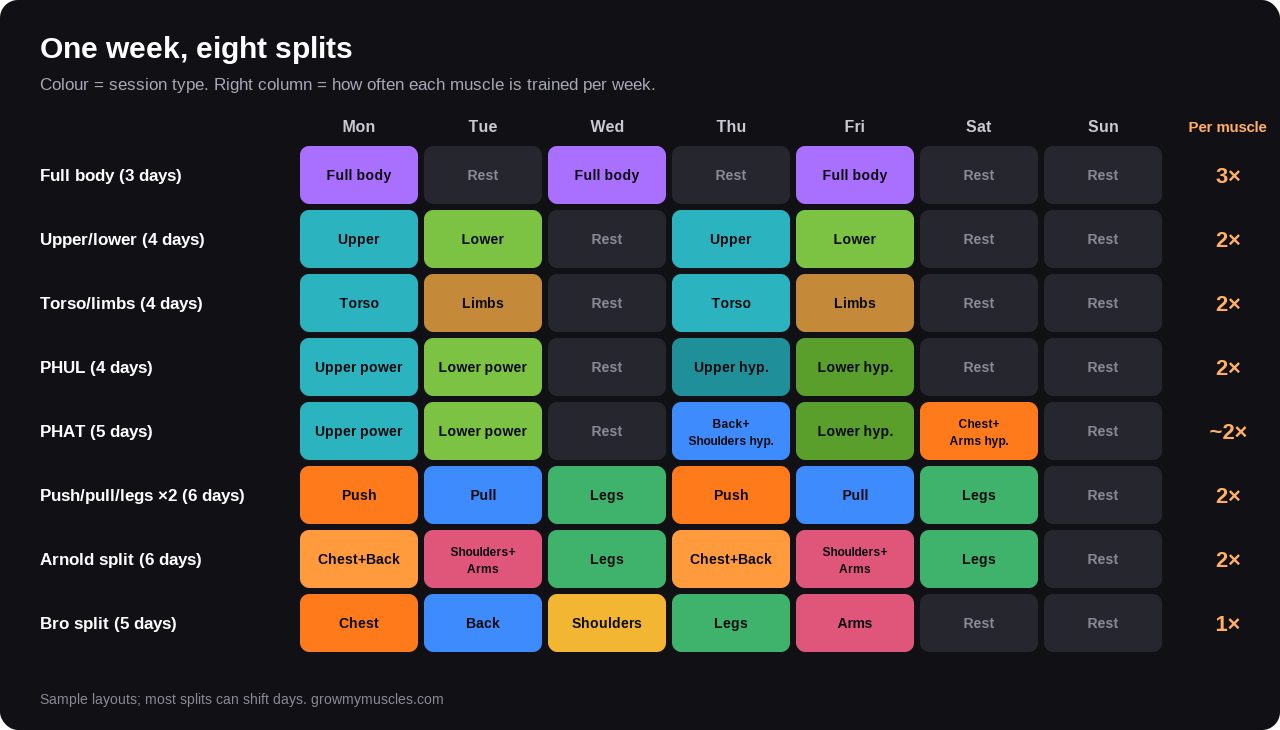
- Pick by schedule first. 2–3 days: full body. 4 days: upper/lower (or PHUL). 5 days: a hybrid such as upper/lower + push/pull/legs. 6 days: push/pull/legs twice or the Arnold split.
- Then count sets. Aim for about 10–20 hard sets per muscle per week if you’re past the beginner stage, counting sets for muscles that only assist a lift as half sets. Beginners grow well on less. See how many sets per week you need.
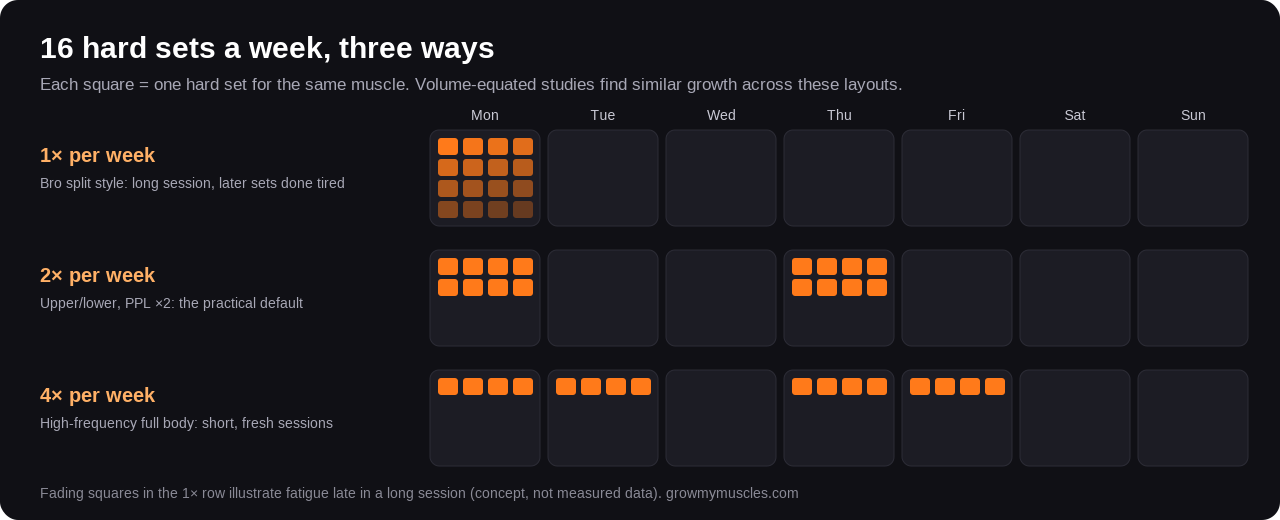
- Train each muscle at least twice a week as a default. That isn’t because once a week can’t work. It’s because 2 × 8 good sets is easier to do well than 1 × 16.
- Strength programs need extra arm, shoulder and calf work if size is a goal.
- Run it for 8–12 weeks before you judge it, and change it for a reason, not out of boredom.
Part 1: The science that decides which splits work
A split is just a way of distributing volume (hard sets) across the week. So before comparing programs, we need what the research says about volume, frequency, session size, recovery and specificity. (For a frequency-only deep dive, see our training frequency guide.)
Weekly volume: the main driver, with diminishing returns
The strongest predictor of how much a muscle grows is roughly how many hard sets (sets taken close to failure) it gets per week. Schoenfeld, Ogborn and Krieger’s 2017 meta-analysis found a graded dose-response between weekly sets and muscle growth. A 2019 trial in trained men then found that more weekly sets produced more muscle thickness, but not more strength, over eight weeks.
The largest analysis to date, by Pelland and colleagues (Sports Medicine, published online December 2025, in print 2026), pooled 67 studies and 2,058 participants. Three findings matter for split design:
- Gains rise with weekly volume for both size and strength, but with diminishing returns. The returns diminish much faster for strength than for size.
- How you count sets matters. The model fit best when sets that train a muscle only indirectly (triceps on a bench press, say) counted as half a set. This is the “fractional” method we use throughout this site.
- Frequency’s own effect on hypertrophy was compatible with being negligible once volume was accounted for. For strength, higher frequency kept helping, again with diminishing returns.
(The authors disclose that they are also coaches and writers in the fitness industry.)
Individual trials show both sides of “more is better”. In trained men, 32 weekly sets per muscle beat 16 for thigh and triceps thickness over eight weeks. But other trials found no extra growth from 18 or 24 sets compared with 12 in strong, trained lifters, or from 27 compared with 18 for the biceps. A systematic review of trained lifters found no difference between 12–20 and more than 20 weekly sets for the quadriceps and biceps, with only the triceps favouring higher volume. Its authors suggest 12–20 weekly sets as a sensible standard. Response also varies between people: in a within-person study of untrained adults, 3 sets beat 1 set per exercise on average, but only 13 of 34 participants showed a clear extra benefit for hypertrophy.
What it means for splits: the split is a container for volume. A program that delivers 4 weekly sets for your side delts won’t grow them like one that delivers 14, whatever it’s called.
Frequency: mostly a way to spread volume
Frequency has been meta-analysed several times, and the conclusions changed as more data arrived:
| Meta-analysis | Studies | Main finding |
|---|---|---|
| Schoenfeld, Ogborn & Krieger 2016 | 10 | Training a muscle twice a week gave larger hypertrophy effect sizes than once a week (0.49 vs 0.30). |
| Schoenfeld, Grgic & Krieger 2019 | 25 | When volume is equated, frequency makes no significant difference to hypertrophy, including in trained lifters. Without equal volume, higher frequency wins modestly, because it adds volume. |
| Grgic et al. 2018, strength | 22 | Strength effect sizes rose from 0.74 (1×/week) to 0.82, 0.93 and 1.08 (2, 3 and 4+×/week), but the effect disappeared when volume was equated. Most participants were untrained. |
| Ralston et al. 2018, strength | 12 | Volume-equated: no significant difference between low and high frequency. High frequency helped upper-body strength (ES 0.48). |
| Kneffel et al. 2021, adults over 60 | 14 | Strength rose slightly with each extra training day (ES +0.14 per day). Hypertrophy: no effect of frequency. |
| Pelland et al. 2026 | 67 | Frequency’s independent effect on hypertrophy may be negligible. Its effect on strength is consistent, with diminishing returns. |
The practical reading. For muscle growth, frequency is mostly a tool for fitting in volume without sessions turning into marathons. For strength, practising the lifts more often seems to add something on top, which fits the idea of strength as a skill. In one trial, untrained people who simply practised their 1RM gained about as much strength as people doing four hard sets to failure, while only the hard-set group grew more muscle.
What the head-to-head split trials actually found
Here is every relevant split-versus-split trial we could verify. Notice how small and short most of them are.
| Study | Who | Duration | Comparison | Result |
|---|---|---|---|---|
| Schoenfeld et al. 2015 | 20 trained men | 8 wk | 3×/wk total body vs 1×/wk split, same sets | Greater forearm-flexor thickness with total body. No strength difference. |
| Thomas & Burns 2016 | 19 trained adults (7 women) | 8 wk | 3 × 3 sets vs 1 × 9 sets per muscle | Similar lean mass and strength. |
| Ribeiro et al. 2015 | 10 elite male bodybuilders | 4 wk | 4 vs 6 sessions/wk | Similar fat-free mass and strength (pilot study). |
| Crewther et al. 2016 | 24 rugby players | 4 wk (crossover) | Full body vs split, equal volume | Similar strength gains. |
| Yue et al. 2018 | 18 recreationally trained men | 6 wk | 2 heavier days vs 4 lighter days | Both gained. Only the 2-day group grew arm thickness significantly. |
| Ochi et al. 2018 | 20 untrained adults | 11 wk | Knee extension: 1 × 6 sets vs 3 × 2 sets | Similar hypertrophy. More strength gain with 3×/wk (+65% vs +44% MVC). |
| Colquhoun et al. 2018 | 28 trained men | 6 wk | 3 vs 6 sessions/wk, equal volume | Similar powerlifting strength and fat-free mass. |
| Brigatto et al. 2019 | 20 trained men | 8 wk | 16 sets once vs 8 sets twice per muscle | No significant difference. Effect sizes slightly favoured twice. |
| Gomes et al. 2019 | 23 well-trained men | 8 wk | 5-day total body vs 5-day split, same sets | No difference in strength or lean mass. |
| Saric et al. 2019 | 27 trained men | 6 wk | 3 vs 6 sessions/wk, equal volume | Similar strength and muscle thickness. |
| Zaroni et al. 2019 | 18 trained men | 8 wk | 1×/wk split vs 5×/wk total body | Greater elbow-flexor and thigh thickness with total body. Strength similar. |
| Lasevicius et al. 2019 | 28 trained men completed | 10 wk | 4-day split (2×/muscle) vs 3-day total body (3×/muscle) | No significant difference. Effect sizes favoured the split for hypertrophy. |
| Bartolomei et al. 2021 | 21 trained men | 10 wk | Total body vs split routine | Total body: more slow-speed isokinetic bench strength. Split: more vastus lateralis growth. |
| Carneiro et al. 2024 | 23 well-trained men | 8 wk | Full body 5×/wk vs split 1×/wk, 75 sets/wk | Full body lost more fat mass. |
The pooled verdict comes from Ramos-Campo and colleagues’ 2024 meta-analysis of 14 studies and 392 participants. When volume was equal, split and full-body routines produced no significant difference in bench press strength, lower-body strength, or growth of the arms, thighs or lean body mass. The authors conclude that lifters can choose “based on their personal preferences”.
What this doesn’t tell you: almost every trial lasted 4–10 weeks, most had 10–30 participants, and nearly all were young men. Small effects (say, a few percent more growth over a year) can’t be ruled out in either direction. The honest summary is “no meaningful difference has been shown”, not “proven identical”.
Per-session volume and the “junk volume” debate
If weekly volume drives growth, why not do all 20 chest sets on Monday? The worry is that, beyond some number of hard sets in one session, extra sets for the same muscle add fatigue but little stimulus. People call these “junk sets”.
What the evidence actually shows:
- Big single sessions still work. Brigatto 2019 found 16 sets in one weekly session performed about as well as 2 × 8. Heaselgrave 2019 found 9 biceps sets done once a week was enough to grow the biceps.
- Very high per-exercise volume may backfire. In German Volume Training trials, 10 sets of 10 per exercise was no better than 5 sets, and partly worse (see GVT below). Krieger’s meta-analysis of sets per exercise showed growth rising from 1 to 2–3 and 4–6 sets, not an endless climb.
- There’s no proven per-session cap. Popular figures like “no more than 6–10 sets per muscle per session” are educated guesses, not findings. No trial has isolated per-session volume while holding everything else constant across a wide range.
Our practical rule: if a muscle needs more than about 10–12 hard sets a week, split them over 2–3 sessions. Watch your logbook. When reps on the last sets of a muscle fall off sharply at the same load, the extra sets are probably buying little.
Muscle protein synthesis: why “48 hours” became a rule
The “train each muscle every 48–72 hours” advice comes partly from muscle protein synthesis (MPS) studies:
- In 6 young men, MPS was about 50% higher at 4 hours and about 109% higher at 24 hours after heavy elbow-flexor training, and by 36 hours it was back within 14% of the untrained arm.
- In 8 untrained adults studied fasted, mixed MPS was raised by 112% at 3 h, 65% at 24 h and 34% at 48 h. Net protein balance improved for up to 48 hours.
- Training status matters. In trained people the MPS rise peaks earlier and is shorter-lived. Over the first weeks of a program, much of the early MPS response goes to repairing damage. MPS lined up with actual growth (r ≈ 0.9) only after damage had subsided, at weeks 3 and 10.
That last point led researchers to propose that trained lifters might grow more by training muscles more often, to raise MPS more times per week. It’s a plausible hypothesis, but long-term volume-equated trials haven’t shown a clear hypertrophy advantage for very high frequencies (see the table above). MPS data are mechanistic: they suggest. Long-term trials decide.
Recovery, fatigue and the next session
A split also has to manage fatigue that spills into the next workout:
- Training to failure slows recovery. In trained men, sets taken to failure (3 × 10 with a 10-rep max) took longer to recover than the same volume stopped short (6 × 5), with neuromuscular performance still lower at 24–48 hours. Taking sets close to failure is good for growth, but if you train a muscle again within 48 hours, stopping most sets 1–3 reps short makes sense.
- Rest between sets. In trained men, 3-minute rests produced more strength and thigh growth than 1-minute rests at equal sets. Splits that cram lots of exercises into short sessions often cut rest, so they trade some quality for time.
- Overlap between days. Back work trains biceps, and pressing trains triceps and front delts. A “legs” day hits the lower back hard, and so does a deadlift on “back” day. Good splits arrange days so the same joints and muscles aren’t hammered on back-to-back days.
- Deloads and breaks are less fragile than you think. A one-week break midway through a 9-week program didn’t reduce muscle growth, though strength gained slightly less. Untrained men who trained in cycles of 6 weeks on and 3 weeks off grew about as much over 24 weeks as continuous trainers. So a missed week on any split is not a disaster.
Specificity: strength is a skill
For strength, the lifts you test should appear in the program often and heavily. Heavy, low-rep training produces more 1RM strength than light training, while hypertrophy is similar across a wide range of loads when sets are hard. A volume-equated trial comparing a 7 × 3 “powerlifting” routine with a 3 × 10 “bodybuilding” routine found similar biceps growth but more bench press strength with the heavy routine. Meta-analyses of periodization find undulating schemes (changing loads within the week) boost 1RM in trained lifters, but hypertrophy doesn’t differ between periodization models.
Age, sex and training status
- Older adults. Frequency did not affect hypertrophy in adults over 60, and the authors judged more than two sessions a week unlikely to add much. Older adults also seem to need more weekly work than the young to keep muscle. When training was cut to one-third or one-ninth of the original dose, young adults kept their muscle size but older adults did not. Translation: 2–3 full-body sessions, without dropping volume too low.
- Women. In the strength-frequency meta-analysis, higher frequency improved strength in women but not significantly in men. This is a subgroup finding, so treat it as tentative. Most split trials studied men only, so for women the evidence is extrapolated.
- Beginners vs trained. Most frequency data come from untrained people. Trained lifters show the same “volume over frequency” pattern in the trials above, but with smaller, noisier effects.
Bottom line of Part 1: If two programs give a muscle the same number of hard sets per week, expect similar growth. Choose the split that gets your target volume done with good set quality, sensible recovery between sessions, and a schedule you’ll keep.
Part 2: Every split and scheme, analysed
Each entry gives the origin, the structure, what it delivers per muscle, what the science says, pros and cons, who it suits, and a sample week. Set counts are typical examples counted with the fractional method, not official rules. Original programs vary, and we summarise each one in our own words rather than copying it.
Body-part splits
1. Full body
Origin. The oldest way to lift. Strongmen and early bodybuilders mostly trained the whole body three times a week until body-part splits took over from the 1960s on.
Structure. Every session trains a squat or leg press, a hinge, a horizontal or vertical push, a pull, and one or two smaller exercises. Usually 3 days a week, but 2 or 4–5 days work too.
Delivers. Each muscle 2–5×/week. With 3 sessions of 3–4 sets per muscle you get about 9–12 weekly sets. Five short sessions can push past 15.
Science (grade A). It’s the most studied split. Some trials favoured it over once-a-week splits, others found a tie, and the meta-analysis calls it equal when volume matches. One trial found greater fat loss with high-frequency full body at matched volume, but that’s a single 8-week study.
Pros. Missing a day costs little. Frequent practice of the main lifts. Short sessions. Ideal for 2–3 days a week. Cons. Hard to give every muscle lots of volume without long sessions. Squatting and deadlifting heavy in the same session can be draining. Little room for isolation work. Suits. Beginners, busy lifters, athletes, older lifters, anyone with an unpredictable week.
| Day | Session (example) |
|---|---|
| Mon | Squat 3 × 5–8, bench press 3 × 6–10, cable row 3 × 8–12, lateral raise 2 × 12–20, curl 2 × 10–15 |
| Wed | Romanian deadlift 3 × 6–10, overhead press 3 × 6–10, pull-up 3 × 6–10, leg extension 2 × 12–15, triceps extension 2 × 10–15 |
| Fri | Leg press 3 × 10–15, incline dumbbell press 3 × 8–12, lat pulldown 3 × 8–12, leg curl 2 × 10–15, calf raise 3 × 10–15 |
Deep guide: Full-body training. Key lifts: back squat, bench press, Romanian deadlift.
2. Upper/lower
Origin. A staple of strength and bodybuilding coaching since at least the 1970s–80s, and the base for PHUL.
Structure. Alternate upper-body and lower-body days, usually 4 days a week (Upper–Lower–rest–Upper–Lower).
Delivers. Each muscle 2×/week. With 5–8 sets per muscle per session you reach 10–16 weekly sets in sessions of about 60–75 minutes.
Science (grade C, close to A). Never tested by name, but it’s a twice-a-week, equal-volume design, and the trials and meta-analyses above apply directly. The 4-day split routine in Lasevicius 2019 was essentially an upper/lower-type split. It matched a 3-day total-body routine, with effect sizes leaning toward the split.
Pros. Great balance of volume, recovery and session length. Easy to add heavy and light days. Cons. Upper days get long if you want lots of arm and shoulder work. Lower days are tough twice a week. Suits. Most intermediates. Anyone with 4 days.
| Mon | Tue | Thu | Fri |
|---|---|---|---|
| Upper A: bench, row, OHP, pulldown, arms | Lower A: squat, RDL, leg curl, calves | Upper B: incline press, pull-up, cable row, lateral raise, arms | Lower B: deadlift or hip thrust, leg press, leg extension, calves |
Deep guide: Upper/lower split.
3. Torso/limbs
Origin. A less common 4-day alternative to upper/lower that circulates in coaching circles. We found no single originator.
Structure. Torso day: chest, back, shoulders (sometimes abs). Limbs day: legs plus biceps and triceps.
Delivers. 2× per week for everything. Arms are trained fresh, not after an hour of pressing and pulling.
Science (grade C). Untested by name. It has the same frequency and volume logic as upper/lower.
Pros. Fresher arm training. Shorter upper sessions. Cons. Leg day plus arms is long. Arms still get indirect fatigue from torso day 24–48 hours earlier. Suits. Intermediates who want more arm volume on 4 days.
| Mon | Tue | Thu | Fri |
|---|---|---|---|
| Torso: bench, row, OHP, pulldown, rear delts | Limbs: squat, leg curl, calves, curl, triceps extension | Torso: incline press, pull-up, dips, lateral raise | Limbs: RDL, leg press, calves, hammer curl, pushdown |
4. Push/pull/legs (PPL)
Origin. It grew out of bodybuilding and powerlifting practice of grouping muscles by movement. It was popular long before the internet, and it’s now the most common split online.
Structure. Push (chest, shoulders, triceps), pull (back, rear delts, biceps), legs. Run 3 days (1×/week) or 6 days (2×/week).
Delivers. The 6-day version gives 2× frequency and makes 15–20+ weekly sets for chest, back and shoulders easy to fit. The 3-day version gives 1× frequency.
Science (grade C). The principles are supported. In the 6-day version, the frequency and volume literature applies. The 3-day version is covered by the equal-volume evidence.
Pros. Smart grouping of synergists. Triceps are pre-worked by pressing, so little direct work is needed. High volume is possible. Cons. 6 days is a big commitment. A missed day breaks the rotation. The 3-day version is 1×/week. Suits. Intermediate and advanced lifters with 5–6 days.
| Mon | Tue | Wed | Thu | Fri | Sat |
|---|---|---|---|---|---|
| Push (heavy) | Pull (heavy) | Legs (squat focus) | Push (volume) | Pull (volume) | Legs (hinge focus) |
Full program with tables: the Push/Pull/Legs guide.
5. The bro split (one muscle group per day)
Origin. The classic magazine-era bodybuilding week from the 1980s–90s. Chest Monday (“International Chest Day”), then back, shoulders, legs, arms.
Structure. 5 days, each muscle once a week, often 12–20+ sets for that muscle in one session.
Delivers. 1× frequency. All of a muscle’s weekly volume lands on one day.
Science (grade B, mixed). It’s the low-frequency arm of most trials. Some favoured spreading the volume. Others found no difference. And in one 6-week trial with equal weekly volume, fewer and bigger sessions (2 days a week) grew the arms while a 4-day plan with smaller sessions did not, a reminder that big sessions aren’t automatically worse. The 2019 meta-analysis found no significant frequency effect at equal volume.
Pros. Huge focus and pump. Each muscle gets almost a week to recover. Many lifters love it. Cons. Late sets in a 20-set session are done tired. A missed day means a muscle goes two weeks untrained. Shoulders and arms get hit indirectly on other days anyway. Suits. Experienced lifters who enjoy it and keep set quality high. Modern fix: keep the layout but add 4–6 sets for priority muscles on another day.
| Mon | Tue | Wed | Thu | Fri |
|---|---|---|---|---|
| Chest | Back | Shoulders | Legs | Arms |
Deep guide: The bro split.
6. The Arnold split
Origin. Popularised by Arnold Schwarzenegger in the 1970s and described in his encyclopedia of bodybuilding. It’s a 6-day “double split” pairing antagonists.
Structure. Chest + back, shoulders + arms, legs, each done twice a week.
Delivers. 2× frequency for everything. Antagonist pairing (chest with back, biceps with triceps) allows supersets and very high volume.
Science (grade C). Untested by name. Twice-weekly frequency and antagonist supersets are reasonable. But 1970s set counts came from full-time athletes with elite genetics and, in that era, widespread drug use. Don’t copy the original volumes.
Pros. High upper-body volume. Chest and back pairing is time-efficient. Big shoulder and arm emphasis. Cons. 6 days. Shoulders get hit on chest/back day and again the next day. Legs only get two of the six days. Suits. Advanced lifters with time who want upper-body size.
| Mon | Tue | Wed | Thu | Fri | Sat |
|---|---|---|---|---|---|
| Chest + back | Shoulders + arms | Legs | Chest + back | Shoulders + arms | Legs |
Deep guide: The Arnold split.
7. Hybrids: PPL × upper/lower and PPL × Arnold
Origin. Modern coaching mash-ups for people with 5 days a week. These are templates, not branded programs.
Structure.
- Upper/lower + PPL (5 days): Upper, Lower, rest, Push, Pull, Legs.
- Arnold × PPL (5 days): Chest + back, Shoulders + arms, Legs, then Push and Pull hybrid days with legs again early the next week. Fiddlier, but it suits lifters who want arm days.
Delivers. About 2× per week for every muscle in 5 sessions.
Science (grade C). Same logic as upper/lower and PPL.
Pros. Fits 5 days without a once-a-week muscle. Flexible. Cons. Rotations need planning. Watch legs on back-to-back days. Suits. Intermediates with exactly 5 days.
| Mon | Tue | Wed | Thu | Fri | Sat |
|---|---|---|---|---|---|
| Upper | Lower | Rest | Push | Pull | Legs |
8. Specialization splits
Origin. Bodybuilders have long used “priority” phases for a lagging muscle. We cover the principle in our specialization phases guide.
Structure. For 4–8 weeks, give 1–2 target muscles 16–20+ weekly sets over 3–4 sessions, trained first in the session. Cut the rest of the body to roughly maintenance volume.
Delivers. 3–4× frequency for the target muscle and 1–2× for the rest at lower volume.
Science (grade C). It applies the volume dose-response directly. Maintenance looks cheap for young lifters: one-third or even one-ninth of the original weekly dose kept muscle size in young adults, though not in older adults. No trial has tested a “specialization phase” as such.
Pros. Targets the muscle you care about without crushing recovery. Cons. Short-term only. Other muscles may stall. Suits. Intermediate and advanced lifters with a clear weak point.
| Mon | Tue | Thu | Sat |
|---|---|---|---|
| Side delts 5 sets first, then upper body | Side delts 4 sets, then lower body | Side delts 5 sets, then full body light | Side delts 4 sets + arms |

Power–hypertrophy hybrids
These mix heavy “power” days with higher-rep “hypertrophy” days in the same week. Researchers would call that a form of undulating periodization.
9. PHAT (Power Hypertrophy Adaptive Training)
Origin. Designed by Dr Layne Norton, a natural pro bodybuilder and powerlifter with a PhD in nutritional sciences, and published online in the late 2000s.
Structure. 5 days: Upper power, Lower power, rest, Back + shoulders hypertrophy, Lower hypertrophy, Chest + arms hypertrophy. Power days use heavy compound sets of about 3–5 reps. Hypertrophy days use about 8–20 reps, starting with speed sets at a lighter load.
Delivers. About 2× per week per muscle. Typically 12–20+ weekly sets for most muscles.
Science (grade C). No direct trials. Its pillars are supported: twice-weekly frequency, mixed loads, and undulating periodization helping strength in trained lifters while hypertrophy doesn’t differ.
Pros. Strength and size in one plan. High volume. Cons. Long sessions. Heavy lower days twice a week plus a demanding volume. Recovery-hungry. Suits. Intermediate–advanced lifters with 5 days and good recovery.
| Mon | Tue | Thu | Fri | Sat |
|---|---|---|---|---|
| Upper power | Lower power | Back + shoulders hypertrophy | Lower hypertrophy | Chest + arms hypertrophy |
Deep guide: PHAT explained.
10. PHUL (Power Hypertrophy Upper Lower)
Origin. A 4-day upper/lower version of the power + hypertrophy idea, popularised through bodybuilding websites in the 2010s. We couldn’t confirm a single original author.
Structure. Upper power, Lower power, rest, Upper hypertrophy, Lower hypertrophy.
Delivers. 2× per week. Typically 10–16 weekly sets.
Science (grade C). Same as PHAT: no direct trials, but well-supported principles.
Pros. Structured strength and size on 4 days. Shorter sessions than PHAT. Cons. Arm and delt volume can be light. Add 2–4 sets. Suits. Intermediates with 4 days.
| Mon | Tue | Thu | Fri |
|---|---|---|---|
| Upper power (3–5 reps) | Lower power (3–5 reps) | Upper hypertrophy (8–15 reps) | Lower hypertrophy (8–15 reps) |
Deep guide: PHUL explained.
11. Daily undulating periodization (DUP)
Origin. A sports-science model rather than a branded program. It changes the rep target from session to session within the week. The classic trial is Rhea et al. 2002.
Structure. For example: Monday 8–10 reps, Wednesday 6 reps, Friday 3–4 reps on the same main lifts.
Delivers. Usually 2–3× per week for the main lifts.
Science (grade A). One of the best-studied schemes. Rhea 2002 found DUP produced greater strength gains than linear periodization over 12 weeks. Meta-analyses show no hypertrophy difference between linear and undulating models, but undulating models produce more 1RM strength in trained lifters (ES 0.61 in the trained subgroup).
Pros. Great for strength. Built-in variety. Cons. Neutral for size versus other well-designed plans. Suits. Intermediates chasing strength with some size.
| Mon | Wed | Fri |
|---|---|---|
| Hypertrophy day: squat, bench 4 × 8–10 | Strength day: squat, bench 5 × 5–6 | Power/heavy day: squat, bench 6 × 3 |
Deep guide: DUP for hypertrophy.
Strength-first programs
These are built around the big lifts. They build muscle, especially in novices, but usually deliver less volume for small muscles.
12. StrongLifts 5×5 and Madcow 5×5
Origin. StrongLifts 5×5 was popularised online by Mehdi Hadim from the late 2000s, building on Bill Starr’s 5×5 tradition from the 1970s. Madcow 5×5 is an online adaptation of Starr’s intermediate heavy/light/medium week.
Structure. StrongLifts: two alternating workouts, A (squat, bench, row) and B (squat, overhead press, deadlift), 3 days a week, 5 × 5 (the deadlift 1 × 5), adding weight every session. Madcow: a Monday of ramping sets of 5, a lighter Wednesday, and a Friday top set aiming for a weekly PR.
Delivers. The squat 3×/week, everything else 1.5×. Small muscles (arms, side delts, calves) get very little direct volume.
Science (grade C). No direct trials. Heavy multi-set training builds strength and adequate size.
Pros. Simple. Fast early strength gains. Teaches the lifts. Cons. Linear progress stalls within months. Little arm and delt work. Squatting 3×/week heavy can grind. Suits. Beginners (StrongLifts), early intermediates (Madcow). Add 6–9 weekly sets of arms and lateral raises if size matters.
| Mon | Wed | Fri |
|---|---|---|
| A: squat, bench, row 5 × 5 | B: squat, OHP 5 × 5, deadlift 1 × 5 | A: squat, bench, row 5 × 5 |
Deep guide: 5×5 programs compared.
13. The Texas Method
Origin. Associated with Mark Rippetoe and the late weightlifting coach Glenn Pendlay. It was described in Practical Programming for Strength Training as the natural next step after a novice program.
Structure. Monday volume day (5 × 5 at about 90% of Friday’s 5-rep weight), Wednesday light day, Friday intensity day (one hard set of 5 aiming for a PR).
Delivers. The main lifts 2–3×/week. Modest total volume concentrated on a few lifts.
Science (grade C). No trials, but the heavy/light/medium week is a form of undulation, which helps strength in trained lifters.
Pros. A proven structure for intermediate strength. Cons. Monday volume days are brutal. Little hypertrophy accessory work. Suits. Lifters mainly chasing strength after their novice gains.
| Mon | Wed | Fri |
|---|---|---|
| Volume: squat, bench/OHP 5 × 5 | Light: squat 2 × 5 lighter, alternate press | Intensity: squat, bench/OHP 1 × 5 PR |
Deep guide: The Texas Method.
14. Wendler’s 5/3/1
Origin. Created by powerlifter Jim Wendler and first published in 2009.
Structure. Four main lifts, each trained once a week on a training max of 90% of your 1RM. Each cycle runs a 5-rep week, a 3-rep week and a “5/3/1” week with an AMRAP (as many reps as possible) final set, followed by a deload. Assistance templates decide hypertrophy volume. Boring But Big adds 5 × 10 of a main lift at a light percentage of the training max.
Delivers. Base 5/3/1 gives low volume. With BBB plus assistance, legs and chest can reach 10–15+ weekly sets.
Science (grade C). Never tested. Slow progression, a training max below your true max, and planned deloads are sensible for long-term strength. Hypertrophy depends almost entirely on the assistance work.
Pros. Sustainable for years. Built-in deloads. Endlessly customisable. Cons. Base program is low-volume. Progress feels slow. Suits. Intermediate–advanced lifters wanting steady strength gains plus size via templates.
| Mon | Tue | Thu | Fri |
|---|---|---|---|
| OHP 5/3/1 + BBB press, chins | Deadlift 5/3/1 + BBB deadlift, leg curl | Bench 5/3/1 + BBB bench, rows | Squat 5/3/1 + BBB squat, calves |
Deep guide: 5/3/1 for size and strength.
15. GZCL and GZCLP
Origin. Created by powerlifter Cody Lefever, who shared it online in the 2010s.
Structure. Tiers. T1 heavy main lifts (about 1–5 reps). T2 secondary compounds (about 6–12 reps). T3 accessories (12+ reps). GZCLP, the beginner version, runs 4 days with T1 sets of 3, T2 sets of 10 and T3 sets of 15+.
Delivers. Each main lift twice a week. Substantial T2/T3 volume gives moderate-to-high weekly sets.
Science (grade C). Untested, but it maps cleanly onto the evidence: heavy work for strength, plenty of hard moderate- and high-rep sets for size.
Pros. One of the most size-friendly strength systems. Clear progression rules. Cons. T3 volume needs effort to be productive. Suits. Lifters wanting strength and size with structure.
| Mon | Tue | Thu | Fri |
|---|---|---|---|
| T1 squat, T2 bench, T3 pulldown | T1 OHP, T2 deadlift, T3 row | T1 bench, T2 squat, T3 pulldown | T1 deadlift, T2 OHP, T3 row |
Deep guide: The GZCL method.
16. nSuns 5/3/1 LP
Origin. Created around 2016–17 by a Reddit user known as nSuns, loosely based on 5/3/1.
Structure. 4–6 days. Each day has a primary lift with nine sets, including a “1+” AMRAP that sets next week’s weight, and a secondary lift with eight sets, then accessories.
Delivers. Very high main-lift volume, 2–3× per week for the big lifts.
Science (grade D). No research. High volume fits the dose-response literature, but sessions are long and the fatigue is heavy.
Pros. Rapid strength gains for intermediates who recover well. Cons. Long sessions (often 90+ min). Joint wear. Accessory volume often gets skipped. Suits. Time-rich, well-recovered intermediates.
| Mon | Tue | Wed | Thu | Fri |
|---|---|---|---|---|
| Bench 9 sets + OHP 8 sets | Squat 9 + sumo deadlift 8 | OHP 9 + incline 8 | Deadlift 9 + front squat 8 | Bench 9 + close-grip 8 |
Deep guide: nSuns explained.
Volume and intensity systems
17. German Volume Training (GVT)
Origin. Popularised by strength coach Charles Poliquin in the 1990s, who traced it to German weightlifting coaches.
Structure. 10 sets of 10 at about 60% 1RM with short rests (about 60–90 s), on one compound exercise per body part, usually paired with an antagonist.
Delivers. Very high volume per exercise (10 sets) with 1–2× frequency.
Science (grade B, and it contradicts the “10”). One of the few named programs with direct trials. In 19 men over 6 weeks, 5 sets of 10 matched or beat 10 sets. Trunk lean mass, bench press and lat pulldown strength gains favoured the 5-set group, and arm lean mass showed a similar trend. A 12-week pilot in 12 men found no added benefit beyond about 5 sets per exercise. Both trials are small.
Pros. Simple. Big pump. A short shock phase. Cons. Short rests and 10 sets wreck set quality. Joint-unfriendly. No better than 5 × 10. Suits. A 3–6-week change of pace. Consider 5–6 sets instead of 10.
| Mon | Tue | Thu | Fri |
|---|---|---|---|
| Chest + back 10 × 10 (paired) | Legs + abs 10 × 10 | Arms + shoulders 10 × 10 | Optional repeat or rest |
Deep guide: German Volume Training.
18. High-Intensity Training (HIT): Arthur Jones and Mike Mentzer
Origin. Arthur Jones, inventor of Nautilus machines, promoted brief, hard training in the 1970s. Mike Mentzer’s “Heavy Duty” took it further, recommending progressively less frequent training as you get stronger.
Structure. Usually one all-out set per exercise, to failure and sometimes beyond (forced reps, negatives), with few exercises and long recovery between sessions.
Delivers. Very low volume (often 1–4 weekly sets per muscle) and 1× or less per week.
Science (grade D for the full system, A for the effort part). Training close to failure promotes hypertrophy, and single sets do build muscle. But multiple sets produced about 40% larger hypertrophy effect sizes than single sets, and volume shows a clear dose-response. Very low frequency isn’t supported either. HIT is time-efficient, not growth-maximising.
Pros. Very short workouts. Teaches real effort. Cons. Leaves growth on the table. Training beyond failure has high fatigue costs. Suits. Very busy lifters, maintenance phases, short low-volume blocks. See failure vs RIR.
| Mon | Thu |
|---|---|
| Chest, back, shoulders: 1 set each of 3–4 exercises to failure | Legs, arms: 1 set each of 3–4 exercises to failure |
Deep guide: HIT: Mentzer, Jones and one set to failure.
19. DC Training (Doggcrapp)
Origin. Developed by bodybuilding coach Dante Trudel and shared on forums in the early 2000s.
Structure. A 2-way split trained about 3 times a week (A/B/A, then B/A/B), so each muscle gets about 1.5 sessions a week. Usually one rest-pause set per exercise: to failure, a few deep breaths, then more reps, then again, often totalling around 11–15 reps. Then an “extreme” weighted stretch, with strict logbook progression. Run in hard “blast” phases followed by easy “cruise” phases.
Delivers. Very few sets but maximal effort. Rest-pause sets pack several near-failure efforts into one.
Science (grade C). DC itself is untested. In the closest trial, a 6-week study in 18 trained people, rest-pause produced similar strength and more thigh muscle thickness than traditional 3 × 6 training. It’s one small trial. Weighted stretching is a separate, still-thin evidence area.
Pros. Short workouts. Strong progression culture. Cons. Training to failure every set is taxing and demands careful exercise choice. Risky with poor form. Suits. Advanced lifters comfortable with failure training.
| Mon | Wed | Fri |
|---|---|---|
| A: chest, shoulders, triceps, back width, back thickness | B: biceps, forearms, calves, hamstrings, quads | A again (next week starts with B) |
Deep guide: DC training and rest-pause. Related: rest-pause done right.
20. Y3T (Yoda 3 Training)
Origin. Created by UK bodybuilding coach Neil Hill.
Structure. A 3-week rotating cycle. Week 1: heavy compound work at about 6–10 reps. Week 2: moderate reps (about 10–14) with more variety. Week 3: very high reps and intensity techniques (giant sets, drop sets).
Delivers. 1–2× per week depending on the split used. High volume that rotates.
Science (grade D). No studies. Each week is defensible: muscle grows across low, moderate and high reps when sets are hard. Rotating loads is periodization, which doesn’t obviously change hypertrophy.
Pros. Variety keeps motivation high. Cons. Week 3 is brutal. The systematic logic isn’t proven better. Suits. Experienced lifters motivated by variety.
| Week 1 | Week 2 | Week 3 |
|---|---|---|
| Heavy compounds, 6–10 reps | Moderate, 10–14 reps, more exercises | High reps, giant sets, drop sets |
Deep guide: Y3T explained.
21. FST-7 (Fascia Stretch Training)
Origin. Created by coach Hany Rambod and made famous by his Mr Olympia clients.
Structure. Finish a muscle’s workout with 7 sets of 8–15 reps on an isolation or machine exercise with 30–45 s rest, chasing a maximal pump to “stretch the fascia”.
Delivers. Adds about 7 extra sets for the targeted muscle per session.
Science (grade D for the mechanism). We found no controlled studies of FST-7, and fascia stretching as a growth mechanism hasn’t been shown in humans. The 7 sets do add real volume, but very short rests reduce set quality. In trained men, 3-minute rests beat 1-minute rests for both strength and thigh growth.
Pros. Easy add-on for a lagging muscle. Big pump. Cons. The mechanism is unproven. Short rests waste some of the volume. Suits. Lifters who enjoy pump work. Treat it as “extra volume with short rests”.
| Example (chest day) |
|---|
| Bench 3 × 6–8, incline dumbbell 3 × 8–10, then FST-7: cable fly 7 × 10–12, 30–45 s rest |
Deep guide: FST-7 explained.
Part 3: The master comparison table
Weekly sets are typical ranges for the main muscles, counted with the fractional method. Evidence grades: A direct and strong, B direct but small trials, C untested by name but principles supported, D coaching experience only or contradicted.
| Split / scheme | Days/wk | Frequency per muscle | Typical weekly hard sets per muscle | Focus | Recovery demand | Level | Evidence |
|---|---|---|---|---|---|---|---|
| Full body | 2–5 | 2–5× | 8–15 | Size + strength | Low–moderate | All, esp. beginners | A |
| Upper/lower | 4 | 2× | 10–16 | Size + strength | Moderate | Intermediate | C (near A) |
| Torso/limbs | 4 | 2× | 10–16 (more arms) | Size | Moderate | Intermediate | C |
| PPL ×1 | 3 | 1× | 6–12 | Size | Low | Beginner–intermediate | B (low-frequency trials) |
| PPL ×2 | 6 | 2× | 12–20+ | Size | High | Intermediate–advanced | C |
| Bro split | 5 | 1× | 10–20 in one session | Size | Moderate | Experienced | B (mixed) |
| Arnold split | 6 | 2× | 15–25+ | Size (upper body) | High | Advanced | C |
| UL + PPL hybrid | 5 | ~2× | 12–18 | Size | Moderate–high | Intermediate | C |
| Specialization | 4–6 | 3–4× target, 1–2× rest | 16–20+ target, 4–8 rest | Size of one muscle | Moderate | Intermediate–advanced | C |
| PHAT | 5 | ~2× | 12–20+ | Strength + size | High | Intermediate–advanced | C |
| PHUL | 4 | 2× | 10–16 | Strength + size | Moderate | Intermediate | C |
| DUP | 3–4 | 2–3× | 8–15 | Strength (size equal) | Moderate | Intermediate | A |
| StrongLifts / Madcow 5×5 | 3 | 1.5–3× (main lifts) | Low for arms, delts, calves | Strength | Moderate | Beginner / early intermediate | C |
| Texas Method | 3 | 2–3× (main lifts) | Low–moderate | Strength | High (Monday) | Intermediate | C |
| 5/3/1 | 3–4 | 1–2× | 4–15 (template-dependent) | Strength (+ size with BBB) | Low–moderate | Intermediate–advanced | C |
| GZCL / GZCLP | 4 | 2× | 10–16 | Strength + size | Moderate | Beginner–intermediate | C |
| nSuns | 4–6 | 2–3× (main lifts) | High on main lifts | Strength + size | Very high | Intermediate | D |
| GVT (10×10) | 3–4 | 1–2× | Very high per exercise | Size | High | Short phases | B, no better than 5×10 |
| HIT (Jones/Mentzer) | 1–3 | ≤1× | 1–4 | Time efficiency | Low volume, high effort | Busy / maintenance | D (effort part A) |
| DC Training | 3 | ~1.5× | Few sets, maximal effort | Size | High | Advanced | C (rest-pause: one trial) |
| Y3T | 4–6 | 1–2× | High, rotating | Size | High in week 3 | Advanced | D |
| FST-7 | 4–6 | 1–2× | High (+7 pump sets) | Size | Moderate–high | Add-on | D |
Part 4: Pick your split (decision guide)
For a step-by-step version with session-length math and worked examples, see how to choose a training split.
Work through these five questions in order. The first answer usually decides most of it.
1. How many days can you reliably train?
Plan for the days you’ll hit in a bad week, not a perfect one.
| Days | Best fit | Also good |
|---|---|---|
| 2 | Full body ×2 (3–5 sets per muscle per session) | HIT-style minimal block |
| 3 | Full body ×3 | GZCLP-style, 5×5 + arms (beginners), DUP |
| 4 | Upper/lower | PHUL, torso/limbs, GZCL, 5/3/1 + BBB |
| 5 | Upper/lower + PPL hybrid | PHAT, modernised bro split (+ a second hit for priority muscles) |
| 6 | PPL ×2 | Arnold split |
2. How experienced are you?
- Beginner (under about 1 year): full body or a simple barbell program. About 6–10 hard sets per muscle per week is plenty. Learning the lifts and adding load is what drives progress.
- Intermediate (1–3 years): upper/lower, PPL, PHUL or GZCL at about 10–16 sets. Add heavy and moderate days.
- Advanced: any split works. The lever is targeted volume, pushing 1–2 lagging muscles toward 16–20+ sets via a specialization block while the rest stays near maintenance.
3. What’s your main goal?
- Mainly size: upper/lower, PPL, a UL + PPL hybrid or a modernised bro split, with 2× frequency and 12–20 sets for priority muscles.
- Size and strength: PHUL, PHAT, GZCL, or 5/3/1 with Boring But Big.
- Mainly strength: practise the competition lifts often and heavily. Frequency adds strength even when volume doesn’t. That means 5×5 variants, Texas Method, DUP or 5/3/1.
- Minimum time: 2–3 full-body sessions of 1–3 hard sets per exercise.
4. How well do you recover?
- Poor sleep, high stress, physical job, or in a calorie deficit: fewer sessions, moderate volume, most sets 1–3 reps short of failure. Full body or upper/lower.
- Great recovery and you love the gym: PPL ×2, Arnold or PHAT.
- Joint niggles: avoid splits that load the same joint on consecutive days (for example heavy squats Monday and deadlifts Tuesday).
5. Age and life stage
- Over about 60: 2–3 full-body sessions. More frequency adds a little strength but not size, and don’t cut volume too far when life gets busy.
- Teenagers: full body with technique coaching. Under-18s should train with supervision.
- Shift workers and parents: full body or an “A/B rotation” you run whenever you can train, rather than fixed weekdays.
How to switch splits without losing progress
- Audit the old program. Count weekly hard sets per muscle (fractional method) and note your working weights.
- Match volume in week 1 of the new split, then adjust. For example, a bro split that gave chest 16 sets becomes 2 × 8 on upper/lower.
- Keep your main lifts. Change the layout, not every exercise. Random exercise variation can hurt progress, while purposeful variation helps.
- Expect a short dip in performance as you adapt to new fatigue patterns. Judge after 6–8 weeks.
- Use breaks wisely. A deload or a missed week is not lost muscle.
How to equate volume across splits (worked example)
Say your goal is 16 weekly hard sets for chest and 12 for side delts.
- Bro split: chest day 12 direct sets + shoulder day presses 8 sets × 0.5 = 4 → 16 chest. Side delts: 9 lateral-raise sets on shoulder day + 3 on arm day = 12.
- Upper/lower: two upper days of 6 direct chest sets each = 12, plus 4 sets of overhead press × 0.5 = 2, plus 4 sets of dips across the week (×0.5) = 2 → 16. Side delts: 6 lateral-raise sets per upper day = 12.
- PPL ×2: two push days of 7 chest sets = 14, plus overhead press 4 sets × 0.5 = 2 → 16. Side delts: 4 sets per push day + 2 sets per pull day = 12.
Same weekly dose, three layouts. That’s exactly the comparison the volume-equated trials make, and they mostly find a tie.
Make any split better
- Count your sets and fill gaps, usually side delts, rear delts, calves and hamstrings.
- Train each muscle at least twice a week where possible.
- Take most sets 0–3 reps from failure: closer on isolation work, further on heavy squats and deadlifts.
- Rest about 2–3 minutes on big compounds. See our rest times guide.
- Use a range of loads, with heavy compounds and moderate-to-high-rep accessories.
- Progress systematically: see progressive overload.
- Eat for it: enough protein (protein guide) and, for maximal growth, a modest surplus (lean bulk).
Myths about training splits
Myth: “Once a week is optimal because muscles need 7 days to recover.” Muscle protein synthesis is mostly back near baseline within about 36–48 hours, and twice a week is at least as good as once at equal volume. Once a week works, but it isn’t required.
Myth: “Full body is only for beginners.” Several trials in trained men found full-body routines matched or beat splits.
Myth: “Higher frequency always builds more muscle.” Not when volume is matched. Extra frequency mostly helps because it lets you do more good sets.
Myth: “You need to confuse your muscles with a new program every few weeks.” Random variation can hurt progress. Change things with a purpose, such as a new angle, a different muscle length, or a weak point.
Myth: “More sets are always better.” Returns diminish, and several trials found no extra growth past moderate volumes. GVT’s 10 sets weren’t better than 5.
Myth: “Strength programs don’t build muscle.” Heavy training grows muscle when volume is adequate. The issue is usually too little volume for small muscles, not the low reps.
Myth: “Twice-daily training is the secret of elite lifters.” In national-level weightlifters, splitting the same volume into two daily sessions gave no significant extra benefit over 3 weeks. It may help with logistics, not magic.
Medical note: this guide is general education, not medical advice. If you have an injury, heart, kidney or other chronic condition, are pregnant, or are under 18, talk to a doctor or qualified coach before starting a demanding program.
Frequently asked questions (FAQ)
What is the best training split for building muscle?
There isn’t one best split. When weekly volume is equal, split and full-body routines produce similar growth. Pick the split that lets you do about 10–20 quality hard sets per muscle per week, trains each muscle about twice a week, and fits your schedule.
Is training each muscle once a week enough to grow?
Yes, it can work. Trials found once-a-week training matching twice a week at equal volume, although some favoured higher frequency. Twice a week is the safer default, mostly because it keeps sessions shorter and set quality higher.
Is push/pull/legs better than upper/lower?
Neither has been shown better. Both train each muscle twice a week in their common forms (PPL ×2 and 4-day upper/lower). PPL suits 6 days and very high volume. Upper/lower suits 4 days and leaves more time to recover.
Is a full-body routine better than a split for natural lifters?
The research doesn’t show a difference at matched volume, for trained or untrained lifters. Choose by schedule and preference.
How many days a week should I lift to build muscle?
Three to four days are enough for most people to train each muscle twice or more with plenty of volume. More days mainly make sessions shorter. Adults over 60 may not gain size from more than two to three sessions.
How long should I stay on one split before changing?
Run a program for at least 8–12 weeks while you keep progressing. Change when progress stalls despite good sleep, food and effort, or when your schedule changes, not just because you’re bored.
Can I combine two splits, like PPL and upper/lower?
Yes. A 5-day upper/lower + push/pull/legs hybrid is a popular way to train everything about twice a week on five days. Just count weekly sets per muscle and avoid hitting the same joints on consecutive days.
Do women need a different split from men?
There’s no evidence for a different split. One meta-analysis found higher frequency improved strength in women, but most split trials studied only men, so pick by the same principles: volume, frequency, recovery and schedule.
References
- Schoenfeld BJ, Ogborn D, Krieger JW. Dose-response relationship between weekly resistance training volume and increases in muscle mass: A systematic review and meta-analysis. J Sports Sci. 2017;35(11):1073-1082. doi:10.1080/02640414.2016.1210197. PubMed: 27433992
- Schoenfeld BJ, Contreras B, Krieger J, et al. Resistance Training Volume Enhances Muscle Hypertrophy but Not Strength in Trained Men. Med Sci Sports Exerc. 2019;51(1):94-103. doi:10.1249/MSS.0000000000001764. PubMed: 30153194
- Pelland JC, Remmert JF, Robinson ZP, et al. The Resistance Training Dose Response: Meta-Regressions Exploring the Effects of Weekly Volume and Frequency on Muscle Hypertrophy and Strength Gains. Sports Med. 2026;56(2):481-505. doi:10.1007/s40279-025-02344-w. PubMed: 41343037
- Brigatto FA, Lima LEM, Germano MD, et al. High Resistance-Training Volume Enhances Muscle Thickness in Resistance-Trained Men. J Strength Cond Res. 2022;36(1):22-30. doi:10.1519/JSC.0000000000003413. PubMed: 31868813
- Aube D, Wadhi T, Rauch J, et al. Progressive Resistance Training Volume: Effects on Muscle Thickness, Mass, and Strength Adaptations in Resistance-Trained Individuals. J Strength Cond Res. 2022;36(3):600-607. doi:10.1519/JSC.0000000000003524. PubMed: 32058362
- Heaselgrave SR, Blacker J, Smeuninx B, et al. Dose-Response Relationship of Weekly Resistance-Training Volume and Frequency on Muscular Adaptations in Trained Men. Int J Sports Physiol Perform. 2019;14(3):360-368. doi:10.1123/ijspp.2018-0427. PubMed: 30160627
- Baz-Valle E, Balsalobre-Fernández C, Alix-Fages C, Santos-Concejero J. A Systematic Review of The Effects of Different Resistance Training Volumes on Muscle Hypertrophy. J Hum Kinet. 2022;81:199-210. doi:10.2478/hukin-2022-0017. PubMed: 35291645
- Hammarström D, Øfsteng S, Koll L, et al. Benefits of higher resistance-training volume are related to ribosome biogenesis. J Physiol. 2020;598(3):543-565. doi:10.1113/JP278455. PubMed: 31813190
- Schoenfeld BJ, Ogborn D, Krieger JW. Effects of Resistance Training Frequency on Measures of Muscle Hypertrophy: A Systematic Review and Meta-Analysis. Sports Med. 2016;46(11):1689-1697. doi:10.1007/s40279-016-0543-8. PubMed: 27102172
- Schoenfeld BJ, Grgic J, Krieger J. How many times per week should a muscle be trained to maximize muscle hypertrophy? A systematic review and meta-analysis of studies examining the effects of resistance training frequency. J Sports Sci. 2019;37(11):1286-1295. doi:10.1080/02640414.2018.1555906. PubMed: 30558493
- Grgic J, Schoenfeld BJ, Davies TB, et al. Effect of Resistance Training Frequency on Gains in Muscular Strength: A Systematic Review and Meta-Analysis. Sports Med. 2018;48(5):1207-1220. doi:10.1007/s40279-018-0872-x. PubMed: 29470825
- Ralston GW, Kilgore L, Wyatt FB, et al. Weekly Training Frequency Effects on Strength Gain: A Meta-Analysis. Sports Med Open. 2018;4(1):36. doi:10.1186/s40798-018-0149-9. PubMed: 30076500
- Kneffel Z, Murlasits Z, Reed J, Krieger J. A meta-regression of the effects of resistance training frequency on muscular strength and hypertrophy in adults over 60 years of age. J Sports Sci. 2021;39(3):351-358. doi:10.1080/02640414.2020.1822595. PubMed: 32948100
- Mattocks KT, Buckner SL, Jessee MB, et al. Practicing the Test Produces Strength Equivalent to Higher Volume Training. Med Sci Sports Exerc. 2017;49(9):1945-1954. doi:10.1249/MSS.0000000000001300. PubMed: 28463902
- Schoenfeld BJ, Ratamess NA, Peterson MD, et al. Influence of Resistance Training Frequency on Muscular Adaptations in Well-Trained Men. J Strength Cond Res. 2015;29(7):1821-9. doi:10.1519/JSC.0000000000000970. PubMed: 25932981
- Thomas MH, Burns SP. Increasing Lean Mass and Strength: A Comparison of High Frequency Strength Training to Lower Frequency Strength Training. Int J Exerc Sci. 2016;9(2):159-167. doi:10.70252/HDLQ5133. PubMed: 27182422
- Ribeiro AS, Schoenfeld BJ, Silva DR, et al. Effect of Two- Versus Three-Way Split Resistance Training Routines on Body Composition and Muscular Strength in Bodybuilders: A Pilot Study. Int J Sport Nutr Exerc Metab. 2015;25(6):559-65. doi:10.1123/ijsnem.2015-0077. PubMed: 26008801
- Crewther BT, Heke T, Keogh J. The effects of two equal-volume training protocols upon strength, body composition and salivary hormones in male rugby union players. Biol Sport. 2016;33(2):111-6. doi:10.5604/20831862.1196511. PubMed: 27274103
- Yue FL, Karsten B, Larumbe-Zabala E, et al. Comparison of 2 weekly-equalized volume resistance-training routines using different frequencies on body composition and performance in trained males. Appl Physiol Nutr Metab. 2018;43(5):475-481. doi:10.1139/apnm-2017-0575. PubMed: 29216446
- Ochi E, Maruo M, Tsuchiya Y, et al. Higher Training Frequency Is Important for Gaining Muscular Strength Under Volume-Matched Training. Front Physiol. 2018;9:744. doi:10.3389/fphys.2018.00744. PubMed: 30013480
- Colquhoun RJ, Gai CM, Aguilar D, et al. Training Volume, Not Frequency, Indicative of Maximal Strength Adaptations to Resistance Training. J Strength Cond Res. 2018;32(5):1207-1213. doi:10.1519/JSC.0000000000002414. PubMed: 29324578
- Brigatto FA, Braz TV, Zanini TCDC, et al. Effect of Resistance Training Frequency on Neuromuscular Performance and Muscle Morphology After 8 Weeks in Trained Men. J Strength Cond Res. 2019;33(8):2104-2116. doi:10.1519/JSC.0000000000002563. PubMed: 29528962
- Gomes GK, Franco CM, Nunes PRP, Orsatti FL. High-Frequency Resistance Training Is Not More Effective Than Low-Frequency Resistance Training in Increasing Muscle Mass and Strength in Well-Trained Men. J Strength Cond Res. 2019;33 Suppl 1:S130-S139. doi:10.1519/JSC.0000000000002559. PubMed: 29489727
- Saric J, Lisica D, Orlic I, et al. Resistance Training Frequencies of 3 and 6 Times Per Week Produce Similar Muscular Adaptations in Resistance-Trained Men. J Strength Cond Res. 2019;33 Suppl 1:S122-S129. doi:10.1519/JSC.0000000000002909. PubMed: 30363041
- Zaroni RS, Brigatto FA, Schoenfeld BJ, et al. High Resistance-Training Frequency Enhances Muscle Thickness in Resistance-Trained Men. J Strength Cond Res. 2019;33 Suppl 1:S140-S151. doi:10.1519/JSC.0000000000002643. PubMed: 31260419
- Lasevicius T, Schoenfeld BJ, Grgic J, et al. Similar Muscular Adaptations in Resistance Training Performed Two Versus Three Days Per Week. J Hum Kinet. 2019;68:135-143. doi:10.2478/hukin-2019-0062. PubMed: 31531139
- Bartolomei S, Nigro F, Malagoli Lanzoni I, et al. A Comparison Between Total Body and Split Routine Resistance Training Programs in Trained Men. J Strength Cond Res. 2021;35(6):1520-1526. doi:10.1519/JSC.0000000000003573. PubMed: 32168178
- Carneiro MAS, Nunes PRP, Souza MVC, et al. Full-body resistance training promotes greater fat mass loss than a split-body routine in well-trained males: A randomized trial. Eur J Sport Sci. 2024;24(6):846-854. doi:10.1002/ejsc.12104. PubMed: 38874955
- Ramos-Campo DJ, Benito-Peinado PJ, Andreu-Caravaca L, et al. Efficacy of Split Versus Full-Body Resistance Training on Strength and Muscle Growth: A Systematic Review With Meta-Analysis. J Strength Cond Res. 2024;38(7):1330-1340. doi:10.1519/JSC.0000000000004774. PubMed: 38595233
- Amirthalingam T, Mavros Y, Wilson GC, et al. Effects of a Modified German Volume Training Program on Muscular Hypertrophy and Strength. J Strength Cond Res. 2017;31(11):3109-3119. doi:10.1519/JSC.0000000000001747. PubMed: 27941492
- Hackett DA, Amirthalingam T, Mitchell L, et al. Effects of a 12-Week Modified German Volume Training Program on Muscle Strength and Hypertrophy-A Pilot Study. Sports (Basel). 2018;6(1):. doi:10.3390/sports6010007. PubMed: 29910312
- Krieger JW. Single vs. multiple sets of resistance exercise for muscle hypertrophy: a meta-analysis. J Strength Cond Res. 2010;24(4):1150-9. doi:10.1519/JSC.0b013e3181d4d436. PubMed: 20300012
- MacDougall JD, Gibala MJ, Tarnopolsky MA, et al. The time course for elevated muscle protein synthesis following heavy resistance exercise. Can J Appl Physiol. 1995;20(4):480-6. doi:10.1139/h95-038. PubMed: 8563679
- Phillips SM, Tipton KD, Aarsland A, et al. Mixed muscle protein synthesis and breakdown after resistance exercise in humans. Am J Physiol. 1997;273(1 Pt 1):E99-107. doi:10.1152/ajpendo.1997.273.1.E99. PubMed: 9252485
- Damas F, Phillips S, Vechin FC, Ugrinowitsch C. A review of resistance training-induced changes in skeletal muscle protein synthesis and their contribution to hypertrophy. Sports Med. 2015;45(6):801-7. doi:10.1007/s40279-015-0320-0. PubMed: 25739559
- Damas F, Phillips SM, Libardi CA, et al. Resistance training-induced changes in integrated myofibrillar protein synthesis are related to hypertrophy only after attenuation of muscle damage. J Physiol. 2016;594(18):5209-22. doi:10.1113/JP272472. PubMed: 27219125
- Dankel SJ, Mattocks KT, Jessee MB, et al. Frequency: The Overlooked Resistance Training Variable for Inducing Muscle Hypertrophy? Sports Med. 2017;47(5):799-805. doi:10.1007/s40279-016-0640-8. PubMed: 27752983
- Morán-Navarro R, Pérez CE, Mora-Rodríguez R, et al. Time course of recovery following resistance training leading or not to failure. Eur J Appl Physiol. 2017;117(12):2387-2399. doi:10.1007/s00421-017-3725-7. PubMed: 28965198
- Robinson ZP, Pelland JC, Remmert JF, et al. Exploring the Dose-Response Relationship Between Estimated Resistance Training Proximity to Failure, Strength Gain, and Muscle Hypertrophy: A Series of Meta-Regressions. Sports Med. 2024;54(9):2209-2231. doi:10.1007/s40279-024-02069-2. PubMed: 38970765
- Schoenfeld BJ, Pope ZK, Benik FM, et al. Longer Interset Rest Periods Enhance Muscle Strength and Hypertrophy in Resistance-Trained Men. J Strength Cond Res. 2016;30(7):1805-12. doi:10.1519/JSC.0000000000001272. PubMed: 26605807
- Coleman M, Burke R, Augustin F, et al. Gaining more from doing less? The effects of a one-week deload period during supervised resistance training on muscular adaptations. PeerJ. 2024;12:e16777. doi:10.7717/peerj.16777. PubMed: 38274324
- Ogasawara R, Yasuda T, Ishii N, Abe T. Comparison of muscle hypertrophy following 6-month of continuous and periodic strength training. Eur J Appl Physiol. 2013;113(4):975-85. doi:10.1007/s00421-012-2511-9. PubMed: 23053130
- Schoenfeld BJ, Grgic J, Ogborn D, Krieger JW. Strength and Hypertrophy Adaptations Between Low- vs. High-Load Resistance Training: A Systematic Review and Meta-analysis. J Strength Cond Res. 2017;31(12):3508-3523. doi:10.1519/JSC.0000000000002200. PubMed: 28834797
- Lopez P, Radaelli R, Taaffe DR, et al. Resistance Training Load Effects on Muscle Hypertrophy and Strength Gain: Systematic Review and Network Meta-analysis. Med Sci Sports Exerc. 2021;53(6):1206-1216. doi:10.1249/MSS.0000000000002585. PubMed: 33433148
- Schoenfeld BJ, Peterson MD, Ogborn D, et al. Effects of Low- vs. High-Load Resistance Training on Muscle Strength and Hypertrophy in Well-Trained Men. J Strength Cond Res. 2015;29(10):2954-63. doi:10.1519/JSC.0000000000000958. PubMed: 25853914
- Schoenfeld BJ, Ratamess NA, Peterson MD, et al. Effects of different volume-equated resistance training loading strategies on muscular adaptations in well-trained men. J Strength Cond Res. 2014;28(10):2909-18. doi:10.1519/JSC.0000000000000480. PubMed: 24714538
- Moesgaard L, Beck MM, Christiansen L, et al. Effects of Periodization on Strength and Muscle Hypertrophy in Volume-Equated Resistance Training Programs: A Systematic Review and Meta-analysis. Sports Med. 2022;52(7):1647-1666. doi:10.1007/s40279-021-01636-1. PubMed: 35044672
- Grgic J, Mikulic P, Podnar H, Pedisic Z. Effects of linear and daily undulating periodized resistance training programs on measures of muscle hypertrophy: a systematic review and meta-analysis. PeerJ. 2017;5:e3695. doi:10.7717/peerj.3695. PubMed: 28848690
- Bickel CS, Cross JM, Bamman MM. Exercise dosing to retain resistance training adaptations in young and older adults. Med Sci Sports Exerc. 2011;43(7):1177-87. doi:10.1249/MSS.0b013e318207c15d. PubMed: 21131862
- Rhea MR, Ball SD, Phillips WT, Burkett LN. A comparison of linear and daily undulating periodized programs with equated volume and intensity for strength. J Strength Cond Res. 2002;16(2):250-5. PubMed: 11991778
- Prestes J, A Tibana R, de Araujo Sousa E, et al. Strength and Muscular Adaptations After 6 Weeks of Rest-Pause vs. Traditional Multiple-Sets Resistance Training in Trained Subjects. J Strength Cond Res. 2019;33 Suppl 1:S113-S121. doi:10.1519/JSC.0000000000001923. PubMed: 28617715
- Kassiano W, Nunes JP, Costa B, et al. Does Varying Resistance Exercises Promote Superior Muscle Hypertrophy and Strength Gains? A Systematic Review. J Strength Cond Res. 2022;36(6):1753-1762. doi:10.1519/JSC.0000000000004258. PubMed: 35438660
- Fonseca RM, Roschel H, Tricoli V, et al. Changes in exercises are more effective than in loading schemes to improve muscle strength. J Strength Cond Res. 2014;28(11):3085-92. doi:10.1519/JSC.0000000000000539. PubMed: 24832974
- Enes A, DE Souza EO, Souza-Junior TP. Effects of Different Weekly Set Progressions on Muscular Adaptations in Trained Males: Is There a Dose-Response Effect? Med Sci Sports Exerc. 2024;56(3):553-563. doi:10.1249/MSS.0000000000003317. PubMed: 37796222
- Hartman MJ, Clark B, Bembens DA, et al. Comparisons between twice-daily and once-daily training sessions in male weight lifters. Int J Sports Physiol Perform. 2007;2(2):159-69. doi:10.1123/ijspp.2.2.159. PubMed: 19124903