Leg Curl (Seated or Lying)
How to do a seated or lying hamstring curl through a full stretch: setup, technique, cues, common mistakes, why the seated version has a strong evidence case, and programming.
Primary muscles
Secondary muscles
Equipment
Seated or lying (prone) leg-curl machine
Level
Beginner–advanced
Setup
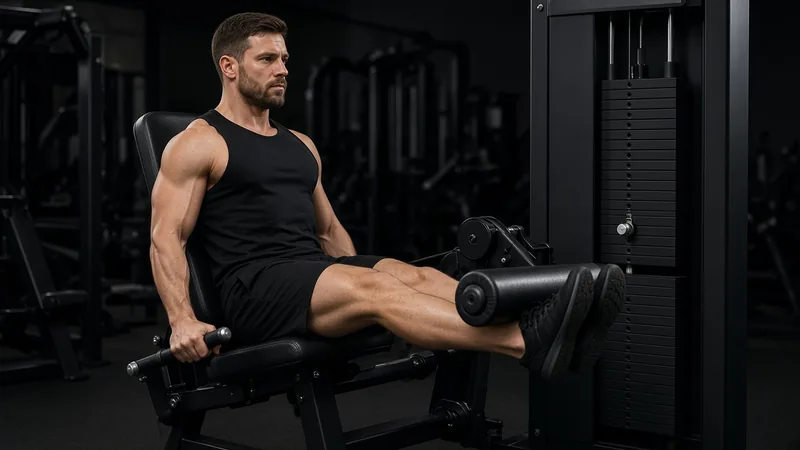
- Seated: sit so the knee joint lines up with the machine’s pivot. The thigh pad should sit just above the knees, and the ankle pad should rest on the back of the lower legs.
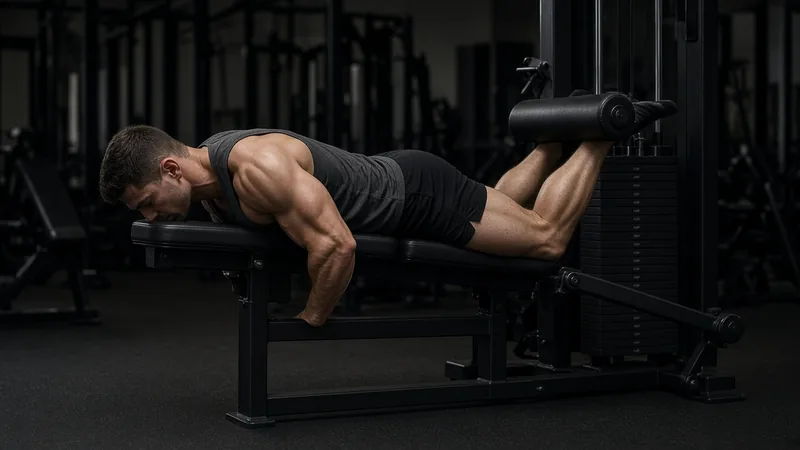
- Lying: lie face down with the hips on the bench and the pad on the back of the ankles, just above the shoes. The knees should line up with the pivot.
- Hold the handles and brace. You should not have to yank the first inch of the lift.
Step by step
- Curl: bend the knees and bring the heels toward your glutes under control.
- Squeeze briefly at the top without cramping into a tiny pulse.
- Lower until the knees are almost straight and the hamstrings are stretched, then repeat. Do not bang the plates.
Coaching cues
- “Heels to glutes, hips quiet.”
- “Slow on the way down — that stretch is the set.”
- “Don’t let the hips lift off the pad.”
Common mistakes and fixes
Variations
| Variation | Why use it |
|---|---|
| Seated leg curl | The hip is more flexed, so the hamstrings start at a longer length. This version has the stronger trial evidence (see below). |
| Lying leg curl | A perfectly useful curl if that is the machine you have; the illustration on this page shows this version. |
| Single-leg curl | Useful for evening out sides or working around a cranky knee. |
How to program it
Use 3–4 sets of 8–12 reps with 0–1 rep in reserve and 60–120 seconds’ rest. Prefer the seated machine when both are free. The curl is a main hamstring slot in the PPL, full-body and upper/lower programs.
Seated, lying, and muscle length
A leg curl is the clean way to load knee flexion, which a Romanian deadlift only does as a side-effect of a hip hinge. Between curl machines, the seated version puts the hamstrings at a longer length because the hip is flexed.
Evidence note: Maeo and colleagues (2021) compared seated and lying leg curls for 12 weeks. The seated (long-length) condition produced greater hamstring hypertrophy, with similar protection against damage. If your gym has both machines, give the seated curl the main slot; a lying curl is still useful work if that is what you have.
Reference
Maeo S, Huang M, Wu Y, et al. Greater Hamstrings Muscle Hypertrophy but Similar Damage Protection after Training at Long versus Short Muscle Lengths. Med Sci Sports Exerc. 2021;53(4):825-837. doi:10.1249/MSS.0000000000002523. PubMed: 33009197