Seated Cable Row
How to do the seated cable row with a long spine and a full stretch: setup, technique, cues, common mistakes, muscles worked, attachments and programming.

Primary muscles
Secondary muscles
Equipment
Cable row station with a chest-height or low pulley, and a close or wide handle
Level
Beginner–advanced
Setup
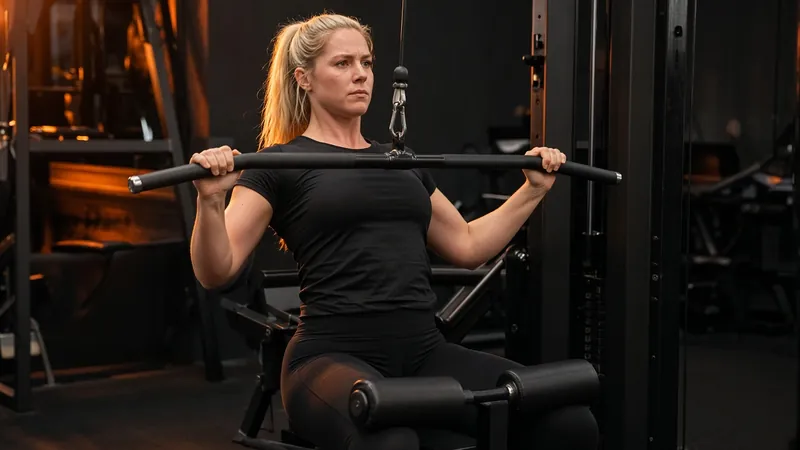
- Sit on the pad with your feet on the platform, knees soft.
- Hinge forward just enough to grab the handle, then sit back until your torso is close to vertical and your arms are straight.
- Brace your trunk. The first pull should not start with a backward lean.
Step by step
- Row: pull the handle to your lower ribs or upper abdomen. Your elbows travel close to your sides on a close grip, or slightly wider on a wide handle.
- Pause briefly with the shoulder blades together.
- Reach: let the handle travel forward under control until the arms are straight and you feel a stretch across the back, without rounding the lower back.
- Breathe and repeat.
Coaching cues
- “Chest to the handle, not the handle to a collapsing chest.”
- “Shoulders down, away from the ears.”
- “Reach long at the stretch, then pull the elbows back.”
Common mistakes and fixes
Variations
| Variation | Why use it |
|---|---|
| Wide-grip or lat-bar row | A wider handle shifts some emphasis toward the mid-back and rear delts. |
| Single-arm cable row | Useful for evening out sides and finding a comfortable path around the torso. |
| Chest-supported machine row | A close cousin if the seated cable station bothers your lower back. |
How to program it
Use 3–4 sets of 8–12 reps with about 1 rep in reserve and around 2 minutes’ rest. It is a second horizontal pull in the PPL pull day and in the upper/lower and full-body plans.
A stable horizontal pull
The seated cable row gives you a constant load and a simple way to train the stretch of a horizontal pull without balancing a barbell in a hinge. That makes it a useful second row after a barbell or chest-supported row, or a main row if your lower back is already tired from squats or deadlifts.
Evidence note: Close-to-failure sets grow muscle across a wide load range (Schoenfeld et al., 2017). Choose a handle and a load that let you reach a full stretch and a controlled finish, not the heaviest stack you can bounce.
Reference
Schoenfeld BJ, Grgic J, Ogborn D, Krieger JW. Strength and Hypertrophy Adaptations Between Low- vs. High-Load Resistance Training: A Systematic Review and Meta-analysis. J Strength Cond Res. 2017;31(12):3508-3523. doi:10.1519/JSC.0000000000002200. PubMed: 28834797