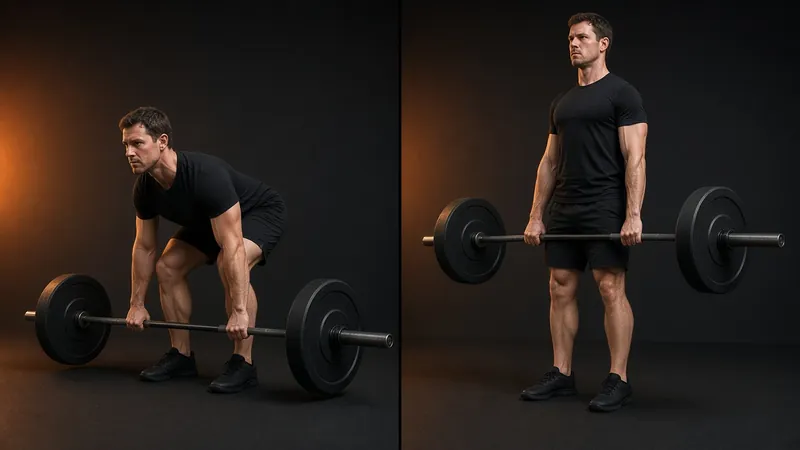
Romanian Deadlift (RDL)
How to do a Romanian deadlift with good form: setup, step-by-step hinge technique, coaching cues, common mistakes, muscles worked, variations and how to program it for hamstring and glute growth.
Primary muscles
Secondary muscles
Equipment
Barbell (or dumbbells)
Level
Beginner–advanced
Setup
- Start standing with the bar in your hands — unrack it from a rack set at mid-thigh, or deadlift it up from the floor.
- Use a double-overhand grip just outside your thighs; straps are fine for heavy sets.
- Feet hip-width apart, knees slightly bent (soft, not locked).
- Pull your shoulders back slightly, brace your core and keep your chest proud.
Step by step
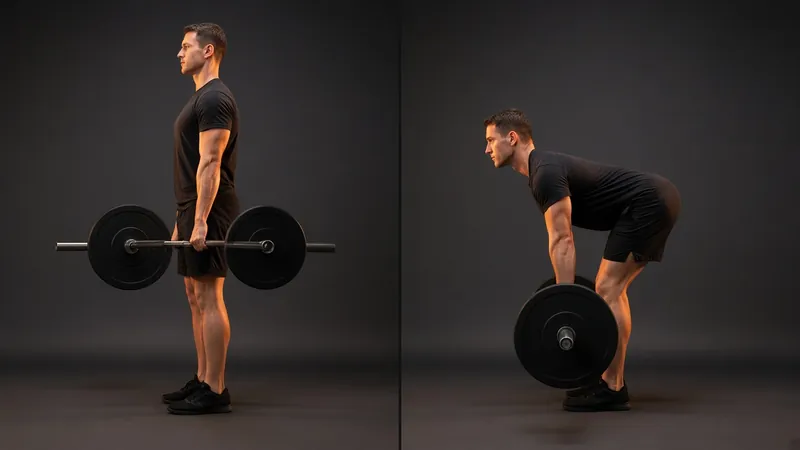
- Hips back: push your hips backward as if closing a car door with your butt. Your knees stay at roughly the same bend.
- Slide the bar down your thighs: keep it in contact or very close to your legs.
- Feel the stretch: lower until you feel a strong hamstring stretch — usually around mid-shin to just below the knee — without your lower back rounding.
- Drive the hips forward: squeeze your glutes and hamstrings to stand back up, keeping the bar close.
- Finish tall without leaning back, then repeat. Don't set the bar down between reps.
Coaching cues
- “Hips back, not down.”
- “Shave your legs with the bar.”
- “Long spine — proud chest.”
- “Stretch, then snap the hips through.”
Common mistakes and fixes
Variations
| Variation | Why use it |
|---|---|
| Dumbbell RDL | Easier to learn; good for home training. |
| Single-leg RDL | Trains balance and each side separately; use lighter loads. |
| Stiff-legged deadlift | Starts from the floor with straighter legs; more hamstring stretch, harder on the lower back. |
| Good morning | Bar on the upper back; a classic hamstring and spinal erector builder. |
| 45° back extension | Bodyweight or loaded; great for adding hinge volume without heavy spinal loading. |
How to program it
Use 3–4 sets of 6–12 reps with 1–3 reps in reserve and 2–3 minutes' rest. Pair it with a seated leg curl — hinges train the hamstrings at the hip, curls at the knee. Together, aim for about 10–16 weekly hamstring sets. See Legs A in our PPL program.
Why squats aren’t enough for your hamstrings
Evidence note: In Kubo et al. (2019), 10 weeks of squat training — full or half depth — produced no measurable hamstring growth (MRI) even though the quads, glutes and adductors grew. Hamstrings need direct work: hinges like the RDL and knee-flexion exercises like leg curls.
When choosing a leg curl to pair with RDLs, consider a seated version: in Maeo et al. (2021), seated leg curls — which train the hamstrings at longer lengths because the hip is flexed — grew the whole hamstrings more than lying leg curls (+14% vs +9%) over 12 weeks.
References
- Kubo K, Ikebukuro T, Yata H. Effects of squat training with different depths on lower limb muscle volumes. Eur J Appl Physiol. 2019;119(9):1933-1942. doi:10.1007/s00421-019-04181-y. PubMed: 31230110
- Maeo S, Huang M, Wu Y, et al. Greater Hamstrings Muscle Hypertrophy but Similar Damage Protection after Training at Long versus Short Muscle Lengths. Med Sci Sports Exerc. 2021;53(4):825-837. doi:10.1249/MSS.0000000000002523. PubMed: 33009197