Lat Pulldown
How to do the lat pulldown to the upper chest with a long stretch at the top: setup, technique, cues, common mistakes, grip choices, muscles worked and programming.
Primary muscles
Secondary muscles
Equipment
Lat-pulldown station with a thigh pad and a straight or slightly cambered bar
Level
Beginner–advanced
Setup
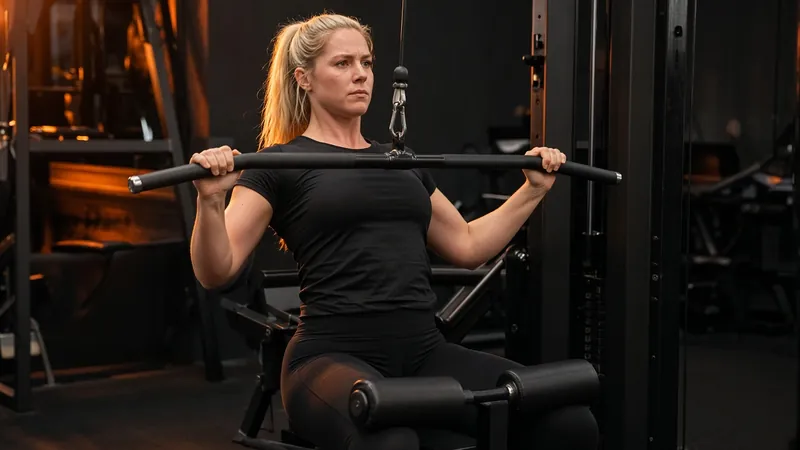
- Adjust the thigh pad so it holds you down when your arms are overhead.
- Take a grip slightly wider than your shoulders on a straight bar (or a comfortable width on a close handle).
- Sit tall, chest up, and start with the arms long and the shoulders slightly depressed, not shrugged into your ears.
Step by step
- Pull: bring the bar to the upper chest, leading with the elbows and keeping a slight lean back of the torso — not a lay-back.
- Pause briefly with the bar at the chest.
- Raise: let the bar travel up under control until the arms are long and the lats are stretched.
- Breathe and repeat. Pull to the chest, not behind the neck.
Coaching cues
- “Elbows to your back pockets.”
- “Chest up to meet the bar.”
- “Long arms at the top, no bounce off the stack.”
Common mistakes and fixes
Variations
| Variation | Why use it |
|---|---|
| Close-grip or neutral-grip pulldown | Often more comfortable at the elbows and involves the biceps a little more. |
| Single-arm pulldown | Useful for evening out sides and finding a slightly more adducted path. |
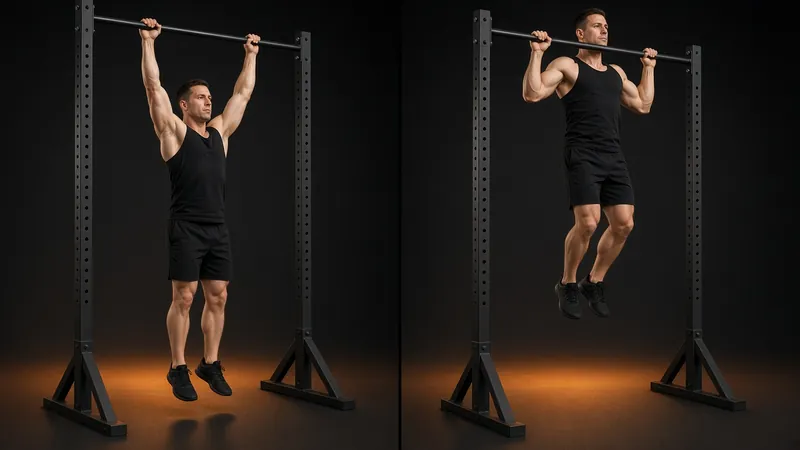
| Pull-up or chin-up | The free-body version of the same vertical-pull pattern. Use the pulldown when you cannot yet do enough strict pull-up reps. |
How to program it
Use 3–4 sets of 6–12 reps with 1–2 reps in reserve and 2–3 minutes’ rest. Swap it with the pull-up in the PPL, full-body and upper/lower programs when you need a more scalable vertical pull.
Pulldown or pull-up?
Both are vertical pulls. The pulldown is easier to load in small steps and to take close to failure without changing body position. The pull-up is a useful skill and a hard full-body tension lift. In our programs you can use either in that slot.
Evidence note: Load itself matters less for muscle growth than taking sets close to failure (Schoenfeld et al., 2017). A well-run pulldown and a strict pull-up can both grow the lats; choose the one you can overload this month.
Reference
Schoenfeld BJ, Grgic J, Ogborn D, Krieger JW. Strength and Hypertrophy Adaptations Between Low- vs. High-Load Resistance Training: A Systematic Review and Meta-analysis. J Strength Cond Res. 2017;31(12):3508-3523. doi:10.1519/JSC.0000000000002200. PubMed: 28834797