The Best Rep Range for Hypertrophy: Is 6–12 Reps Still King?
What research says about the best rep range for hypertrophy: why about 5–30 hard reps build muscle, and how to use heavy, moderate and light loads well.
Key takeaways
- Muscle grows across a wide load spectrum — roughly 5–30 hard reps per set — when sets approach failure.
- The classic 6–12 range is an outstanding default, not a scientific requirement.
- Heavy loads win for 1RM strength; light loads can match growth but demand true near-failure effort.
- Very light loading (~20% 1RM) looks suboptimal for muscle size.
- Program by exercise: heavier on big compounds, moderate-to-high reps on machines and isolation.
Ask ten lifters for the best rep range for muscle growth and many will answer “8–12” without blinking. That recommendation is not random—it matches decades of bodybuilding practice and older guideline charts that labeled moderate loads as the “hypertrophy zone.” The modern evidence paints a wider picture: muscle growth can be achieved across a broad loading spectrum when sets are taken close to failure. The classic 6–12 range is still excellent. It is just not the only effective option.
This article reviews what load and rep-range studies actually show, explains mechanical tension and “effective reps” in plain language (and flags where those ideas get speculative), and gives practical ways to choose and combine ranges in a program. For how many hard sets to do each week, see the companion piece on sets per week for hypertrophy; this article focuses on how heavy those sets should feel.
The Science: Load, Reps, and Muscle Growth
What “rep range” really means
Repetition ranges are a proxy for relative load (percent of 1-repetition maximum, or 1RM):
| Rough zone | Typical reps | Approximate load |
|---|---|---|
| Heavy / strength-biased | ~1–5 (sometimes ≤8 RM) | ≥~80–85% 1RM |
| Moderate / classic hypertrophy | ~6–15 | ~60–80% 1RM |
| Light / high-rep | ~15–30+ | ≤~60% 1RM (often ~30–50%) |
Studies usually compare loads (e.g., ≤60% vs >60% 1RM) rather than aesthetic “zones.” When researchers say low- and high-load training grow muscle similarly, they almost always mean sets were taken to failure or very near it. Easy high-rep sets do not earn the same credit.
Landmark studies and meta-analyses
Schoenfeld, Grgic, Ogborn, and Krieger (2017) meta-analyzed 21 studies comparing low-load (≤60% 1RM) and high-load (>60% 1RM) training with sets to momentary failure for at least six weeks. Hypertrophy outcomes were similar between conditions. Gains in 1RM strength favored high loads; isometric strength did not differ significantly. Their conclusion is the backbone of modern recommendations: heavy loading is better for maximal strength, while hypertrophy can be achieved across a spectrum of loads.
Lopez and colleagues (2021) pushed the comparison further with a network meta-analysis of 28 studies (747 healthy adults), all training to volitional failure. They grouped loads as high (≤8 RM), moderate (9–15 RM), and low (>15 RM). Muscle hypertrophy did not differ meaningfully across those three categories. Strength improvements were superior with high and moderate loads versus low loads, with a nonsignificant trend favoring high over moderate for strength.
Refalo et al. (2021) likewise found similar hypertrophy at whole-body, whole-muscle, and fiber levels when comparing higher-load (>60% 1RM or <15-RM) and lower-load (≤60% 1RM or ≥15-RM) training across 45 studies, while higher loads produced superior 1RM and isometric strength.
Individual trials in trained lifters reinforce the meta-analyses:
- Schoenfeld et al. (2015): Well-trained men trained 8 weeks with either 8–12 reps or 25–35 reps to failure. Muscle thickness of the elbow flexors, elbow extensors, and quads increased similarly. Squat 1RM rose more with heavier loading; high-rep training improved high-rep bench endurance more.
- Morton et al. (2016): Forty-nine resistance-trained men trained 12 weeks with either ~8–12 reps at ~75–90% 1RM or ~20–25 reps at ~30–50% 1RM, all sets to failure. Lean mass and type I and II fiber cross-sectional area increased similarly. Most strength gains were comparable; bench press 1RM favored the heavier group. Acute post-exercise hormone spikes did not predict growth.
- Lasevicius et al. (2018): Using a within-subject design and volume-load matching, limbs trained at 20%, 40%, 60%, or 80% 1RM. Hypertrophy at 40%, 60%, and 80% was similar and clearly larger than at 20%. Very light loading (~20% 1RM) was suboptimal for size even when volume load was matched. Heavier intensities produced larger strength gains.
One important nuance comes from Schoenfeld et al. (2016), who compared 2–4-rep heavy training with 8–12-rep moderate training using the same number of sets. Squat strength favored heavy loading, but lateral thigh thickness increased more with moderate reps. That does not contradict the broader “loads work when hard” literature; it suggests that when set count is fixed, extremely heavy, very low-rep work may deliver less hypertrophic stimulus per set than moderate ranges—likely because each set includes fewer hard repetitions near failure. Matching weekly hard sets still matters (see the sets-per-week article); matching only set count across radically different loads is not the same as matching effective stimulus.
Why light loads work: proximity to failure
Light loads only match heavier loads for hypertrophy when you push them hard. Early high-rep sets feel easy; motor units that drive the most growth are recruited as fatigue accumulates and the set approaches failure.
Robinson, Pelland, Remmert, and colleagues (2024) meta-regressed estimated repetitions in reserve (RIR) across a large evidence base. Strength gains looked similar across a wide RIR range. Hypertrophy improved as sets finished closer to failure. Exact dose–response numbers should be treated cautiously because RIR was estimated from study descriptions, but the direction is clear: for size, proximity to failure matters. Our guide to training to failure vs RIR turns this into targets per exercise.
Refalo et al. (2023) found that training all the way to momentary muscular failure was not clearly superior to non-failure training for hypertrophy in categorical comparisons, with only a trivial advantage when “set failure” was defined broadly. That seems to conflict with Robinson until you notice the designs: many “non-failure” groups still trained fairly hard, and relationships may be nonlinear. Practically, you do not need to die on every set—but leaving five-plus easy reps in the tank, especially with light loads, is a poor hypertrophy strategy.
Mechanical tension and “effective reps” (plain language, with caveats)
Mechanical tension—force transmitted through muscle fibers and their sensing structures—is widely considered the primary driver of hypertrophy (see how muscle grows). Heavier loads create high tension from the first reps. Lighter loads create high tension on the last hard reps, when more motor units are recruited and fibers are working near their force capacity under fatigue.
The popular “effective reps” idea argues that only the last few reps of a set (roughly those within ~5 reps of failure) count most for growth. It is a useful coaching heuristic that matches the finding that easy sets do little. It is also partly speculative: studies do not directly tag individual reps as “effective,” and the exact number of final reps that “count” is not settled. Treat “effective reps” as a mental model for effort, not a precise scientific unit.
Other proposed drivers—metabolic stress and muscle damage—can accompany hard training but are not required in isolation to grow muscle. Chasing the burn or extreme soreness is not a substitute for progressive, tension-rich sets.
Evidence summary: Across meta-analyses and trained-lifter trials, hypertrophy is largely load-independent from roughly the mid-30% 1RM range upward when sets are hard—practically about ~5–30 reps. Below ~20% 1RM, growth looks suboptimal. Strength still favors heavier loads. The old 6–12 “hypertrophy zone” remains a high-value middle path, not a monopoly.
Practical Application: Choosing and Combining Rep Ranges
Why ~5–30 reps all build muscle when sets are hard
If weekly hard-set volume is in a productive range and you take sets near failure, you can grow with:
- Heavy doubles–fives (skill and strength carryover; fewer reps per set)
- Classic 6–12 or 8–15 (efficient balance of tension, fatigue, and progression)
- 15–30-rep work (joint-friendly options; high discomfort; longer sets)
Outside that window, options shrink: singles all day are inefficient for hypertrophy per unit fatigue, and ultra-light 40–50-rep sets become miserable and often suboptimal.
Pros and cons: heavy vs moderate vs light
| Approach | Pros | Cons |
|---|---|---|
| Heavy (~3–6 reps) | Best for 1RM strength; high tension early; shorter sets | Higher joint/systemic stress; longer rests; technique demands; may need more sets for equal hypertrophy stimulus |
| Moderate (~6–15 reps) | Best overall compromise for most lifters; easy to progress; matches classic programming | Can still stress joints if form is poor; “middle” can feel less exciting than extremes |
| Light (~15–30 reps) | Lower absolute load; useful for pump work, machines, rehab-friendly loading; builds local endurance | High metabolic discomfort; harder to judge RIR early in the set; time-consuming (see rest times between sets); poor choice if you quit far from failure |
For pure size, choose the range you can push hard, recover from, and progress on. For size plus strength, keep a meaningful dose of heavier compound work.
Rep range suggestions by exercise type
Barbell and heavy compounds (squat, deadlift variations, bench, row, overhead press):
- Emphasize ~5–10 (sometimes up to ~12) for most working sets.
- Very high-rep free-weight compounds often break down technically before the target muscle is fully stimulated.
- Occasional heavier 3–5 work builds strength that lets you overload moderate sets later.
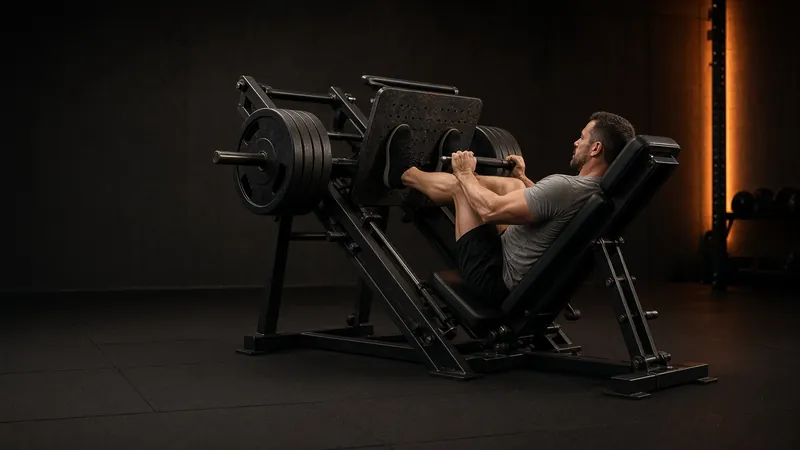
Machine compounds and guided paths (leg press, chest press, hack squat, cable rows):
- Comfortable across ~6–20.
- Excellent place for higher-rep sets when free-weight joints need a break.
Isolation (curls, laterals, leg extensions, flyes, pushdowns):
- Shine in ~8–20 (even ~10–25).
- Light absolute loads still create high local tension near failure with less systemic fatigue.
Example pairing: squat 5–8, leg press 8–15, leg extension 12–20 in the same week.
How to combine ranges in a program
You do not need a different “zone” every session. Simple strategies that fit the research:
- Default moderate, sprinkle extremes. Most sets in 6–12 or 8–15; add some 4–6 strength work on big lifts and some 15–25 work on isolation or machines.
- Heavy compounds, lighter accessories. Keeps strength progressing while accessories accumulate hard reps with less axial load.
- Daily undulating style. e.g., Day A 5–8, Day B 8–12, Day C 12–20 for the same muscle across the week—useful when you already hit muscles 2–3 times weekly.
- Match effort to the load. Heavier sets: often 1–3 RIR (0 RIR sparingly). Lighter sets: usually 0–2 RIR so the set actually becomes hard.
- Progress like you mean it. Add load when you top the rep target with solid form, or add reps within the range before adding weight.
Weekly set targets from the companion volume article still apply: beginners often thrive on fewer hard sets; intermediates commonly land around the low-to-mid teens per muscle; advanced lifters may specialize volume upward. Rep range chooses how those sets are performed, not whether volume matters.
Sample week: mixed rep ranges (intermediate upper/lower)
Assumes ~10–16 hard fractional sets for major groups across the week; adjust to recovery.
| Day | Focus | Example sets × rep targets |
|---|---|---|
| Upper A | Strength-biased push/pull | Bench 3–4×5–8; Row 3×6–10; Overhead press 2–3×6–10; Pulldown 2–3×8–12; Lateral raise 3×12–20; Curl 2×10–15; Triceps 2×10–15 |
| Lower A | Squat pattern + accessories | Squat 3–4×5–8; RDL 3×6–10; Leg press 2–3×10–15; Leg curl 3×10–15; Calf raise 3×10–15 |
| Upper B | Moderate/high-rep bias | Incline DB press 3×8–12; Chest-supported row 3×8–12; Machine press 2×10–15; Cable row 2×10–15; Flye or pec deck 2×12–20; Lateral raise 3×15–20; Arms 2–3×12–20 each |
| Lower B | Hinge/quad mix | Deadlift variant or hip thrust 3×5–8; Front squat or leg press 3×8–12; Leg extension 3×12–20; Leg curl 2–3×12–20; Walking lunge or split squat 2×8–12/leg; Calves 3×12–20 |
Keep most working sets within a few reps of failure. Warm-ups do not count toward weekly hypertrophy volume.
Common Myths and FAQ
“Is 6–12 still king?”
It is still a crown prince: efficient, well tolerated, easy to progress, and squarely inside the evidence-based hypertrophy window. It is not exclusive. Meta-analyses show similar growth from heavier and lighter failure training across a wide band of loads.
“Do I need the pump and burn to grow?”
No. Discomfort often shows up in high-rep sets, but tension and hard effort drive growth. You can grow with grinding heavy fives that never produce a big pump.
“Are high reps only for definition or endurance?”
No. When taken near failure, ~20–25-rep training grew muscle similarly to 8–12-rep training in trained men (Schoenfeld 2015; Morton 2016). High reps also improve local muscular endurance; they are not “cutting-only” magic.
“Should beginners only do light weights for form?”
Beginners should prioritize technique, but that does not mean endless easy high-rep sets. Moderate loads (roughly 6–12) with controlled form teach skill and provide a clear growth stimulus. Very heavy singles are usually unnecessary early on.
“If light loads grow muscle, why bother lifting heavy?”
Because strength, bone stress, and performance still favor heavier loading, and stronger lifters can overload moderate sets more productively over months and years. Hypertrophy parity is not training-goal parity.
“Is 20% 1RM fine if I do enough reps?”
Lasevicius et al. found 20% 1RM suboptimal for hypertrophy versus 40–80% even with volume-load matching. Stay out of the “featherweight forever” zone if size is the goal.
“Must every set go to failure?”
Not necessarily. Training close to failure matters more for light loads; leaving a couple of reps in reserve on heavy compounds is often smarter for technique and fatigue. Going to failure more often on isolation and machines is usually fine.
Conclusion: Key Takeaways
- Hypertrophy is possible across a wide load spectrum—roughly loads that allow ~5–30 hard reps—when sets approach failure.
- The classic 6–12 (or ~6–15) range remains an outstanding default, not a scientific requirement.
- Heavy loads win for 1RM strength; light loads can match growth but usually lose on maximal strength and demand true near-failure effort.
- Extremely light loading (~20% 1RM) looks suboptimal for muscle size.
- Use mechanical tension as your north star; treat “effective reps” as a helpful but partly speculative coaching idea.
- Program by exercise: heavier on big compounds, moderate-to-high reps on machines and isolation; combine ranges across the week.
- Pair smart rep choices with productive weekly set volume—effort and volume still matter more than hunting a single magic number.
6–12 reps were never wrong. They were incomplete. Build most of your program there if you like, then use heavier and lighter hard sets as tools—not as rival religions.
Related: How many sets per week to build muscle · Every training split explained · Push/pull/legs guide
References
-
Schoenfeld BJ, Grgic J, Ogborn D, Krieger JW. Strength and Hypertrophy Adaptations Between Low- vs. High-Load Resistance Training: A Systematic Review and Meta-analysis. Journal of Strength and Conditioning Research. 2017;31(12):3508-3523. doi:10.1519/JSC.0000000000002200. PubMed: https://pubmed.ncbi.nlm.nih.gov/28834797/
-
Lopez P, Radaelli R, Taaffe DR, et al. Resistance Training Load Effects on Muscle Hypertrophy and Strength Gain: Systematic Review and Network Meta-analysis. Medicine & Science in Sports & Exercise. 2021;53(6):1206-1216. doi:10.1249/MSS.0000000000002585. PubMed: https://pubmed.ncbi.nlm.nih.gov/33433148/
-
Refalo MC, Hamilton DL, Paval DR, Gallagher IJ, Feros SA, Fyfe JJ. Influence of resistance training load on measures of skeletal muscle hypertrophy and improvements in maximal strength and neuromuscular task performance: A systematic review and meta-analysis. Journal of Sports Sciences. 2021;39(15):1723-1745. doi:10.1080/02640414.2021.1898094. PubMed: https://pubmed.ncbi.nlm.nih.gov/33874848/
-
Schoenfeld BJ, Peterson MD, Ogborn D, Contreras B, Sonmez GT. Effects of Low- vs. High-Load Resistance Training on Muscle Strength and Hypertrophy in Well-Trained Men. Journal of Strength and Conditioning Research. 2015;29(10):2954-2963. doi:10.1519/JSC.0000000000000958. PubMed: https://pubmed.ncbi.nlm.nih.gov/25853914/
-
Morton RW, Oikawa SY, Wavell CG, et al. Neither load nor systemic hormones determine resistance training-mediated hypertrophy or strength gains in resistance-trained young men. Journal of Applied Physiology. 2016;121(1):129-138. doi:10.1152/japplphysiol.00154.2016. PubMed: https://pubmed.ncbi.nlm.nih.gov/27174923/
-
Lasevicius T, Ugrinowitsch C, Schoenfeld BJ, et al. Effects of different intensities of resistance training with equated volume load on muscle strength and hypertrophy. European Journal of Sport Science. 2018;18(6):772-780. doi:10.1080/17461391.2018.1450898. PubMed: https://pubmed.ncbi.nlm.nih.gov/29564973/
-
Schoenfeld BJ, Contreras B, Vigotsky AD, Peterson M. Differential Effects of Heavy Versus Moderate Loads on Measures of Strength and Hypertrophy in Resistance-Trained Men. Journal of Sports Science and Medicine. 2016;15(4):715-722. PubMed: https://pubmed.ncbi.nlm.nih.gov/27928218/. PMC: https://pmc.ncbi.nlm.nih.gov/articles/PMC5131226/
-
Robinson ZP, Pelland JC, Remmert JF, et al. Exploring the Dose-Response Relationship Between Estimated Resistance Training Proximity to Failure, Strength Gain, and Muscle Hypertrophy: A Series of Meta-Regressions. Sports Medicine. 2024;54:2209-2231. doi:10.1007/s40279-024-02069-2. PubMed: https://pubmed.ncbi.nlm.nih.gov/38970765/
-
Refalo MC, Helms ER, Trexler ET, Hamilton DL, Fyfe JJ. Influence of Resistance Training Proximity-to-Failure on Skeletal Muscle Hypertrophy: A Systematic Review with Meta-analysis. Sports Medicine. 2023;53(3):649-665. doi:10.1007/s40279-022-01784-y. PubMed: https://pubmed.ncbi.nlm.nih.gov/36334240/