Progressive Overload: 7 Ways to Keep Gaining Muscle (and Which Work Best)
Progressive overload explained: 7 ways to progress (load, reps, sets, effort and more), what research shows for each, ready-made models and stall fixes.
Key takeaways
- Progressive overload means making training gradually harder over time. Adding weight is one way, not the only way.
- In trained lifters, adding reps at the same load grew muscle as well as adding load over 8 weeks (Plotkin et al., 2022).
- A 2026 trial found that legs trained with progressive load grew faster in the last weeks than legs trained with a fixed load, mainly because sets stayed close to failure.
- For most lifters, double progression (add reps in a range, then add load) is the simplest, most reliable system. Autoregulating by reps in reserve (RIR) is a strong alternative.
- When you stall, fix effort, sleep and food first. Then change one variable: reps, sets, exercise variant, or take a deload.
Every muscle-building program works for the same basic reason: it asks your muscles to do a bit more than they are used to, and then it keeps asking. That is progressive overload. Stop progressing and, sooner or later, you stop growing.
But “add weight to the bar every week” is only one version of the idea, and it runs out quickly. This guide explains what progressive overload really means for hypertrophy, the 7 ways to apply it, what the research says about each, and the progression models that work in practice. It ends with a troubleshooting plan for stalls.
New to the bigger picture? Start with our beginner’s guide to building muscle, the training splits pillar and the training methods hub.
What progressive overload really means
Muscle grows when it is exposed to enough mechanical tension: sets taken close to failure, over enough weekly volume. As you adapt, the same workout produces less of that stimulus, because you are stronger and the sets feel easier. Progressive overload is simply keeping the stimulus high as you adapt.
For hypertrophy, the goal is not “more weight at any cost”. The goal is to keep producing hard, high-quality sets of good-technique reps. Load on the bar is the easiest way to measure it, which is why we track it.
What the research says
Adding reps works as well as adding load
Plotkin et al. (2022) randomised 43 trained men and women (at least one year of lower-body training) to two progression styles for 8 weeks, training twice a week with four sets of the squat, leg extension and two calf raises:
- LOAD group: kept reps constant and increased weight.
- REPS group: kept weight constant and increased reps.
Muscle growth was similar. Rectus femoris growth modestly favoured the reps group; squat 1RM gains slightly favoured the load group; and the differences in muscle thickness were under 1 mm with narrow confidence intervals. The authors concluded that both are viable ways to progress.
Progression matters, eventually
Ferrari et al. (2026) trained one leg of each of 31 untrained young adults with progressive load and the other leg with a fixed load (knee extensions, 3 × 10–12, twice weekly for 12 weeks). Both legs grew, with no difference at most checkpoints. But between sessions 18 and 24, the progressive leg grew more (1.22 cm² more cross-sectional area). The likely reason: by the end, the fixed-load leg’s sets were far from failure (about 4 reps in reserve) while the progressive leg stayed near failure (about 0.2 RIR).
What this means: in the short term, a fixed load still works because it remains challenging. Over months, as the weight gets easier, sets drift away from failure and the stimulus fades. Progression, in any form, keeps sets hard.
Effort is the hidden variable
A 2024 series of meta-regressions found that muscle growth increased as sets were stopped closer to failure, while strength gains were similar across a wide range of reps in reserve (Robinson et al., 2024). That explains why progressing reps or load both work: each keeps your sets close to failure. Our guide on training to failure vs RIR goes deeper.
More volume is a form of overload, too
Weekly set volume has a dose–response relationship with hypertrophy, with diminishing returns (Pelland et al., 2026). Adding sets over a training block is a legitimate progression for muscles that are lagging, as long as you can recover. See how many sets per week.
The 7 ways to progressively overload
| # | Method | How | Best for | Evidence |
|---|---|---|---|---|
| 1 | Add load | Same reps, more weight | Compound lifts, strength | Strong |
| 2 | Add reps | Same weight, more reps | Machines, dumbbells, isolation | Strong for hypertrophy (Plotkin et al., 2022) |
| 3 | Add sets | More weekly hard sets | Lagging muscles, planned blocks | Strong (dose–response) |
| 4 | Train closer to failure | Reduce reps in reserve | Isolation and machine work | Moderate–strong |
| 5 | Improve range of motion and control | Deeper stretch, slower eccentric, no bouncing | Everything | Moderate (long-length data) |
| 6 | Add frequency | Spread more volume across more sessions | High-volume phases | Moderate (works via volume) |
| 7 | Progress the exercise | Harder variation (e.g. push-up → weighted dip) | Bodyweight and home training | Practical; limited direct data |
1. Add load
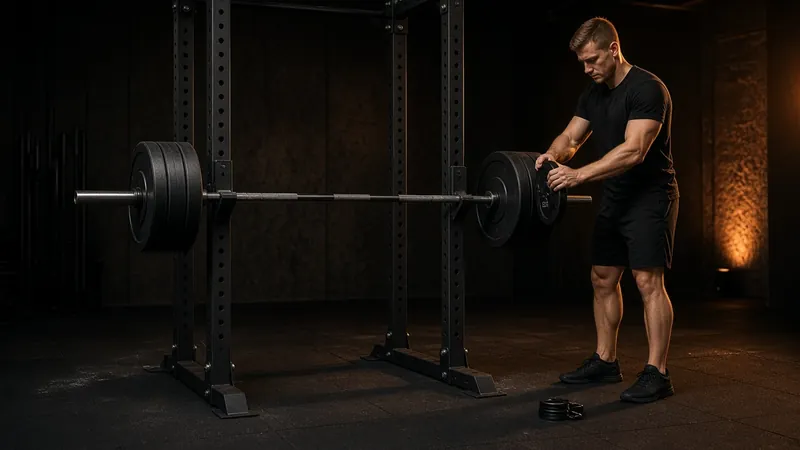
The classic approach. Add the smallest increment your equipment allows (1–2.5 kg on barbells, the next dumbbell, a single pin on machines) when you hit your target reps. It is easy to track and builds strength along with size.
Limitation: progress slows. Beginners can add weight every session for months; intermediates often only every 2–6 weeks.
2. Add reps
Keep the weight and beat your previous rep count. This is the most practical method for dumbbells and machines with big jumps between weights. Plotkin et al. (2022) showed it builds muscle as well as load progression over 8 weeks.
Limitation: above roughly 30 reps, sets become more about tolerance of discomfort. Increase the load when you reach the top of your rep range.
3. Add sets
Start a training block (mesocycle) at the lower end of your productive volume and add 1–2 sets per muscle every week or two. This is the backbone of many modern hypertrophy programs.
Limitation: volume is expensive. If performance drops, you’ve gone past what you can recover from. Never add sets to everything at once.
4. Train closer to failure
If your sets were ending 3–4 reps short of failure, moving to 1–2 reps short is a real increase in stimulus without changing the load. Robinson et al. (2024) support that sets closer to failure produce more growth.
Limitation: you can only get as close as failure, and very hard sets on heavy compound lifts produce a lot of fatigue. Use 0–1 RIR mainly on machines and isolation exercises.
5. Improve range of motion and control
Doing the same weight with a deeper stretch, a controlled eccentric and no bounce is a harder set. Research on training at long muscle lengths suggests the stretched position is especially valuable for growth; for example, seated leg curls grew the hamstrings more than lying leg curls (Maeo et al., 2021). Read more in long muscle lengths.
Limitation: it’s hard to quantify. Film your sets occasionally and keep technique standards fixed so you can’t “progress” by getting sloppier.
6. Add frequency
Training a muscle more often lets you do more total volume with better quality per set. Frequency itself has little independent effect on hypertrophy when volume is equal (Pelland et al., 2026), so treat it as a tool to fit in more productive sets. See the upcoming training frequency guide.
7. Progress the exercise
For bodyweight and home training, changing leverage is the main way to overload: incline push-up → push-up → deficit push-up → weighted push-up; assisted pull-up → bodyweight → weighted.
What doesn’t count as progressive overload for hypertrophy
- Shorter rest periods. They make a workout feel harder, but cutting rest below about 60–90 seconds tends to reduce the volume and quality of later sets. See rest times between sets.
- Random variety. “Muscle confusion” with new exercises every session makes progress impossible to track. A systematic review found that excessive, random variation can compromise gains, while planned variation can help (Kassiano et al., 2022).
- Worse technique. Adding weight by shortening range of motion or using momentum reduces the stimulus.
Progression models you can use
Model 1: Linear progression (beginners)
Add a small, fixed amount of weight every session or every week while reps stay the same.
| Week | Squat (3 × 5) |
|---|---|
| 1 | 60 kg |
| 2 | 62.5 kg |
| 3 | 65 kg |
| 4 | 67.5 kg |
| … | Continue until you miss reps twice, then switch to double progression |
Model 2: Double progression (most lifters, most exercises)
Choose a rep range (e.g. 8–12). Keep the same weight until you hit the top of the range on all sets, then add weight and start again at the bottom.
| Session | Weight | Reps (3 sets) | Next step |
|---|---|---|---|
| 1 | 30 kg | 10, 9, 8 | Same weight |
| 2 | 30 kg | 11, 10, 9 | Same weight |
| 3 | 30 kg | 12, 11, 10 | Same weight |
| 4 | 30 kg | 12, 12, 12 | Add weight |
| 5 | 32.5 kg | 9, 8, 8 | Same weight |
This is our default for almost every exercise in our push/pull/legs program.
Model 3: RIR-based autoregulation (intermediate and advanced)
Prescribe sets by reps in reserve instead of fixed weights: e.g. “3 × 6–8 @ 2 RIR”. Each session, pick a weight that lands in that rep range at the target effort. When you’re stronger, the weight goes up automatically.
- An RIR-based effort scale has been validated for squats, with ratings strongly linked to bar speed, especially in experienced lifters (Zourdos et al., 2016).
- In trained men, effort-based (RPE) loading produced similar muscle growth to percentage-based loading and possibly a small strength advantage (Helms et al., 2018).
- In college football players, an autoregulated program (APRE) produced greater bench and squat gains than fixed linear periodisation over 6 weeks (Mann et al., 2010).
Caveat: people are imperfect at estimating RIR. A meta-analysis found that participants under-predicted their remaining reps by about one rep on average, with large variation, and that accuracy improved closer to failure and with heavier loads (Halperin et al., 2022). Calibrate by taking an occasional set to failure on safe exercises.
Model 4: Planned blocks (mesocycles)
Run 4–6 weeks where volume or effort rises, then deload. Example for one muscle:
| Week | Sets per week | Target RIR |
|---|---|---|
| 1 | 10 | 3 |
| 2 | 12 | 2 |
| 3 | 14 | 1–2 |
| 4 | 16 | 0–1 |
| 5 | Deload: 6–8 | 3–4 |
When volume is equated, different periodisation models produce similar hypertrophy; periodisation mainly helps strength, and undulating models beat linear ones for strength only in trained lifters (Moesgaard et al., 2022). So pick a model you enjoy and can follow.
How fast should you progress?
| Training age | Realistic progress on main lifts | Best model |
|---|---|---|
| 0–6 months | Every session or week | Linear progression |
| 6 months–2 years | Every 1–4 weeks | Double progression |
| 2+ years | Over months; small PRs in reps | RIR autoregulation, planned blocks |
Muscle growth itself is slow and varies a lot between people. In a study of 585 people training their arms for 12 weeks, size changes ranged from −2% to +59% (Hubal et al., 2005). Don’t compare your rate to anyone else’s. Compare your log to your log.
Track it or it didn’t happen
You can’t overload what you don’t measure. Log exercise, weight, reps and RIR for every working set. A notebook, a spreadsheet or an app all work.
Weekly review questions:
- Did my key lifts go up in weight or reps over the last 2–4 weeks?
- Are most sets ending within 0–3 reps of failure?
- Is any lift stuck for 3+ sessions?
Stalls: a troubleshooting checklist
When a lift doesn’t progress for 2–3 weeks, work through this list in order:
- Recovery basics. Sleep 7–9 hours? Eating enough? Protein at 1.6–2.2 g/kg (protein guide)? If you’re in a deficit, slower progress is normal.
- Effort. Are you actually close to failure? Film a set or test one to failure.
- Technique consistency. Same range of motion, same tempo?
- Rep range. Move the range (e.g. 6–8 → 10–12) for 4–6 weeks.
- Volume. Too little (fewer than ~8 hard sets/week) or too much (performance dropping across lifts)?
- Exercise variant. Swap to a close variation for a block (e.g. barbell → dumbbell bench press). Keep the swap for at least 4–6 weeks.
- Deload. Cut sets by about half for a week, then restart a few percent below your previous working weights.
Common progressive overload mistakes
- Adding weight every week forever. It works for beginners, then it stops. Switch models.
- Chasing load with worse form. That’s not progress.
- Progressing everything at once. Pick one variable at a time.
- No log. Memory is unreliable.
- Ignoring reps as progress. One more rep at the same weight is overload.
- Constant exercise rotation. You can’t progress on lifts you never repeat.
- Never deloading. Fatigue hides fitness.
FAQ
What is progressive overload?
Gradually increasing the demands of training (weight, reps, sets, effort or range of motion) so your muscles keep receiving a strong enough stimulus to adapt and grow.
Do you have to increase weight to build muscle?
Not necessarily. A trial in trained lifters found that adding reps at the same weight built as much muscle as adding weight over 8 weeks. But over months, the load usually needs to rise to keep sets in a productive rep range.
How often should I increase the weight?
When you hit the top of your rep range on all sets at your target effort. For beginners that may be every session; for experienced lifters, every few weeks.
What should I do when I stop progressing?
Check sleep, nutrition and effort first. Then change one thing: rep range, volume, exercise variation, or take a deload week.
Is progressive overload the same for strength and hypertrophy?
The principle is the same, but strength benefits more from adding load and practising heavy lifts, while hypertrophy can progress just as well through reps, sets and effort.
Can you progressively overload with bodyweight exercises?
Yes: add reps, slow the lowering phase, increase range of motion, use harder variations or add a weight vest or backpack.
References
- Plotkin D, Coleman M, Van Every D, et al. Progressive overload without progressing load? The effects of load or repetition progression on muscular adaptations. PeerJ. 2022;10:e14142. doi:10.7717/peerj.14142. PubMed: 36199287 ↩
- Ferrari O, Silva DG, Camargo JBB, et al. Time course of muscle hypertrophy with and without progressive overload. Int J Sports Med. 2026. Online ahead of print. doi:10.1055/a-2980-6473. PubMed: 42880344 ↩
- Robinson ZP, Pelland JC, Remmert JF, et al. Exploring the Dose-Response Relationship Between Estimated Resistance Training Proximity to Failure, Strength Gain, and Muscle Hypertrophy: A Series of Meta-Regressions. Sports Med. 2024;54(9):2209-2231. doi:10.1007/s40279-024-02069-2. PubMed: 38970765 ↩
- Pelland JC, Remmert JF, Robinson ZP, et al. The Resistance Training Dose Response: Meta-Regressions Exploring the Effects of Weekly Volume and Frequency on Muscle Hypertrophy and Strength Gains. Sports Med. 2026;56(2):481-505. doi:10.1007/s40279-025-02344-w. PubMed: 41343037 ↩
- Maeo S, Huang M, Wu Y, et al. Greater Hamstrings Muscle Hypertrophy but Similar Damage Protection after Training at Long versus Short Muscle Lengths. Med Sci Sports Exerc. 2021;53(4):825-837. doi:10.1249/MSS.0000000000002523. PubMed: 33009197 ↩
- Kassiano W, Nunes JP, Costa B, et al. Does Varying Resistance Exercises Promote Superior Muscle Hypertrophy and Strength Gains? A Systematic Review. J Strength Cond Res. 2022;36(6):1753-1762. doi:10.1519/JSC.0000000000004258. PubMed: 35438660 ↩
- Zourdos MC, Klemp A, Dolan C, et al. Novel Resistance Training-Specific Rating of Perceived Exertion Scale Measuring Repetitions in Reserve. J Strength Cond Res. 2016;30(1):267-75. doi:10.1519/JSC.0000000000001049. PubMed: 26049792 ↩
- Helms ER, Byrnes RK, Cooke DM, et al. RPE vs. Percentage 1RM Loading in Periodized Programs Matched for Sets and Repetitions. Front Physiol. 2018;9:247. doi:10.3389/fphys.2018.00247. PubMed: 29628895 ↩
- Mann JB, Thyfault JP, Ivey PA, et al. The effect of autoregulatory progressive resistance exercise vs. linear periodization on strength improvement in college athletes. J Strength Cond Res. 2010;24(7):1718-23. doi:10.1519/JSC.0b013e3181def4a6. PubMed: 20543732 ↩
- Halperin I, Malleron T, Har-Nir I, et al. Accuracy in Predicting Repetitions to Task Failure in Resistance Exercise: A Scoping Review and Exploratory Meta-analysis. Sports Med. 2022;52(2):377-390. doi:10.1007/s40279-021-01559-x. PubMed: 34542869 ↩
- Moesgaard L, Beck MM, Christiansen L, et al. Effects of Periodization on Strength and Muscle Hypertrophy in Volume-Equated Resistance Training Programs: A Systematic Review and Meta-analysis. Sports Med. 2022;52(7):1647-1666. doi:10.1007/s40279-021-01636-1. PubMed: 35044672 ↩
- Hubal MJ, Gordish-Dressman H, Thompson PD, et al. Variability in muscle size and strength gain after unilateral resistance training. Med Sci Sports Exerc. 2005;37(6):964-72. PubMed: 15947721 ↩