Machines vs Free Weights: Which Builds More Muscle?
Machines vs free weights: what two meta-analyses found for muscle growth and strength, when each is the better tool and a hybrid 3-day plan to use both.
Key takeaways
- For muscle growth, machines and free weights work about equally. A 2023 meta-analysis found no difference in hypertrophy, and neither did a 2022 analysis (Haugen et al., 2023; Heidel et al., 2022).
- Strength is specific: you get stronger on the equipment you train with. Free-weight training raised free-weight strength more, and machine training tended to raise machine strength more.
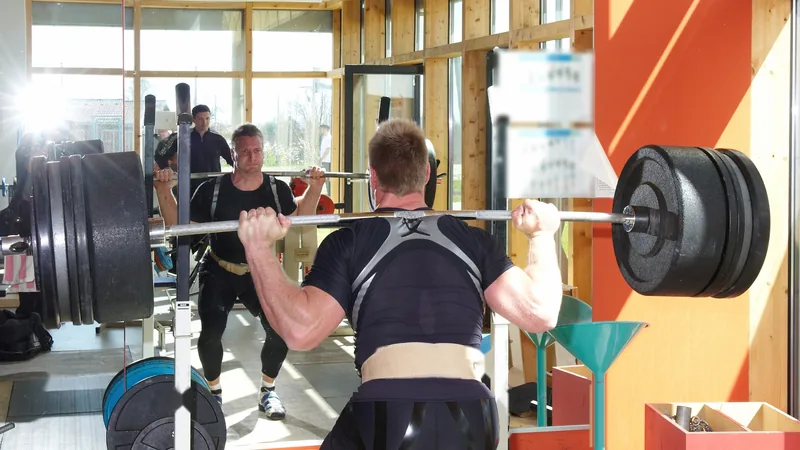
- Machines make it easier to train close to failure safely, to load the stretched position and to isolate one muscle. Free weights train balance and the lifts you may want to test.
- Higher muscle activity on free-weight lifts (up to 43% in one small EMG study) has not translated into more growth in training studies.
- The best plan for most lifters uses both: a free-weight or machine compound for each pattern, plus machines and cables for isolation work.
Machines or free weights? It is one of the oldest arguments in the gym. One camp says barbells and dumbbells are “real” training and machines are for beginners. The other says machines are safer, easier to load and just as good for size. For muscle growth, the research has a fairly clear answer, and it is less dramatic than either side claims.
This guide covers what the meta-analyses and training studies found for growth and strength, what stability, muscle activity and injury data add, a decision table for choosing between them, a swap list for every major movement and a hybrid 3-day plan with a volume audit. It is part of our Training Methods section; for how equipment choices fit into a weekly plan, see our pillar on every training split.
Evidence in one line: machines and free weights build about the same amount of muscle when the effort and the sets are the same; choose by goal, joint comfort and what you’ll keep doing.
What this page covers. This guide compares equipment types. Which muscle lengths and ranges to train is covered in range of motion, and how to order the exercises in a session is covered in exercise order.
Key terms
- Free weights: barbells, dumbbells, kettlebells and plates. You control the path of the weight.
- Machines: equipment that guides the path, such as selectorised (pin-loaded) and plate-loaded machines and the Smith machine.
- Cables: a pulley with a stack of weights. The path is free but the resistance comes from the cable direction, so cables sit between the two.
- Stability demand: how much you must balance the load. Dumbbells demand more than a barbell, and a barbell more than a machine.
- EMG (electromyography): a measure of the electrical activity in a muscle. It shows how active a muscle is, not how much it will grow.
- RIR (reps in reserve): how many more reps you could have done at the end of a set. See training to failure vs RIR.
What the research says
Muscle growth: no difference
Two meta-analyses have pooled the training studies.
- A 2023 meta-analysis included 13 studies with 1,016 participants (789 men, 219 women), all lasting at least 6 weeks. In direct comparisons, there was no difference in muscle growth between free-weight and machine training (standardised mean difference −0.055, essentially zero). There was also no difference in dynamic strength, isometric strength or jump height when tested on neutral equipment (Haugen et al., 2023).
- A 2022 meta-analysis reached the same conclusion for muscle size (effect size −0.01) and power (Heidel et al., 2022).
Single trials agree. In 46 young adults (26 of them women) training for 8 weeks, biceps and quadriceps thickness grew similarly with free weights and with machines (Schwanbeck et al., 2020). In a within-subject study of 8 untrained women, one leg trained with lunges and the other with an inclined leg press for 9 weeks; regional growth of the vastus lateralis and rectus femoris did not differ (Amanuma et al., 2025). The 2026 ACSM position stand listed equipment type among the variables that did not consistently affect training outcomes (Currier et al., 2026).
Evidence note (moderate): only five studies measured hypertrophy in the larger meta-analysis, and most lasted 8–12 weeks. Many participants were untrained or young. We don’t have long-term data in advanced bodybuilders, but nothing suggests the result reverses with experience.
Strength: you get good at what you train
Strength results depend on how strength is tested.
- In the 2023 analysis, free-weight training raised free-weight strength more than machines did (standardised mean difference 0.21), while machine training tended to raise machine strength more (0.29, not statistically significant) (Haugen et al., 2023).
- The 2022 analysis found the same pattern more strongly: free-weight training won on free-weight tests (effect size 0.66), machine training won on machine tests (0.78) and the two were similar on neutral tests (Heidel et al., 2022).
- In the 2020 trial, the machine group gained more on the machine bench press (13.9% vs 8.6%), while free-weight bench press, squat and Smith machine squat strength rose similarly in both groups (Schwanbeck et al., 2020).
- In a 10-week trial comparing squats, leg presses and both, squat training transferred better to squat strength than leg pressing did (Rossi et al., 2018).
If you want a big barbell squat, bench or deadlift, you need to practise them. If you only care about size, you don’t.
Stability and the “more muscles worked” argument
Free weights do recruit more stabilising muscles, and they let you lift less weight.
- In 12 trained men, the dumbbell bench press 1RM was 14% lower than on a Smith machine and 17% lower than with a barbell. Pectoral and front-delt activity did not differ between the three; biceps activity rose with stability demand and triceps activity was lower with dumbbells (Saeterbakken et al., 2011).
- In 16 men and 16 women, squat 1RM was higher on the Smith machine than with free weights, while bench press 1RM was higher with free weights (Cotterman et al., 2005).
- In a small study of six people, average muscle activity across seven muscles was 43% higher in the free-weight squat than in the Smith machine squat (Schwanbeck et al., 2009).
- Making the exercise very unstable backfires. On an unstable surface, peak force in an isometric squat dropped by 45.6% and quad activity fell by about a third (McBride et al., 2006). Unstable squats were never better for muscle activity than stable ones (McBride et al., 2010), and an unstable surface or load reduced the weight lifted in the shoulder press (Kohler et al., 2010).
The key point: more total EMG has not meant more growth in the training studies above. Stabilisers working harder doesn’t make the target muscle grow faster. For growth, what counts is that the target muscle does hard sets close to failure.
Training with unstable equipment also makes strength more specific. In trained people, groups using dumbbells or a Swiss ball improved most on their own exercise, while the Smith-machine group improved similarly on the exercises it hadn’t trained (Saeterbakken et al., 2016).
Injuries
Injury data are limited and hard to compare. A US emergency-department study of weight-training injuries from 1990 to 2007 found that 90.4% occurred with free weights, most often from a weight dropping on the person (65.5%). In people aged 55 and over, a larger share of injuries involved machines (18.2%) than in younger people (9.3%) (Kerr et al., 2010). These figures don’t account for how much each type of equipment is used, so they don’t prove machines are safer per hour of training. In weightlifting and powerlifting, injury rates were about 1.0–4.4 per 1,000 hours of training, similar to other non-contact sports (Aasa et al., 2017).
Variety
Changing exercises within a muscle group seems to be fine, and may help motivation. In 70 young women, rotating between a leg press, hack squat and Smith machine squat (plus a stiff-leg deadlift and two kinds of leg curl) gave the same muscle growth and strength as doing the same two exercises, a 45° leg press and a stiff-leg deadlift, every session (Kassiano et al., 2025). In a 12-week trial, whole-quadriceps growth was similar with fixed or varied exercises, but only the groups that varied their exercises grew all four quadriceps heads significantly (Fonseca et al., 2014). In trained men, randomly varied exercise selection gave similar growth and better motivation (Baz-Valle et al., 2019). Another trial found similar dynamic strength gains with fixed or varied exercises (Costa et al., 2022).
When to choose which
| Situation | Better choice | Why |
|---|---|---|
| You want to compete or test a barbell lift | Free weights for that lift | Strength is specific to the lift you train |
| You train alone and close to failure | Machines for the hard sets | You can fail safely without a spotter |
| You want to load the stretched position | Machines and cables (seated leg curl, overhead cable extension) | Resistance stays high where the muscle is long |
| You want to isolate one muscle | Machines and cables | Fewer limiting muscles, such as grip or lower back |
| Your lower back or grip limits you | Machines (leg press, chest-supported row) | The target muscle reaches failure first |
| You train at home | Free weights | Cheap and versatile |
| You are a beginner | Either; machines are quicker to learn | Learn the free-weight patterns over time |
| You are 55 or older or coming back from injury | Mostly machines, add free weights as you progress | Lower balance demand and easier loading |
| You want balance and athletic carry-over | Free weights | Balance and stability are specific skills |
Swap list: same pattern, other tool
| Pattern | Free-weight option | Machine or cable option |
|---|---|---|
| Squat | Back squat, goblet squat, Bulgarian split squat | Leg press, hack squat, Smith machine squat |
| Hinge | Romanian deadlift, deadlift | 45° back extension, cable pull-through |
| Knee flexion | Nordic curl | Seated or lying leg curl |
| Knee extension | Sissy squat | Leg extension |
| Horizontal press | Bench press, incline dumbbell press | Machine chest press, cable fly |
| Vertical press | Overhead press, seated dumbbell press | Machine shoulder press |
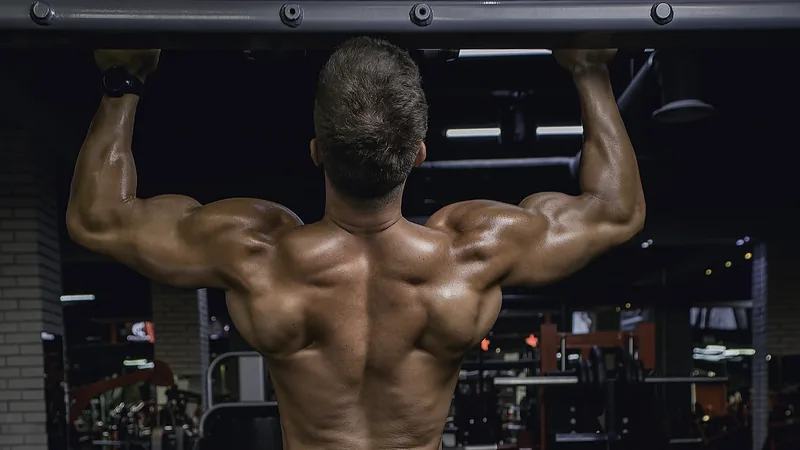
| Vertical pull | Pull-up | Lat pulldown |
| Horizontal pull | Barbell row, one-arm dumbbell row | Seated cable row, chest-supported machine row |
| Side delts | Dumbbell lateral raise | Cable or machine lateral raise |
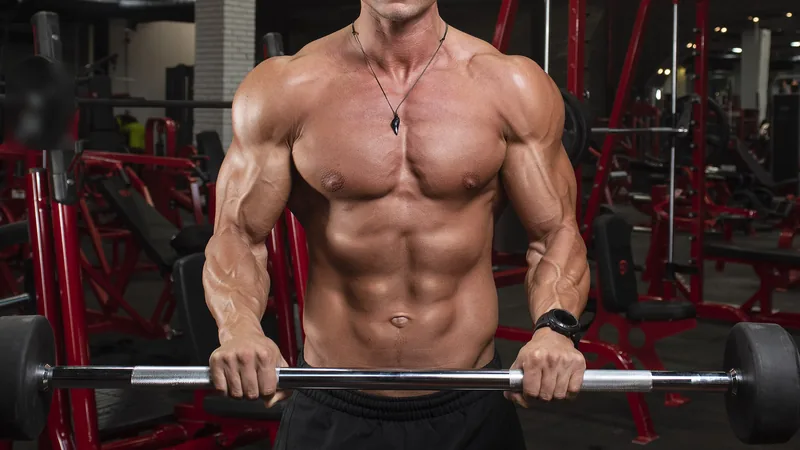
| Biceps | Biceps curl with a barbell or dumbbells | Cable curl, machine preacher curl |
| Triceps | Dumbbell overhead triceps extension | Cable overhead extension, pushdown |
| Calves | Dumbbell single-leg calf raise | Standing calf raise machine, leg-press calf raise |
When you swap, keep the same muscle length emphasis. Swapping a Romanian deadlift for a lying leg curl is not the same stimulus: the RDL loads the hamstrings at the hip, the leg curl at the knee.
The plan: hybrid 3-day full body
Three different full-body days a week (for example Monday, Wednesday, Friday), about half free weights and half machines and cables. Effort is given as RIR. Do 1–3 lighter warm-up sets before the first exercise for each muscle group; see warm-up sets.
Day A
| # | Exercise | Type | Sets × reps | RIR | Rest |
|---|---|---|---|---|---|
| 1 | Back squat | Free weight | 3 × 5–8 | 2 | 3 min |
| 2 | Machine chest press | Machine | 3 × 8–12 | 0–1 | 2 min |
| 3 | Lat pulldown | Cable | 3 × 8–12 | 0–1 | 2 min |
| 4 | Romanian deadlift | Free weight | 3 × 8–10 | 2 | 2–3 min |
| 5 | Cable lateral raise | Cable | 3 × 12–20 | 0–1 | 60–90 s |
| 6 | Cable overhead triceps extension | Cable | 3 × 10–15 | 0–1 | 90 s |
Day B
| # | Exercise | Type | Sets × reps | RIR | Rest |
|---|---|---|---|---|---|
| 1 | Leg press | Machine | 3 × 10–15 | 0–1 | 2 min |
| 2 | Incline dumbbell press | Free weight | 3 × 8–12 | 1–2 | 2 min |
| 3 | Chest-supported machine row | Machine | 4 × 8–12 | 0–1 | 2 min |
| 4 | Seated leg curl | Machine | 3 × 10–15 | 0–1 | 90 s |
| 5 | Dumbbell lateral raise | Free weight | 3 × 12–20 | 0–1 | 60–90 s |
| 6 | EZ-bar biceps curl | Free weight | 3 × 10–12 | 0–1 | 90 s |
| 7 | Triceps pushdown | Cable | 2 × 10–15 | 0–1 | 60–90 s |
Day C
| # | Exercise | Type | Sets × reps | RIR | Rest |
|---|---|---|---|---|---|
| 1 | Bulgarian split squat | Free weight | 3 × 8–12 each leg | 1–2 | 2 min |
| 2 | Bench press | Free weight | 3 × 6–10 | 1–2 | 2–3 min |
| 3 | Pull-up (assisted if needed) | Bodyweight | 3 × 6–10 | 1–2 | 2–3 min |
| 4 | Leg extension | Machine | 2 × 12–15 | 0–1 | 90 s |
| 5 | Lying leg curl | Machine | 3 × 10–15 | 0–1 | 90 s |
| 6 | Incline dumbbell curl | Free weight | 2 × 10–15 | 0–1 | 90 s |
| 7 | Standing calf raise | Machine | 3 × 10–15 | 0–1 | 90 s |
Notice the effort targets: machines and cables go closer to failure (0–1 RIR), heavy free-weight compounds stay at 1–2 RIR. That is the practical advantage of machines: you can push hard without a spotter and without technique breaking down. These RIR targets are our convention.
Volume audit
Weekly hard sets per muscle, counted with our fractional method (1 for the main muscle, 0.5 for clear helpers; split squats counted per leg). Compare with the 10–20 set range from our guide to sets per week.
| Muscle | Day A | Day B | Day C | Week | Verdict |
|---|---|---|---|---|---|
| Quads | 3 | 3 | 5 | 11 | In range |
| Hamstrings | 3 | 3 | 3 | 9 | Just under; fine for most |
| Glutes | 3 | 1.5 | 1.5 | 6 | Low; add hip thrusts if glutes are a priority |
| Calves | 0 | 0 | 3 | 3 | Low; add 3 sets to Day A if you want bigger calves |
| Chest | 3 | 3 | 3 | 9 | Just under; add a set of chest press if needed |
| Back | 3 | 4 | 3 | 10 | In range |
| Front delts | 1.5 | 1.5 | 1.5 | 4.5 | Fine; presses cover them |
| Side delts | 3 | 3 | 0 | 6 | Low; add a lateral-raise set on Day C if needed |
| Biceps | 1.5 | 5 | 3.5 | 10 | In range |
| Triceps | 4.5 | 3.5 | 1.5 | 9.5 | Just under; fine for most |
How we counted: squats, Romanian deadlifts, leg presses and split squats each give 0.5 to the glutes; Romanian deadlifts count 1 for the hamstrings; presses give 0.5 to the front delts and triceps; pulldowns, rows and pull-ups give 0.5 to the biceps.
Machine-only and free-weight-only versions
- Machine-only (commercial gym, joint issues, older lifters): swap each free-weight exercise for the machine option in the swap list. Keep the sets and reps the same.
- Free-weight-only (home gym): use the free-weight options. Replace leg curls with Nordic curls or a slow-lowering Romanian deadlift, and leg extensions with split squats with the front knee travelling forward. Keep 1–2 RIR on compound lifts unless you have safety pins.
Beginner and advanced versions
- Beginner: start with machines for the first 4–8 weeks to learn effort and range, then bring in the free-weight lifts one at a time. Do 2 sets per exercise at 2–3 RIR.
- Advanced: keep the free-weight lifts you want to test, and move most of your extra volume onto machines and cables, where you can train close to failure with less fatigue.
Progression
- Double progression on every exercise. When you hit the top of the rep range on all sets at the target RIR, add the smallest load available next session: about 2.5 kg on barbell lifts, 1–2 kg on dumbbells, one plate on a stack. This is our standard rule; see progressive overload.
- Note the machine and the settings. Machines differ between gyms, and seat height or pin position changes the load. Write them down, or your logbook isn’t comparable.
- Don’t compare loads across equipment. A Smith machine squat and a barbell squat give different numbers for the same effort (Cotterman et al., 2005).
- Deload every 6–8 weeks, or when reps fall two sessions in a row. See when and how to deload.
Common mistakes
- Thinking machines are “only for beginners”. Fix: machines built plenty of muscle in the studies; use them for hard sets close to failure.
- Doing only machines when you want a strong barbell lift. Fix: practise the lift you want to be strong at; strength is specific.
- Using short ranges on machines. Fix: set the seat so you get the full stretch; see range of motion.
- Chasing muscle activity on unstable equipment. Fix: stable exercises let you lift more; unstable training lowered force in the studies.
- Changing machines every session for variety. Fix: rotating a few options is fine, but keep each long enough to progress the load.
- Leaving free-weight sets far from failure out of fear. Fix: use safety pins or a spotter, or move the last hard sets to a machine.
- Ignoring setup. Fix: adjust seat height, back pad and handle position so the joint lines up with the machine’s pivot.
Make it better
- Use a machine for the last exercise for each muscle and take it to 0 RIR. You get the benefit of training close to failure with low risk.
- Pick machines that load the stretch: seated leg curls, overhead cable extensions and cable lateral raises from behind the body.
- Keep one free-weight lift per pattern for a few blocks a year if you want to know your strength.
Safety notes
- On free-weight lifts taken close to failure, use safety pins, collars or a spotter.
- Machine sets close to failure are generally safe; on the leg press, use the safety stops and don’t lock the knees hard under load.
- If you are pregnant, under 18, injured or have heart disease, ask a qualified professional before you change your training.
Related on Grow My Lifespan: cardio, lifting and muscle (on combining lifting with other training).
FAQ
Do free weights build more muscle than machines?
No. Two meta-analyses found no difference in muscle growth between free-weight and machine training. One pooled 13 studies with 1,016 people. Effort and sets matter more than the equipment.
Can you build muscle with only machines?
Yes. In the training studies, machine groups grew as much muscle as free-weight groups. You may not get as strong on barbell lifts, because strength is specific to what you train.
Are machines safer than free weights?
Probably, for many people. Most weight-training injuries in one US emergency-department study involved free weights, often from dropped weights, but that study did not adjust for how much each type was used. In people aged 55 and over, a larger share of injuries involved machines.
Is the Smith machine bad for squats?
No, it’s a fine squat option for growth. You can usually lift more on it than with a barbell, and it removes the balance demand. If you want a strong barbell squat, practise that too.
Should beginners use machines or free weights?
Either works. Machines are quicker to learn and easy to load, which helps you train hard sooner. Add free-weight lifts over time if you want strength on those lifts or train at home.
Do free weights work more muscles?
Yes, more stabilising muscles are active, and EMG can be higher. But more activity has not led to more growth in the training studies, and very unstable exercises reduce force.
References
- Haugen ME, Vårvik FT, Larsen S, et al. Effect of free-weight vs. machine-based strength training on maximal strength, hypertrophy and jump performance - a systematic review and meta-analysis. BMC Sports Sci Med Rehabil. 2023;15(1):103. doi:10.1186/s13102-023-00713-4. PubMed: 37582807
- Heidel KA, Novak ZJ, Dankel SJ. Machines and free weight exercises: a systematic review and meta-analysis comparing changes in muscle size, strength, and power. J Sports Med Phys Fitness. 2022;62(8):1061-1070. doi:10.23736/S0022-4707.21.12929-9. PubMed: 34609100
- Schwanbeck SR, Cornish SM, Barss T, et al. Effects of Training With Free Weights Versus Machines on Muscle Mass, Strength, Free Testosterone, and Free Cortisol Levels. J Strength Cond Res. 2020;34(7):1851-1859. doi:10.1519/JSC.0000000000003349. PubMed: 32358310
- Amanuma MT, Ikeda PLT, Sakamoto MT, et al. Comparable regional hypertrophy of the knee extensor muscles in response to resistance training with machines versus free weights: a randomized within-subject approach. J Bodyw Mov Ther. 2025;45:562-568. doi:10.1016/j.jbmt.2025.09.027. PubMed: 41316621
- Currier BS, D’Souza AC, Singh MAF, et al. American College of Sports Medicine Position Stand. Resistance Training Prescription for Muscle Function, Hypertrophy, and Physical Performance in Healthy Adults: An Overview of Reviews. Med Sci Sports Exerc. 2026;58(4):851-872. doi:10.1249/MSS.0000000000003897. PubMed: 41843416
- Rossi FE, Schoenfeld BJ, Ocetnik S, et al. Strength, body composition, and functional outcomes in the squat versus leg press exercises. J Sports Med Phys Fitness. 2018;58(3):263-270. doi:10.23736/S0022-4707.16.06698-6. PubMed: 27735888
- Saeterbakken AH, van den Tillaar R, Fimland MS. A comparison of muscle activity and 1-RM strength of three chest-press exercises with different stability requirements. J Sports Sci. 2011;29(5):533-8. doi:10.1080/02640414.2010.543916. PubMed: 21225489
- Cotterman ML, Darby LA, Skelly WA. Comparison of muscle force production using the Smith machine and free weights for bench press and squat exercises. J Strength Cond Res. 2005;19(1):169-76. doi:10.1519/14433.1. PubMed: 15705030
- Schwanbeck S, Chilibeck PD, Binsted G. A comparison of free weight squat to Smith machine squat using electromyography. J Strength Cond Res. 2009;23(9):2588-91. doi:10.1519/JSC.0b013e3181b1b181. PubMed: 19855308
- McBride JM, Cormie P, Deane R. Isometric squat force output and muscle activity in stable and unstable conditions. J Strength Cond Res. 2006;20(4):915-8. doi:10.1519/R-19305.1. PubMed: 17194253
- McBride JM, Larkin TR, Dayne AM, et al. Effect of absolute and relative loading on muscle activity during stable and unstable squatting. Int J Sports Physiol Perform. 2010;5(2):177-83. doi:10.1123/ijspp.5.2.177. PubMed: 20625190
- Kohler JM, Flanagan SP, Whiting WC. Muscle activation patterns while lifting stable and unstable loads on stable and unstable surfaces. J Strength Cond Res. 2010;24(2):313-21. doi:10.1519/JSC.0b013e3181c8655a. PubMed: 20072068
- Saeterbakken AH, Andersen V, Behm DG, et al. Resistance-training exercises with different stability requirements: time course of task specificity. Eur J Appl Physiol. 2016;116(11-12):2247-2256. doi:10.1007/s00421-016-3470-3. PubMed: 27671996
- Kerr ZY, Collins CL, Comstock RD. Epidemiology of weight training-related injuries presenting to United States emergency departments, 1990 to 2007. Am J Sports Med. 2010;38(4):765-71. doi:10.1177/0363546509351560. PubMed: 20139328
- Aasa U, Svartholm I, Andersson F, et al. Injuries among weightlifters and powerlifters: a systematic review. Br J Sports Med. 2017;51(4):211-219. doi:10.1136/bjsports-2016-096037. PubMed: 27707741
- Kassiano W, Costa B, Kunevaliki G, et al. Muscle Hypertrophy and Strength Adaptations to Systematically Varying Resistance Exercises. Res Q Exerc Sport. 2025;96(2):371-381. doi:10.1080/02701367.2024.2409961. PubMed: 39388663
- Fonseca RM, Roschel H, Tricoli V, et al. Changes in exercises are more effective than in loading schemes to improve muscle strength. J Strength Cond Res. 2014;28(11):3085-92. doi:10.1519/JSC.0000000000000539. PubMed: 24832974
- Baz-Valle E, Schoenfeld BJ, Torres-Unda J, et al. The effects of exercise variation in muscle thickness, maximal strength and motivation in resistance trained men. PLoS One. 2019;14(12):e0226989. doi:10.1371/journal.pone.0226989. PubMed: 31881066
- Costa BDV, Kassiano W, Nunes JP, et al. Does Varying Resistance Exercises for the Same Muscle Group Promote Greater Strength Gains? J Strength Cond Res. 2022;36(11):3032-3039. doi:10.1519/JSC.0000000000004042. PubMed: 35481889