How Much Protein Do You Need to Build Muscle? The Evidence-Based Answer
How much protein you need to build muscle: 1.6 g/kg is the evidence-based target, when 2.2 g/kg or more helps, per-meal doses, plant protein and safety.
Key takeaways
- For most people who lift, 1.6 g of protein per kg of body weight per day (about 0.7 g per lb) captures most of the muscle-building benefit. Going up to 2.2 g/kg is a sensible safety margin.
- The famous 1.6 g/kg plateau is an estimate with a wide confidence interval (1.03–2.20 g/kg). That's why we recommend 1.6 as a minimum target rather than a ceiling.
- When you are dieting, aim higher: about 2.0–2.4 g/kg of body weight, or 2.3–3.1 g/kg of lean mass if you are lean.
- Split it into 3–5 meals of about 0.4 g/kg each (roughly 25–45 g for most people). Newer data suggest a single large meal is used better than once thought, so distribution is fine-tuning, not a deal-breaker.
- Plant-based eaters can build muscle just as well when total protein is high enough. Intakes up to about 3.3 g/kg for a year showed no harm to kidneys or blood lipids in healthy trained men.
Protein is the one nutrient every lifter asks about, and the one most often oversold. The supplement aisle says you need a shake every two hours. Your aunt says you will ruin your kidneys. The research says something much calmer and more useful: there is a clear daily target, a sensible upper margin, a few situations where you should eat more, and a lot of details that matter far less than the internet thinks.
This guide gives you the number (with how confident we are in it), shows you how to hit it without obsessing, and covers the special cases: cutting, older lifters, women, plant-based eaters, and very high intakes. It is part of our eating for muscle growth pillar. For the rest of the diet, see the nutrition hub. If you are just starting out, our beginner’s guide to building muscle shows where protein fits alongside training and sleep.
Quick answer: eat 1.6–2.2 g of protein per kg of body weight per day (0.7–1.0 g per lb). Use the upper end when you are dieting, very lean, older, or simply want a safety margin. Spread it over 3–5 protein-rich meals.
The research: how much protein builds the most muscle?
The big meta-analysis: about 1.6 g/kg/day
The most-cited paper on this question is a 2018 meta-analysis by Morton and colleagues: 49 randomised controlled trials and 1,863 participants, all doing resistance training for at least six weeks, with or without extra protein (Morton et al., 2018). Protein supplementation increased gains in fat-free mass by an average of 0.30 kg and 1RM strength by about 2.5 kg compared with training alone.
Then came the part everyone quotes. Plotting total daily protein against muscle gain, the authors found that gains in fat-free mass levelled off at about 1.62 g/kg/day. Two details are usually left out:
- The 95% confidence interval for that breakpoint ran from 1.03 to 2.20 g/kg/day, and the breakpoint model itself was not statistically significant (p = 0.079). In other words, the true plateau could be lower or higher than 1.6.
- The effect of extra protein was larger in trained lifters and smaller with increasing age.
That is why many researchers, including the authors, suggest 1.6 g/kg/day as a practical minimum target for maximising gains, and up to 2.2 g/kg/day for anyone who wants to be sure they are past the plateau.
Newer meta-analyses agree
- Nunes et al. (2022) pooled 74 randomised trials. Increasing daily protein produced small additional gains in lean body mass during resistance training (standardised mean difference 0.22; moderate certainty). The benefit was clearest in adults under 65 eating ≥ 1.6 g/kg/day, and in adults over 65 eating 1.2–1.59 g/kg/day.
- Tagawa et al. (2020) analysed 105 papers with 5,402 participants and modelled the dose–response. Below about 1.3 g/kg/day, each extra 0.1 g/kg/day was associated with 0.39 kg more lean mass; above it, the gain per 0.1 g/kg/day fell to 0.12 kg but did not drop to zero up to 3.5 g/kg/day.
Put together: the steep part of the curve ends around 1.3–1.6 g/kg; above that, there are smaller but possibly real gains. Note the Tagawa data include many studies without lifting, so it isn’t specific to trained lifters.
Lab estimates point the same way
A different method, indicator amino acid oxidation, estimates the intake needed to maximise whole-body protein synthesis:
- In male bodybuilders on a rest day, the estimated average requirement was 1.7 g/kg/day, with a recommended intake (upper 95% CI) of 2.2 g/kg/day (Bandegan et al., 2017).
- After a whole-body workout, trained men with high habitual intakes reached a breakpoint at about 2.0 g/kg/day (95% CI 1.44–2.57; Mazzulla et al., 2020).
- In resistance-trained women after exercise, the breakpoint was about 1.5 g/kg/day, with an upper 95% limit of roughly 1.9 g/kg/day (Malowany et al., 2019).
These are small studies (7–8 people each), and whole-body protein balance is not the same as muscle growth. But they land right on the same 1.6–2.2 range.
The position stands
The International Society of Sports Nutrition concludes that 1.4–2.0 g/kg/day is sufficient for most exercising people, and that higher intakes (2.3–3.1 g/kg/day of lean body mass) may be needed to maximise retention of lean mass in lean, resistance-trained people during a calorie deficit (Jäger et al., 2017; Helms et al., 2014).
Your protein target: the numbers
Grams per day by body weight
| Body weight | 1.6 g/kg (minimum target) | 2.2 g/kg (upper margin) |
|---|---|---|
| 55 kg (121 lb) | 88 g | 121 g |
| 65 kg (143 lb) | 104 g | 143 g |
| 75 kg (165 lb) | 120 g | 165 g |
| 85 kg (187 lb) | 136 g | 187 g |
| 95 kg (209 lb) | 152 g | 209 g |
| 110 kg (243 lb) | 176 g | 242 g |
Adjust for your situation
| Situation | Daily target | Why |
|---|---|---|
| Building muscle, maintenance or surplus | 1.6–2.2 g/kg | Covers the meta-analysis plateau with a margin |
| Cutting (calorie deficit) | 2.0–2.4 g/kg body weight; lean lifters 2.3–3.1 g/kg of lean mass | Higher protein protects lean mass when energy is short (see below) |
| Older adults (65+) | ≥ 1.2–1.6 g/kg, aim higher if appetite allows | Older muscle responds less to each meal; Nunes et al. found benefits from 1.2 g/kg upwards |
| Higher body fat (e.g. BMI > 30) | Use goal body weight or lean mass instead of current weight | Fat mass doesn’t need protein; the per-kg targets come from leaner study groups |
| Women | Same g/kg targets | Lab estimates in trained women land in the same range (Malowany et al., 2019) |
Using lean mass: if you know your body-fat percentage, lean mass = body weight × (1 − body fat). Example: 90 kg at 25% fat is 67.5 kg lean mass; 2.3–3.1 g/kg of lean mass is 155–209 g per day.
Protein when cutting: why more helps
A calorie deficit makes the body more willing to break down muscle. A meta-analysis found that energy deficits impaired lean-mass gains during resistance training, and that a deficit of about 500 kcal per day was enough to prevent lean-mass gains on average (Murphy & Koehler, 2022). More protein is one of the few tools that pushes back.
The clearest trial is Longland et al. (2016). Young men ate about 40% fewer calories than they needed for four weeks and trained hard six days a week. One group ate 2.4 g/kg/day of protein, the other 1.2 g/kg/day:
- The higher-protein group gained 1.2 kg of lean mass; the lower-protein group gained 0.1 kg.
- The higher-protein group also lost more fat: 4.8 kg vs 3.5 kg.
That is an extreme deficit and a short study, so the exact numbers won’t transfer to a typical cut. But the direction is consistent with the review data: when you diet, lean toward 2.2–2.4 g/kg. More on this in our body recomposition guide and our guide to mini-cuts.
Is more than 2.2 g/kg useful?
Probably not for muscle gain itself, but it may help body composition and it seems to be safe for healthy people.
Jose Antonio’s group ran several trials in resistance-trained people at very high intakes:
- 4.4 g/kg/day for 8 weeks: despite eating more protein and more calories, the high-protein group did not gain fat, and body composition did not differ from the control group eating about 1.8 g/kg/day (Antonio et al., 2014).
- 3.4 vs 2.3 g/kg/day during heavy training: both groups gained the same fat-free mass (+1.5 kg), but the 3.4 g/kg group lost more fat (−1.7 vs −0.3 kg) despite eating more calories (Antonio et al., 2015).
These studies relied on self-reported diets and were small, so the evidence is preliminary. A plausible explanation comes from a tightly controlled overfeeding study: when people were overfed about 950 kcal/day for 8 weeks, those on a normal- or high-protein diet stored more of the surplus as lean tissue and burned more energy than the low-protein group, while fat gain was similar across all groups (Bray et al., 2012).
Bottom line: there is no strong reason to go beyond 2.2 g/kg/day to build muscle. If you like high-protein food, eating more is unlikely to hurt and may make a surplus a little “leaner”. But it costs money and crowds out the carbohydrates that fuel training.
Is a high-protein diet safe?
For healthy people, the evidence is reassuring:
- A meta-analysis of 28 trials (1,358 participants) found that higher-protein diets (≥ 1.5 g/kg/day, ≥ 20% of energy or ≥ 100 g/day) did not worsen kidney function in healthy adults. Kidney filtration rate was slightly higher after high-protein diets, but the change over time did not differ from normal-protein diets (Devries et al., 2018).
- In a one-year crossover study, 14 resistance-trained men eating ~2.5–3.3 g/kg/day showed no harmful effects on blood lipids, liver or kidney function (Antonio et al., 2016).
Important: if you have kidney disease, diabetes with kidney involvement, or another medical condition, talk to your doctor before raising protein. These studies were in healthy adults.
For a longevity angle on protein, see Related on Grow My Lifespan: protein for healthy ageing.
How much protein per meal?
The 0.4 g/kg rule of thumb
Short-term studies of muscle protein synthesis (MPS) found that 20–25 g of high-quality protein maximally stimulated MPS after a workout in young men, which led to the idea that “the body can only use 25 g at a time”. A review of the evidence concluded that it is reasonable to aim for about 0.4 g/kg per meal across at least four meals to reach 1.6 g/kg/day, or up to 0.55 g/kg per meal to reach 2.2 g/kg/day (Schoenfeld & Aragon, 2018).
| Body weight | 0.4 g/kg per meal | 0.55 g/kg per meal |
|---|---|---|
| 60 kg | 24 g | 33 g |
| 75 kg | 30 g | 41 g |
| 90 kg | 36 g | 50 g |
| 105 kg | 42 g | 58 g |
Does spreading it out matter?
In a 12-hour lab study, trained men drank 80 g of whey after training in three patterns: 8 × 10 g, 4 × 20 g, or 2 × 40 g. Four 20-gram servings every 3 hours produced the highest MPS over the 12 hours (Areta et al., 2013).
But a 2023 study challenged the “25 g limit”. Using a four-isotope method, researchers showed that 100 g of protein after exercise produced a larger and longer (over 12 hours) anabolic response than 25 g (Trommelen et al., 2023). The body doesn’t “waste” a big meal as much as once thought; it just processes it more slowly.
What to do: 3–5 meals with 25–50 g of protein each is a simple and evidence-friendly pattern. If you prefer two big meals or fast for part of the day, you can still build muscle as long as the daily total is high; see the upcoming guides on meal frequency and intermittent fasting.
Before bed
In a 12-week training study, young men who drank 27.5 g of casein protein every night before sleep gained more quadriceps size and strength than a placebo group (Snijders et al., 2015). However, the placebo contained no protein, so the supplement group also ate more protein per day. The study can’t separate the timing from the extra total intake. A pre-bed protein meal is a convenient way to hit your total, not a magic window.
The “anabolic window”
The old advice was to drink a shake within 30 minutes of training. A review concluded that the window is much wider than that. What matters most is total daily protein and having a protein meal within a few hours before and after training (Aragon & Schoenfeld, 2013). If you trained fasted early in the morning, eat soon after; otherwise, relax. Related on Grow My Lifespan: is there really an anabolic window?
Protein quality and plant-based diets
Animal proteins (whey, milk, eggs, meat, fish) contain more leucine per gram and are digested well, so a given dose stimulates MPS a little more. Plant proteins tend to have less leucine and less lysine or methionine, and are slightly less digestible.
Does it matter over months? When protein intake is high enough, apparently not much. In a 12-week trial, habitual vegans and omnivores both ate 1.6 g/kg/day (topped up with soy protein for vegans and whey for omnivores) and trained twice a week. Gains in leg lean mass, muscle size, fibre size and leg-press strength were the same in both groups (Hevia-Larraín et al., 2021). The participants were untrained young men, so this is not yet proven for advanced lifters, but it is strong practical evidence.
Plant-based tips:
- Aim for the upper end (≈ 2.0–2.2 g/kg) to make up for lower quality per gram.
- Combine sources across the day: legumes + grains, soy (tofu, tempeh, edamame), seitan, pea or soy protein powder.
- Make each meal a little bigger (about 30–45 g) to reach a similar leucine dose.
Read the full guide: vegan and plant-based muscle building.
How to hit your protein target with food
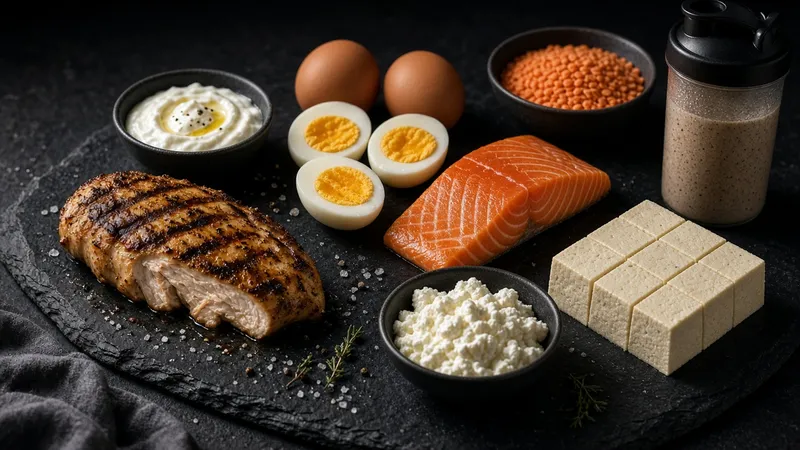
Most lifters fall short because their meals are built around carbohydrates with a little protein on the side. Flip it: choose the protein first, then add the rest of the plate.
Protein per typical portion
| Food | Portion | Protein (approx.) |
|---|---|---|
| Chicken breast, cooked | 150 g | 45 g |
| Lean beef mince (5% fat), cooked | 150 g | 40 g |
| Salmon fillet, cooked | 150 g | 33 g |
| Tuna, canned in water | 1 can (≈ 120 g drained) | 30 g |
| Eggs | 3 large | 19 g |
| Greek yogurt, 0–2% fat | 250 g | 25 g |
| Skyr / quark | 250 g | 27–30 g |
| Cottage cheese | 200 g | 22–24 g |
| Milk | 500 ml | 17 g |
| Whey protein | 1 scoop (30 g) | 22–25 g |
| Tofu, firm | 200 g | 28–32 g |
| Tempeh | 150 g | 28–30 g |
| Lentils, cooked | 250 g | 22 g |
| Seitan | 100 g | 20–25 g |
Values vary by brand; check the label. Plant foods such as lentils also bring a lot of carbohydrate, so they are less “protein-dense” per calorie.
Example day: 80 kg lifter, 160 g target (2.0 g/kg)
| Meal | Food | Protein |
|---|---|---|
| Breakfast | 250 g skyr + oats + berries | 30 g |
| Lunch | Chicken (150 g) + rice + vegetables | 45 g |
| Pre/post workout | Whey shake + banana | 25 g |
| Dinner | Salmon (150 g) + potatoes + salad | 33 g |
| Evening | 200 g cottage cheese + fruit | 24 g |
| Total | ≈ 157 g |
Practical tips
- Track for one or two weeks. Most people overestimate their protein. A food app for a short period teaches you portion sizes for life.
- Have a protein “anchor” in every meal: meat, fish, eggs, dairy, tofu/tempeh or a shake.
- Keep convenient options around: skyr, cottage cheese, canned fish, ready-cooked chicken, protein bars as a backup.
- Protein powder is food, not magic. It’s useful when whole foods are inconvenient; it’s not necessary.
Protein in the bigger picture
Protein matters, but it is one piece:
- Training stimulus comes first. Without hard sets close to failure and enough weekly volume, extra protein has nothing to build. See how many sets per week and our push/pull/legs program.
- Energy balance decides how fast you can grow. A small surplus helps; see the lean bulking guide.
- Protein maximises what your training and calories allow.
- Sleep and consistency keep the process running for months.
The effect of extra protein in the meta-analyses is real but modest (an extra 0.3 kg of fat-free mass over a few months in Morton et al.). It is a multiplier on good training, not a substitute for it.
Common protein mistakes
- Using the RDA as a target. The RDA (0.8 g/kg/day) is the minimum for sedentary adults, not a muscle-building target.
- Calculating from total body weight when carrying a lot of body fat. Use goal weight or lean mass.
- Back-loading everything into dinner. It works, but spreading protein out is easier to digest and may be slightly better for MPS.
- Dropping protein when cutting. Do the opposite: raise it.
- Paying for “anabolic” add-ons. BCAA drinks are pointless if you already eat enough complete protein.
- Ignoring calories. Protein can’t build muscle out of a large energy deficit.
FAQ
How much protein do I need per day to build muscle?
Aim for at least 1.6 g per kg of body weight per day (0.7 g/lb). Most lifters can go up to 2.2 g/kg (1 g/lb) for a safety margin. When you diet, aim for about 2.0–2.4 g/kg.
Is 1 gram of protein per pound of body weight necessary?
No, but it’s a convenient upper margin. One gram per pound is 2.2 g/kg, which is the top of the range supported by the research. Most of the benefit comes by about 1.6 g/kg.
Can you eat too much protein?
For healthy people, intakes up to around 3.3 g/kg/day for a year showed no harm in studies of trained men. The main costs are money and less room for carbohydrates and fats. If you have kidney disease, follow your doctor’s advice.
Does the body only absorb 30 g of protein per meal?
No. You absorb almost all the protein you eat; the question is how much is used for muscle building in the next few hours. A 2023 study found 100 g produced a larger and longer muscle-building response than 25 g. Spreading protein over 3–5 meals is still a good default.
Do I need protein right after a workout?
Not within a strict 30-minute window. Have a protein-rich meal within a few hours before and after training. If you train fasted, eat soon after.
Is plant protein as good as animal protein for muscle?
When total intake is high (about 1.6 g/kg/day or more), a 12-week study found vegans and omnivores gained the same muscle and strength. Plant-based lifters may want to aim a little higher and combine sources.
Should older lifters eat more protein?
Older muscle responds less to each dose of protein, so older adults should aim for at least 1.2–1.6 g/kg/day and slightly larger protein meals (about 0.4 g/kg or more).
References
- Morton RW, Murphy KT, McKellar SR, et al. A systematic review, meta-analysis and meta-regression of the effect of protein supplementation on resistance training-induced gains in muscle mass and strength in healthy adults. Br J Sports Med. 2018;52(6):376-384. doi:10.1136/bjsports-2017-097608. PubMed: 28698222 ↩
- Nunes EA, Colenso-Semple L, McKellar SR, et al. Systematic review and meta-analysis of protein intake to support muscle mass and function in healthy adults. J Cachexia Sarcopenia Muscle. 2022;13(2):795-810. doi:10.1002/jcsm.12922. PubMed: 35187864 ↩
- Tagawa R, Watanabe D, Ito K, et al. Dose-response relationship between protein intake and muscle mass increase: a systematic review and meta-analysis of randomized controlled trials. Nutr Rev. 2020;79(1):66-75. doi:10.1093/nutrit/nuaa104. PubMed: 33300582 ↩
- Bandegan A, Courtney-Martin G, Rafii M, et al. Indicator Amino Acid-Derived Estimate of Dietary Protein Requirement for Male Bodybuilders on a Nontraining Day Is Several-Fold Greater than the Current Recommended Dietary Allowance. J Nutr. 2017;147(5):850-857. doi:10.3945/jn.116.236331. PubMed: 28179492 ↩
- Mazzulla M, Abou Sawan S, Williamson E, et al. Protein Intake to Maximize Whole-Body Anabolism during Postexercise Recovery in Resistance-Trained Men with High Habitual Intakes is Severalfold Greater than the Current Recommended Dietary Allowance. J Nutr. 2020;150(3):505-511. doi:10.1093/jn/nxz249. PubMed: 31618421
- Malowany JM, West DWD, Williamson E, et al. Protein to Maximize Whole-Body Anabolism in Resistance-trained Females after Exercise. Med Sci Sports Exerc. 2019;51(4):798-804. doi:10.1249/MSS.0000000000001832. PubMed: 30395050 ↩
- Jäger R, Kerksick CM, Campbell BI, et al. International Society of Sports Nutrition Position Stand: protein and exercise. J Int Soc Sports Nutr. 2017;14:20. doi:10.1186/s12970-017-0177-8. PubMed: 28642676
- Helms ER, Aragon AA, Fitschen PJ. Evidence-based recommendations for natural bodybuilding contest preparation: nutrition and supplementation. J Int Soc Sports Nutr. 2014;11:20. doi:10.1186/1550-2783-11-20. PubMed: 24864135
- Murphy C, Koehler K. Energy deficiency impairs resistance training gains in lean mass but not strength: A meta-analysis and meta-regression. Scand J Med Sci Sports. 2022;32(1):125-137. doi:10.1111/sms.14075. PubMed: 34623696 ↩
- Longland TM, Oikawa SY, Mitchell CJ, et al. Higher compared with lower dietary protein during an energy deficit combined with intense exercise promotes greater lean mass gain and fat mass loss: a randomized trial. Am J Clin Nutr. 2016;103(3):738-46. doi:10.3945/ajcn.115.119339. PubMed: 26817506 ↩
- Antonio J, Peacock CA, Ellerbroek A, et al. The effects of consuming a high protein diet (4.4 g/kg/d) on body composition in resistance-trained individuals. J Int Soc Sports Nutr. 2014;11:19. doi:10.1186/1550-2783-11-19. PubMed: 24834017 ↩
- Antonio J, Ellerbroek A, Silver T, et al. A high protein diet (3.4 g/kg/d) combined with a heavy resistance training program improves body composition in healthy trained men and women—a follow-up investigation. J Int Soc Sports Nutr. 2015;12:39. doi:10.1186/s12970-015-0100-0. PubMed: 26500462 ↩
- Bray GA, Smith SR, de Jonge L, et al. Effect of dietary protein content on weight gain, energy expenditure, and body composition during overeating: a randomized controlled trial. JAMA. 2012;307(1):47-55. doi:10.1001/jama.2011.1918. PubMed: 22215165 ↩
- Devries MC, Sithamparapillai A, Brimble KS, et al. Changes in Kidney Function Do Not Differ between Healthy Adults Consuming Higher- Compared with Lower- or Normal-Protein Diets: A Systematic Review and Meta-Analysis. J Nutr. 2018;148(11):1760-1775. doi:10.1093/jn/nxy197. PubMed: 30383278 ↩
- Antonio J, Ellerbroek A, Silver T, et al. A High Protein Diet Has No Harmful Effects: A One-Year Crossover Study in Resistance-Trained Males. J Nutr Metab. 2016;2016:9104792. doi:10.1155/2016/9104792. PubMed: 27807480 ↩
- Schoenfeld BJ, Aragon AA. How much protein can the body use in a single meal for muscle-building? Implications for daily protein distribution. J Int Soc Sports Nutr. 2018;15:10. doi:10.1186/s12970-018-0215-1. PubMed: 29497353 ↩
- Areta JL, Burke LM, Ross ML, et al. Timing and distribution of protein ingestion during prolonged recovery from resistance exercise alters myofibrillar protein synthesis. J Physiol. 2013;591(9):2319-31. doi:10.1113/jphysiol.2012.244897. PubMed: 23459753 ↩
- Trommelen J, van Lieshout GAA, Nyakayiru J, et al. The anabolic response to protein ingestion during recovery from exercise has no upper limit in magnitude and duration in vivo in humans. Cell Rep Med. 2023;4(12):101324. doi:10.1016/j.xcrm.2023.101324. PubMed: 38118410 ↩
- Snijders T, Res PT, Smeets JS, et al. Protein Ingestion before Sleep Increases Muscle Mass and Strength Gains during Prolonged Resistance-Type Exercise Training in Healthy Young Men. J Nutr. 2015;145(6):1178-84. doi:10.3945/jn.114.208371. PubMed: 25926415 ↩
- Aragon AA, Schoenfeld BJ. Nutrient timing revisited: is there a post-exercise anabolic window? J Int Soc Sports Nutr. 2013;10(1):5. doi:10.1186/1550-2783-10-5. PubMed: 23360586 ↩
- Hevia-Larraín V, Gualano B, Longobardi I, et al. High-Protein Plant-Based Diet Versus a Protein-Matched Omnivorous Diet to Support Resistance Training Adaptations: A Comparison Between Habitual Vegans and Omnivores. Sports Med. 2021;51(6):1317-1330. doi:10.1007/s40279-021-01434-9. PubMed: 33599941 ↩