Leg Extension
How to do a seated leg extension through a full range: setup, technique, cues, common mistakes, when to use it next to the squat, and programming for the quads.
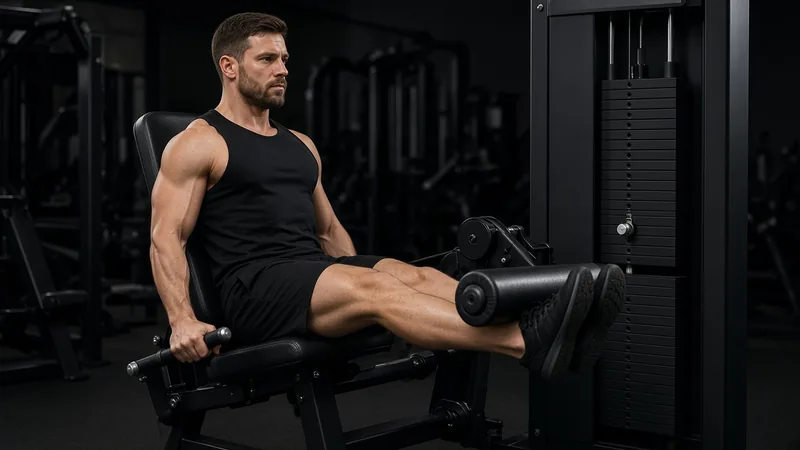
Primary muscles
Secondary muscles
Equipment
Seated leg-extension machine
Level
Beginner–advanced
Setup
- Sit so the knee joint lines up with the machine’s pivot. The back pad should support you without pushing you forward.
- The shin pad should sit on the lower shins, just above the ankles, not on the mid-foot.
- Hold the handles and brace. Start from a knee angle you can control — a deep start is useful if it is comfortable.
Step by step
- Extend: straighten the knees until they are almost locked, without aggressively snapping the joint.
- Lower under control to the start position and repeat. Do not bang the stack.
Coaching cues
- “Push through the shins, not the toes.”
- “Quiet hips — stay seated.”
- “Control the last third on the way down.”
Common mistakes and fixes
Variations
| Variation | Why use it |
|---|---|
| Single-leg extension | Useful for evening out sides or working around one cranky knee. |
| Partial-range work at long length | Some lifters spend more of the set in the bent-knee portion if a full lockout bothers the joint. This is a comfort choice, not a requirement. |
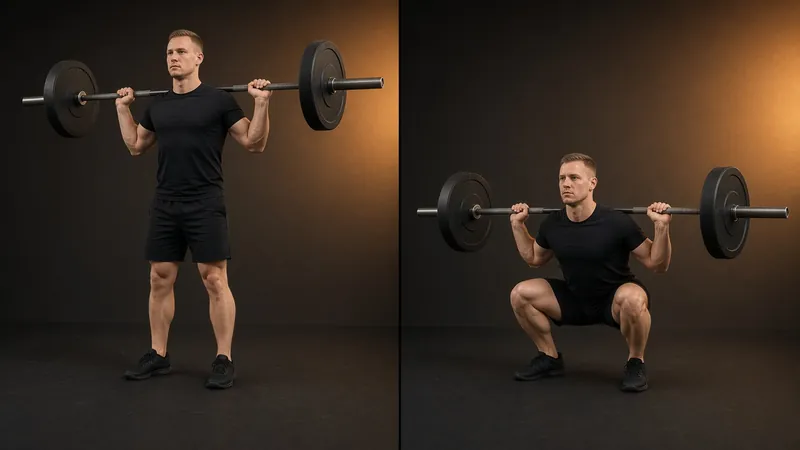
| Squat or leg press | These are the main quad compounds; the extension is the isolation that finishes the weekly dose. |
How to program it
Use 2–4 sets of 8–15 reps with 0–1 rep in reserve and 60–90 seconds’ rest. It finishes the quad work in the PPL, full-body and upper/lower programs after a squat or a press.
An isolation for the quads
The squat already covers a lot of quad work. A leg extension lets you add sets for the quads — including the rectus femoris, which also crosses the hip and often gets a clearer dose in a seated extension than in a squat alone — without loading the back again.
Evidence note: Close-to-failure sets grow muscle across a wide load range (Schoenfeld et al., 2017). On a leg extension, choose a load and a range you can control, especially at the bottom and at the lockout, rather than a stack you have to hitch.
Reference
Schoenfeld BJ, Grgic J, Ogborn D, Krieger JW. Strength and Hypertrophy Adaptations Between Low- vs. High-Load Resistance Training: A Systematic Review and Meta-analysis. J Strength Cond Res. 2017;31(12):3508-3523. doi:10.1519/JSC.0000000000002200. PubMed: 28834797