Standing Calf Raise
How to do a standing calf raise with a full stretch at the bottom and a hard squeeze at the top: setup, technique, cues, common mistakes, seated swaps and programming.
Primary muscles
Secondary muscles
Equipment
Standing calf-raise machine, or a smith machine or dumbbells and a sturdy step
Level
Beginner–advanced
Setup
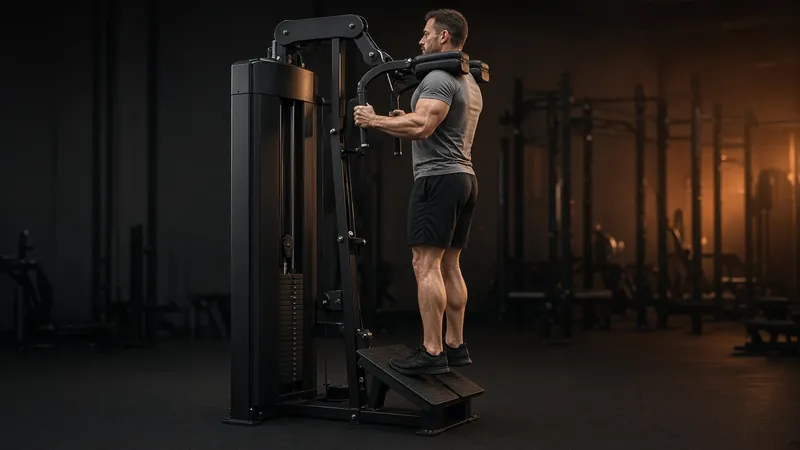
- Stand with the balls of your feet on the platform, heels free to drop below the edge.
- If you use a machine, the shoulder pads should sit comfortably; if you use a step and a dumbbell, hold the support so you can balance.
- Stand tall. You should not have to bend the knees or bounce to start the lift.
Step by step
- Stretch: lower the heels under control until you feel a stretch in the calves.
- Raise: push through the balls of the feet until you are high on your toes, without rolling out onto the little-toe side.
- Pause briefly at the top, then lower again. The knees stay almost straight — this is a standing raise, not a squat.
Coaching cues
- “Full stretch, full squeeze.”
- “Quiet knees — don’t turn it into a bounce.”
- “Equal pressure through the first and second toes.”
Common mistakes and fixes
Variations
| Variation | Why use it |
|---|---|
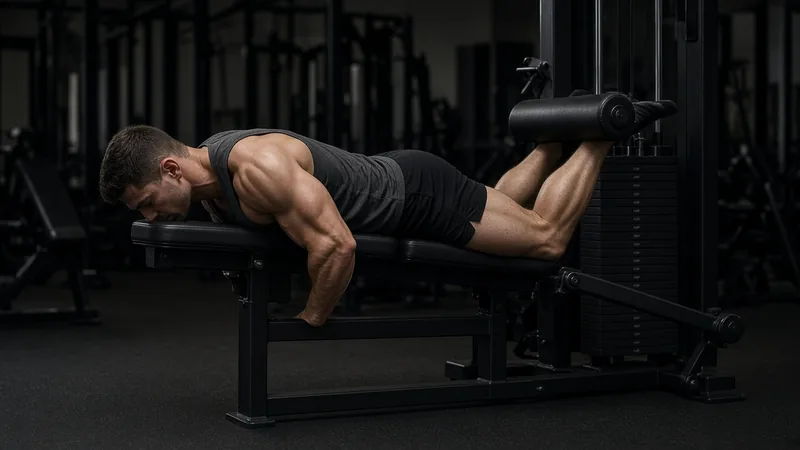
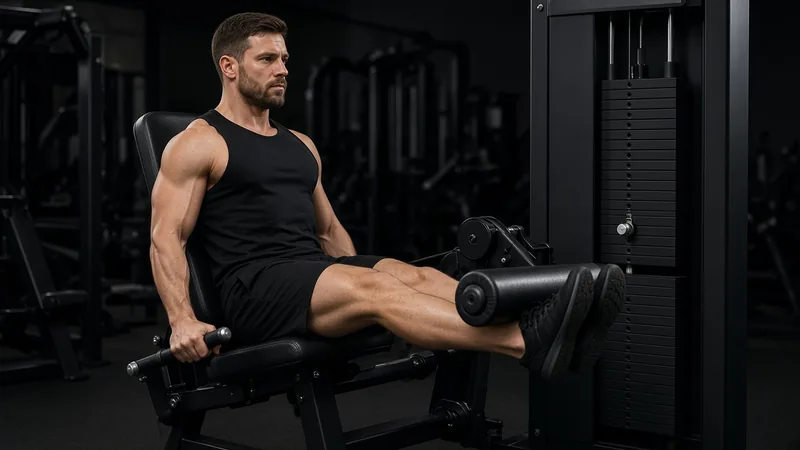
| Seated calf raise | The knees are bent, so the gastrocnemius (which crosses the knee) is less able to contribute and the soleus does more of the work. A useful second calf movement. |
| Single-leg standing raise | A simple way to even out sides or to train calves with a dumbbell when the machine is busy. |
| Leg-press calf raise | The same standing-style pattern (knees more extended) on a leg-press platform, if that is more stable for you. |
How to program it
Use 3–5 sets of 8–15 reps with 0–1 rep in reserve and 60–90 seconds’ rest. Standing calf raises are in the PPL leg day and in the full-body and upper/lower programs. Calves often need a direct dose; they will not reliably grow from squats alone.
Standing versus seated
The gastrocnemius crosses the knee and the ankle, so it is in a better position to work when the knee is straight. The soleus crosses only the ankle, so it still works when you sit. That is why a standing raise is the default in our programs, with a seated raise as a useful extra if you want more soleus work.
Evidence note: As with other isolation lifts, you can grow muscle with a wide range of loads as long as sets get close to failure (Schoenfeld et al., 2017). For calves, a full stretch at the bottom and a controlled pause usually matter more than the exact plate on the machine.
Reference
Schoenfeld BJ, Grgic J, Ogborn D, Krieger JW. Strength and Hypertrophy Adaptations Between Low- vs. High-Load Resistance Training: A Systematic Review and Meta-analysis. J Strength Cond Res. 2017;31(12):3508-3523. doi:10.1519/JSC.0000000000002200. PubMed: 28834797