Standing Overhead Press
How to overhead press with good form: setup, step-by-step technique, coaching cues, common mistakes, muscles worked, variations and how to program it for bigger shoulders.
Primary muscles
Secondary muscles
Equipment
Barbell, squat rack
Level
Beginner–advanced
Setup
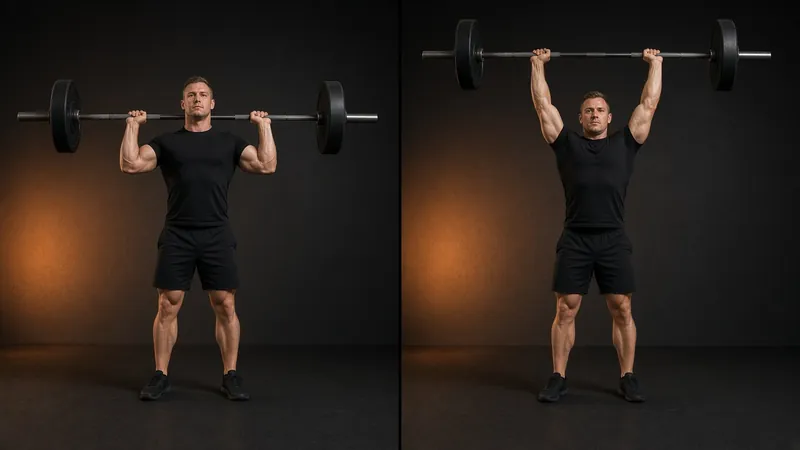
- Set the bar in the rack at about collarbone height.
- Grip just outside shoulder-width with the bar low in your palms, wrists stacked over your forearms.
- Unrack with the bar resting on your front delts / collarbones, elbows slightly in front of the bar.
- Step back and stand with feet hip-width apart. Squeeze your glutes and brace your abs so your ribs stay down.
Step by step
- Breathe and brace before each rep.
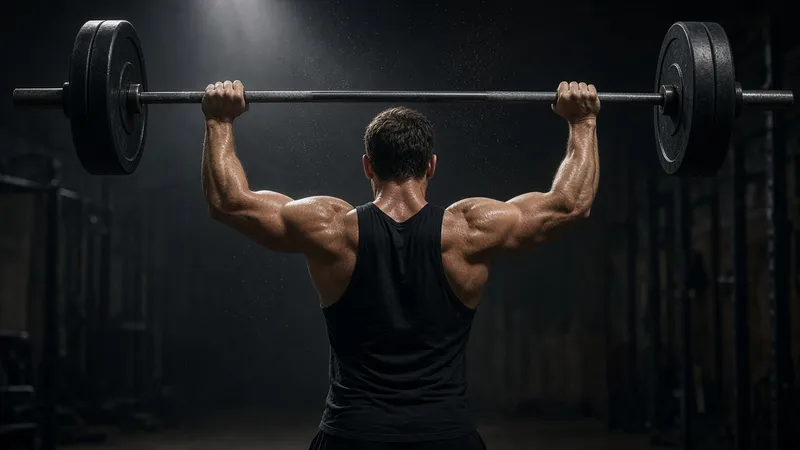
- Press straight up: move your head back slightly so the bar travels in a straight line past your chin.
- Head through: once the bar passes your forehead, push your head and chest forward 'through the window' under the bar.
- Lock out with the bar over the middle of your feet, arms straight and shoulders shrugged slightly up.
- Lower under control back to the collarbones, moving your head out of the way again.
Coaching cues
- “Squeeze your glutes, ribs down.”
- “Bar close to your face.”
- “Head through the window at the top.”
- “Push yourself away from the bar.”
Common mistakes and fixes
Variations
| Variation | Why use it |
|---|---|
| Seated dumbbell press | Back support reduces the need for core stability; easy to train near failure. |
| Push press | A small knee dip and drive allow heavier loads; trains power and lockout. |
| Landmine press | Angled pressing that is often friendlier for sore shoulders. |
| Machine shoulder press | Stable and simple to load. |
| Arnold press | Dumbbell press with rotation; longer range for the front delts. |
How to program it
Use 3–4 sets of 5–10 reps with 1–3 reps in reserve and 2–3 minutes' rest. Because pressing doesn't fully train the side delts, add 6–12 weekly sets of lateral raises. Progress in small steps — 1–2.5 kg at a time. See Push A in our PPL program.
Is the overhead press enough for big shoulders?
It’s an excellent front-delt and triceps builder, but the side delts — which create the ‘width’ look — get only a partial stimulus. Add lateral raises (cable or dumbbell) and see our upcoming page on lateral raises.
Heavy or moderate reps?
Evidence note: In 18 well-trained men, eight weeks of whole-body training with 8–12 reps or 25–35 reps per set (all to failure) produced similar muscle growth in the arms and thighs, but the heavier group gained more squat strength (+19.6% vs +8.8%) and tended to gain more bench strength (Schoenfeld et al., 2015). The study didn’t test the overhead press itself, but the principle carries over: heavier sets for strength, a mix of loads for size.
Reference
Schoenfeld BJ, Peterson MD, Ogborn D, Contreras B, Sonmez GT. Effects of Low- vs. High-Load Resistance Training on Muscle Strength and Hypertrophy in Well-Trained Men. J Strength Cond Res. 2015;29(10):2954-2963. doi:10.1519/JSC.0000000000000958. PubMed: 25853914