Overhead Triceps Extension
How to do a dumbbell or cable overhead triceps extension with a long stretch at the bottom: setup, technique, cues, common mistakes, variations and programming.
Primary muscles
Secondary muscles
Equipment
One dumbbell, or a cable with a rope or single handle set high
Level
Beginner–advanced
Setup
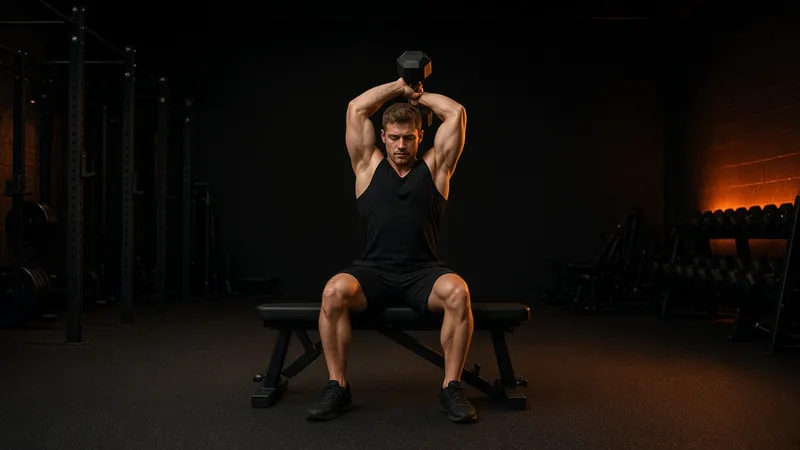
- Hold one dumbbell by the inner plates with both hands, or hold a cable rope with the pulley high behind you.
- Lift the load so your upper arms sit close to your head, elbows pointing up, not flared far out.
- Brace your trunk. A slight forward lean is fine with a cable; do not arch through the lower back to get the weight up.
Step by step
- Lower: bend the elbows and let the load travel behind your head until you feel a stretch through the triceps. Upper arms stay relatively still.
- Extend: straighten the elbows without locking aggressively, keeping the upper arms by your head.
- Breathe and repeat. The motion is at the elbow, not a press with the shoulders.
Coaching cues
- “Upper arms by your ears.”
- “Stretch, then straighten.”
- “Ribs down — do not turn it into a backbend.”
Common mistakes and fixes
Variations
| Variation | Why use it |
|---|---|
| Cable overhead extension (rope or bar) | Easy to set the stretch and to keep tension at the top. This is the version in the PPL push day. |
| Single-arm overhead extension | Useful for evening out sides and finding a comfortable shoulder position. |
| Pushdown or kickback | These are still triceps work, but they load the muscle at a shorter length than an overhead extension. |
How to program it
Use 2–4 sets of 8–12 reps with 0–1 rep in reserve and 60–90 seconds’ rest. It is the main triceps isolation in the PPL, full-body and upper/lower programs, chosen because overhead work has a stronger evidence case than a short-length pushdown alone.
Why overhead?
The long head of the triceps crosses the shoulder as well as the elbow, so it is more stretched when the arm is overhead. In a trial that compared overhead elbow-extension training with a neutral-arm (pushdown-style) position, hypertrophy of the triceps was substantially greater after the overhead version (Maeo et al., 2023). That is why this movement, not only a pushdown, sits in our programs.
Evidence note: Maeo and colleagues (2023) trained healthy adults for 12 weeks on one arm in an overhead position and the other in a neutral position. The overhead arm grew more in all three heads of the triceps, with the largest difference in the long head. It is one well-run study, not a huge literature, but the result is clear enough to prefer an overhead slot when you have room for one triceps isolation.
Reference
Maeo S, Wu Y, Huang M, et al. Triceps brachii hypertrophy is substantially greater after elbow extension training performed in the overhead versus neutral arm position. Eur J Sport Sci. 2023;23(7):1240-1250. doi:10.1080/17461391.2022.2100279. PubMed: 35819335