Barbell Bench Press
How to bench press with good form: setup, step-by-step technique, coaching cues, common mistakes, muscles worked, variations and how to program it for chest growth.
Primary muscles
Secondary muscles
Equipment
Barbell, flat bench with uprights (or rack + safeties)
Level
Beginner–advanced
Setup
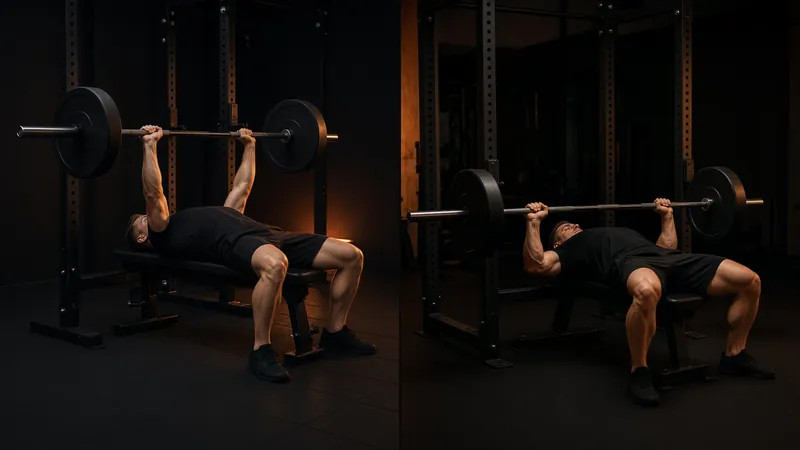
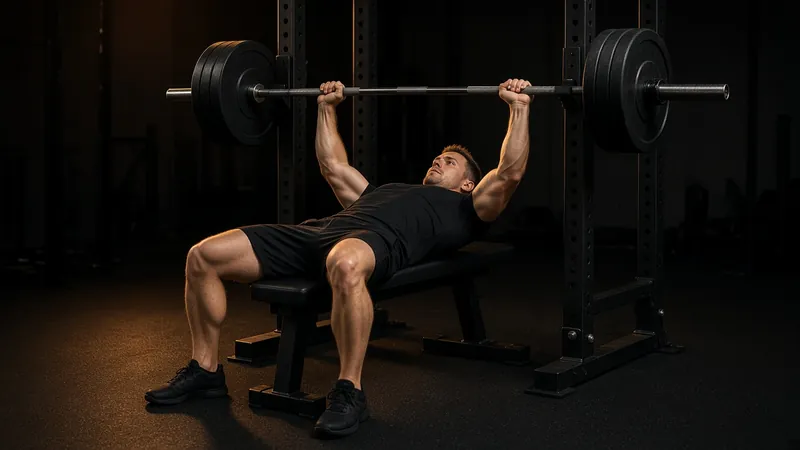
- Lie on the bench with your eyes roughly under the bar.
- Grip the bar slightly wider than shoulder-width — about where your forearms are vertical when the bar touches your chest.
- Pull your shoulder blades back and down and keep them pinned to the bench. A small natural arch in the lower back is fine; your glutes stay on the bench.
- Plant your feet firmly on the floor, slightly behind your knees if comfortable, and press through them.
- Unrack with straight arms and move the bar until it sits over your shoulders. Always use a spotter or safety arms for heavy sets.
Step by step
- Breathe and brace: take a breath into your chest and belly and hold it.
- Lower under control: bring the bar down in a slight diagonal to your lower chest / sternum, elbows about 45–70° from your torso.
- Touch: lightly touch the chest — no bouncing.
- Press: drive the bar up and slightly back toward your shoulders, pushing your feet into the floor.
- Lock out with the bar over your shoulders, then breathe and repeat.
Coaching cues
- “Bend the bar” — screw your hands into it to engage your lats.
- “Shoulder blades in your back pockets.”
- “Leg drive: push the floor away.”
- “Press back toward your face.”
Common mistakes and fixes
Variations
| Variation | Why use it |
|---|---|
| Incline bench press | Bench at 15–45°; puts more emphasis on the upper chest and front delts. |
| Dumbbell bench press | Greater range of motion and stretch, and each arm works independently. |
| Close-grip bench press | Shoulder-width grip; more triceps involvement. |
| Paused bench press | 1–2 s pause on the chest; builds control and strength from the bottom. |
| Machine chest press | Stable and easy to push close to failure safely. |
| Push-up | Bodyweight option; add load with a backpack or bands. |
How to program it
For muscle growth, use 3–4 sets of 5–12 reps with 1–3 reps in reserve and 2–3 minutes' rest. Combine it with an incline or dumbbell press for 10–20 weekly chest sets. Add weight in small steps (1–2.5 kg) once you hit the top of your rep range on every set. See the PPL program for a full push day.
Heavy or light for chest growth?
Evidence note: A meta-analysis comparing low- and high-load training found similar muscle growth across load ranges when sets were taken close to failure, while heavier loads produced greater maximal strength (Schoenfeld et al., 2017). For the bench press, that means you can build your chest with sets anywhere from about 5 to 15+ reps — use heavier sets if you also want a stronger 1RM.
Is the bench press enough for the chest?
It’s a great base, but most lifters benefit from adding an incline press and a fly or dumbbell exercise that stretches the chest more deeply. See how to structure your sets per week.
Reference
Schoenfeld BJ, Grgic J, Ogborn D, Krieger JW. Strength and Hypertrophy Adaptations Between Low- vs. High-Load Resistance Training: A Systematic Review and Meta-analysis. J Strength Cond Res. 2017;31(12):3508-3523. doi:10.1519/JSC.0000000000002200. PubMed: 28834797