Rest Times Between Sets: How Long Should You Rest for Muscle Growth?
How long to rest between sets for muscle growth: what 9+ trials show, why 2 minutes is a smart default, when 3+ minutes helps and how supersets save time.
Key takeaways
- Resting more than 60 seconds between sets gives a small hypertrophy benefit over very short rests (Singer et al., 2024).
- Beyond about 90 seconds, the extra growth from longer rest appears negligible on average.
- A practical default is about 2 minutes: 2–3 minutes for heavy compound lifts, 1–2 minutes for isolation exercises.
- Short rest hurts mainly because it reduces the reps and load you can do in later sets. If you keep your volume up, rest matters less (Longo et al., 2022).
- Supersets of non-competing exercises cut session time without reducing long-term muscle or strength gains (Zhang et al., 2025).
Rest periods are the most ignored variable in training. People plan sets, reps and exercises carefully, then rest “however long it takes to check my phone”.
Rest time matters because it controls how much you can lift in your next set. Too short, and your later sets fall apart. Too long, and your workouts drag on with no extra benefit. Here is what the research says, and how to set your rest timer.
The short answer
| Exercise type | Rest time | Why |
|---|---|---|
| Heavy compound lifts (squat, deadlift, bench press, rows) | 2–3 minutes (up to 5 for very heavy sets) | Big muscles, high systemic fatigue |
| Moderate compound lifts (lunges, machine presses, pulldowns) | 1.5–2.5 minutes | Balance of quality and time |
| Isolation exercises (curls, lateral raises, leg extensions) | 1–2 minutes | Small muscles recover faster |
| Supersets of non-competing muscles | 0–60 s between, ~1.5–2 min per pair | Each muscle still gets rest |
What the research says
Very short rest: a small cost
In an 8-week study, trained men did the same full-body program (3 × 8–12 reps, 7 exercises, 3 days per week) with either 1-minute or 3-minute rest. The 3-minute group gained more squat and bench press strength and more anterior thigh muscle thickness, with a trend for more triceps growth (Schoenfeld et al., 2016).
A 2017 systematic review concluded that both short and long rests can build muscle, with a possible advantage for longer rests in trained people (Grgic et al., 2017).
The 2024 meta-analysis: >60 s helps, >90 s adds little
The most complete analysis pooled 9 randomised studies (19 measurements) with Bayesian methods (Singer et al., 2024):
- Short rest (≤60 s) produced slightly less growth than longer rest, with central estimates favouring longer rest for the arms and thighs.
- There were no appreciable differences when resting longer than 90 seconds.
- Training to failure or not didn’t change this relationship.
The authors suggested the benefit of longer rest is mediated by volume load: with more rest, you lift more in later sets.
Rest vs volume: which really matters?
Longo et al. (2022) cleverly separated the two. Each leg trained with knee extensions at 80% 1RM using either 1-minute or 3-minute rest, and in two conditions the volume load was matched. Legs that did more total volume load grew about twice as much (about 13% vs 7%) regardless of rest interval. In other words: short rest is not harmful in itself, it’s harmful because it usually means less total work.
Longer than 2 minutes?
In trained men, 3-month blocks with 2 versus 5 minutes of rest produced similar muscle and strength gains (Ahtiainen et al., 2005). So beyond about 2 minutes, the benefits flatten out for most people and set types.
“Rest until ready”: the newest evidence
What if you just rest until you feel ready? A trial published in November 2026 randomised 40 trained adults to self-selected rest or a fixed ~2-minute rest for 8 weeks of lower-body training. Muscle growth, strength and endurance improved similarly, but the self-selected group’s workouts took about 29% longer (78.5 vs 56.0 minutes) (Mohan et al., 2026).
Takeaway: a 2-minute timer gives the same results as “resting until ready”, in much less time.
Why rest matters: the mechanism
Muscle growth depends largely on doing enough hard sets with enough load and reps. After a hard set close to failure:
- Your muscle’s ability to produce force drops temporarily.
- Energy stores (phosphocreatine) need time to recover, and metabolic by-products need time to clear.
- Your heart rate, breathing and general fatigue need to settle, especially after big lifts like squats.
If you start the next set too early, you get fewer reps at the same weight or need to use less weight. Over a whole workout, that means less total productive work. The “metabolic stress” from short rest does not appear to make up for it.
How to use rest periods in practice
A simple rule
Start your next set when your breathing has settled and you could repeat your previous performance (within 1–2 reps). For most people, that’s about 2 minutes on big lifts and 60–90 seconds on small ones. Then use a timer to stay consistent.
Let rest depend on the set, not the program
| If… | Then… |
|---|---|
| Your reps drop by 3+ from set 1 to set 2 | Rest longer |
| Your heart rate is still pounding | Rest longer |
| You’re doing heavy sets of 3–6 reps | Rest 3–5 minutes |
| You’re short of time | Use supersets, not shorter rests for the same muscle |
| You’re in a deficit or older | Expect to need a bit more rest |
Track rest like you track weight
If one week you rest 90 seconds and the next 3 minutes, your logbook comparisons are useless. Pick standard rests per exercise and keep them stable so you can see real progressive overload.
Supersets: save time without losing gains
If time is your problem, the best solution is not cutting rest but pairing exercises for different muscles. A 2025 meta-analysis of 19 studies (313 participants) found that supersets shortened sessions and improved training efficiency, with similar long-term gains in strength and hypertrophy compared with traditional sets (Zhang et al., 2025).
There are caveats:
- Agonist–antagonist pairs (e.g. biceps curl + triceps pushdown; row + bench press) maintained volume best.
- Pairing exercises for the same muscle reduced volume load.
- Supersets felt harder (higher ratings of perceived exertion), and the authors noted they may call for a little more recovery between sessions.
Good superset pairs:
| Pair | Why it works |
|---|---|
| Bench press + chest-supported row | Push/pull, minimal overlap |
| Leg curl + overhead triceps extension | Different body parts |
| Lateral raise + calf raise | Small muscles, low fatigue |
| Biceps curl + triceps pushdown | Classic antagonist pair |
| Pull-up + dips | Upper body push/pull |
Avoid pairing squats with deadlifts, or anything that taxes your lower back and grip twice.
Special cases
Drop sets, myo-reps and rest-pause
These deliberately use very short rests within a set extension. They can be time-efficient ways to add hard work for a muscle, especially on isolation exercises. They are not a reason to cut rest between your regular sets. See our guides to myo-reps and rest-pause training.
Heavy strength work
For sets of 1–5 reps on big lifts, 3–5 minutes is common and sensible, because strength is very sensitive to recovery between sets.
Circuit and “conditioning” style training
Short-rest circuits improve conditioning and burn more energy per minute, but they are a poor primary tool for maximum hypertrophy. If you want both, keep your main hypertrophy work with normal rests and add conditioning separately.
How rest time changes your session length
Rest is usually the biggest part of a workout. For a session of 16 working sets (about 40 seconds of lifting each):
| Rest per set | Approximate session time (working sets only) |
|---|---|
| 1 minute | ~27 minutes |
| 2 minutes | ~43 minutes |
| 3 minutes | ~59 minutes |
| 2 minutes, done as 8 supersets (2 min per pair) | ~27 minutes |
That is why the 2-minute default works so well: it captures nearly all the hypertrophy benefit of longer rest, and supersets can win back the time when you need it.
Common rest-time mistakes
- Resting 30–45 seconds to “feel the pump”. It cuts the work you can do in later sets.
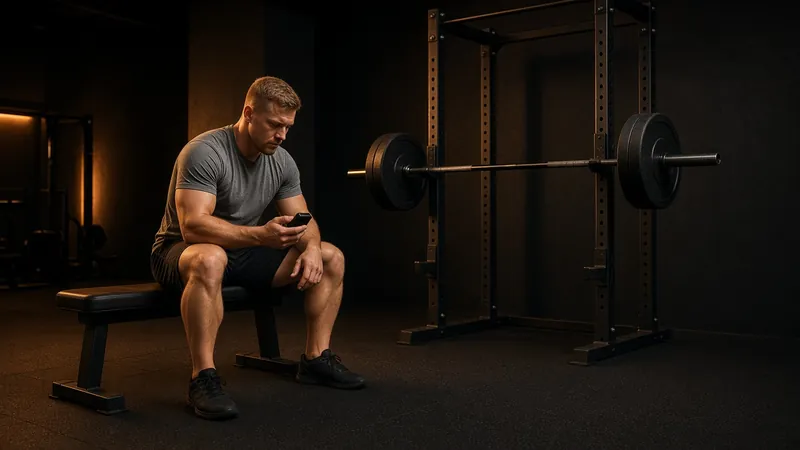
- Unlimited rest with your phone. Workouts last longer for no extra benefit.
- The same rest for squats and curls. Big lifts need longer.
- Inconsistent rests. Makes progress tracking unreliable.
- Cutting rest when time is short. Use supersets or fewer, harder sets instead. See how many sets per week.
FAQ
How long should I rest between sets to build muscle?
Rest at least 60–90 seconds; about 2 minutes is a smart default. Use 2–3 minutes for heavy compound lifts and 1–2 minutes for isolation exercises.
Is 1 minute of rest enough for hypertrophy?
It works, but it may produce slightly less growth than longer rests in trained people, mainly because you can lift less in later sets. If you use 1 minute, add sets to keep your total volume up.
Does resting longer than 3 minutes help?
For most hypertrophy training, not much. Trials comparing 2 and 5 minutes found similar results, and the meta-analysis found no appreciable benefit beyond about 90 seconds. For heavy strength sets, longer rests are useful.
Are supersets good for muscle growth?
Yes. Supersets of non-competing muscles save time and produce similar long-term hypertrophy and strength gains compared with traditional sets.
Should I just rest until I feel ready?
You can, but a 2026 trial found that a fixed 2-minute rest gave the same results with workouts about 29% shorter.
References
- Singer A, Wolf M, Generoso L, et al. Give it a rest: a systematic review with Bayesian meta-analysis on the effect of inter-set rest interval duration on muscle hypertrophy. Front Sports Act Living. 2024;6:1429789. doi:10.3389/fspor.2024.1429789. PubMed: 39205815 ↩
- Schoenfeld BJ, Pope ZK, Benik FM, et al. Longer Interset Rest Periods Enhance Muscle Strength and Hypertrophy in Resistance-Trained Men. J Strength Cond Res. 2016;30(7):1805-12. doi:10.1519/JSC.0000000000001272. PubMed: 26605807 ↩
- Grgic J, Lazinica B, Mikulic P, et al. The effects of short versus long inter-set rest intervals in resistance training on measures of muscle hypertrophy: A systematic review. Eur J Sport Sci. 2017;17(8):983-993. doi:10.1080/17461391.2017.1340524. PubMed: 28641044 ↩
- Longo AR, Silva-Batista C, Pedroso K, et al. Volume Load Rather Than Resting Interval Influences Muscle Hypertrophy During High-Intensity Resistance Training. J Strength Cond Res. 2022;36(6):1554-1559. doi:10.1519/JSC.0000000000003668. PubMed: 35622106 ↩
- Ahtiainen JP, Pakarinen A, Alen M, et al. Short vs. long rest period between the sets in hypertrophic resistance training: influence on muscle strength, size, and hormonal adaptations in trained men. J Strength Cond Res. 2005;19(3):572-82. doi:10.1519/15604.1. PubMed: 16095405 ↩
- Mohan AE, Piñero A, Coleman M, et al. Freedom of Choice? Effects of Self-Selected Rest Intervals on Muscular Adaptations. Int J Sports Med. 2026. Online ahead of print. doi:10.1055/a-2999-0052. PubMed: 42994440 ↩
- Zhang X, Weakley J, Li H, et al. Superset Versus Traditional Resistance Training Prescriptions: A Systematic Review and Meta-analysis Exploring Acute and Chronic Effects on Mechanical, Metabolic, and Perceptual Variables. Sports Med. 2025;55(4):953-975. doi:10.1007/s40279-025-02176-8. PubMed: 39903375 ↩