Pull-Up
How to do a pull-up with good form: setup, step-by-step technique, coaching cues, common mistakes, muscles worked, variations and progressions from your first rep to weighted pull-ups.
Primary muscles
Secondary muscles
Equipment
Pull-up bar (bands or assisted machine optional)
Level
Intermediate (with beginner progressions)
Setup
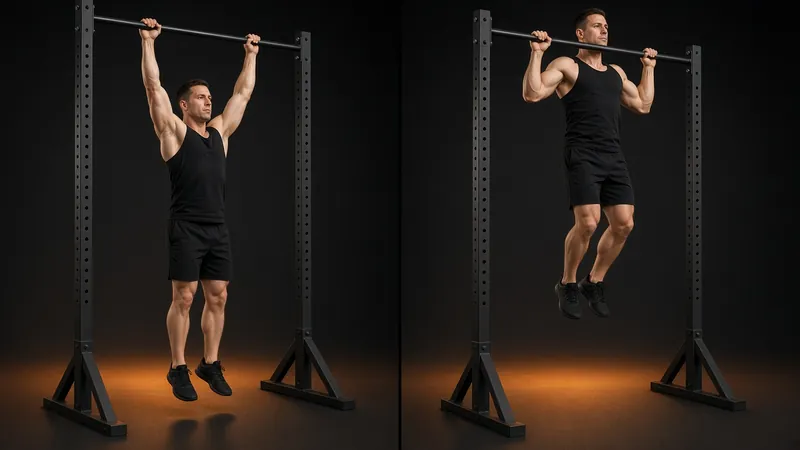
- Grip the bar with palms facing away, hands slightly wider than shoulder-width.
- Hang with straight arms. Let your shoulders rise toward your ears for a full stretch of the lats.
- Squeeze your glutes and brace your core; legs straight or crossed at the ankles. Avoid swinging.
Step by step
- Set the shoulders: start by pulling your shoulder blades slightly down and back without bending your elbows.
- Pull: drive your elbows down toward your back pockets, keeping your chest up.
- Finish: pull until your chin clears the bar — or your upper chest approaches it.
- Lower under control: take 2–3 seconds to return to a full dead hang.
- Pause briefly at the bottom and repeat without kipping.
Coaching cues
- “Elbows to your back pockets.”
- “Chest to the bar.”
- “Squeeze the bar hard.”
- “Stay long and tight — no swinging.”
Common mistakes and fixes
Variations
| Variation | Why use it |
|---|---|
| Chin-up | Palms facing you; more biceps involvement and usually easier. |
| Neutral-grip pull-up | Palms facing each other; often the most shoulder-friendly. |
| Band-assisted or machine-assisted pull-up | Reduces the load so you can practise full reps. |
| Negative (eccentric) pull-up | Jump to the top and lower slowly for 3–5 seconds — a classic beginner progression. |
| Weighted pull-up | Add load with a dip belt or vest once you can do 10+ clean reps. |
| Lat pulldown | Machine alternative that's easy to load and progress. |
How to program it
Use 3–4 sets of 5–12 reps close to failure. If you can't do 5 reps, start with negatives or assisted reps (3–4 sets of 5–8). Once you can do 3 × 10 clean reps, add 2.5 kg and build back up. Pair with rows for complete back development — see Pull A in our PPL program.
How to get your first pull-up
- Dead hangs: 3 × 20–30 seconds to build grip and shoulder tolerance.
- Scapular pulls: from a dead hang, pull your shoulder blades down without bending your arms — 3 × 8.
- Negatives: 3–5 sets of 3–5 slow reps.
- Assisted pull-ups: reduce the assistance over time.
How long it takes varies a lot with body weight and starting strength; practising two or three times a week and progressing steadily is what matters.
Should you switch grips often?
Evidence note: A systematic review on exercise variation found that planned variation (rotating a few exercises in a structured way) may help regional growth, but excessive, random variation can hurt progress (Kassiano et al., 2022). Pick one or two vertical pulls — for example, pull-ups and neutral-grip pulldowns — and stick with them for a full training block.
Reference
Kassiano W, Nunes JP, Costa B, et al. Does Varying Resistance Exercises Promote Superior Muscle Hypertrophy and Strength Gains? A Systematic Review. J Strength Cond Res. 2022;36(6):1753-1762. doi:10.1519/JSC.0000000000004258. PubMed: 35438660