Key takeaways
- Mechanical tension on muscle fibres is the main trigger for growth. Hard sets under load are how you deliver it (Wackerhage et al., 2019).
- Muscle damage is probably not essential for growth. Early in training, much of the extra protein synthesis goes to repair, not growth (Damas et al., 2016).
- Metabolic stress (the 'pump' and burn) may contribute, but the evidence is indirect.
- Hormone spikes after training are not related to how much muscle you gain (Morton et al., 2016).
- Growth is the sum of many small rises in protein synthesis after each workout, fed by protein, across months. People differ a lot in how fast they respond.
Every training decision, from your rep range to your rest times, is a bet on how muscle actually grows. If you understand the biology, you can tell good advice from nonsense on your own.
This guide explains muscle growth (hypertrophy) in plain English: what’s inside a muscle, what signals make it grow, the three “mechanisms” you’ve heard of and how much each really matters, and what this means for your training. Where the science is still unsettled, we say so. If you would rather start with the practical side, read how to build muscle as a beginner first and come back here for the biology.
Inside a muscle
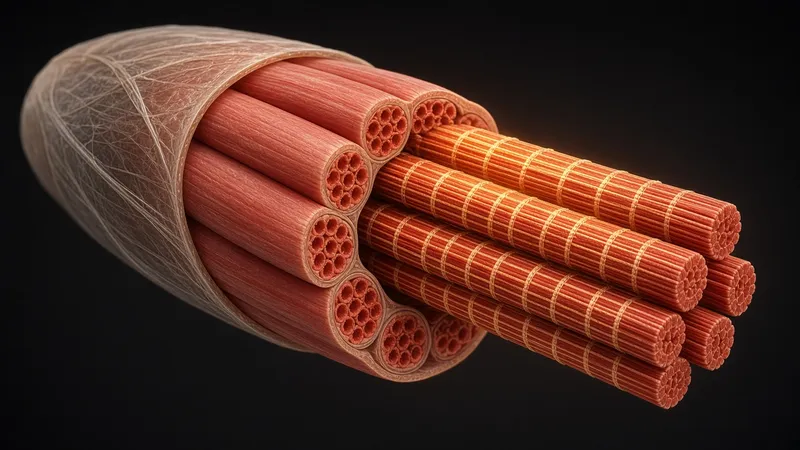
| Level | What it is | Size |
|---|---|---|
| Muscle | e.g. biceps, quadriceps | cm |
| Fascicle | A bundle of muscle fibres | mm |
| Muscle fibre | One long muscle cell with many nuclei | 0.05–0.1 mm wide |
| Myofibril | Chains of contractile units inside the fibre | ~1 µm |
| Sarcomere | The contractile unit: actin and myosin filaments that slide and pull | ~2–3 µm long |
When a muscle “grows”, mostly the fibres get thicker: more contractile protein is added, in parallel. You don’t gain many (if any) new fibres in adulthood; you make the ones you have bigger.
Muscle fibres have many nuclei
Muscle fibres are unusual cells with hundreds of nuclei. Each nucleus “manages” a region of the fibre. When fibres grow a lot, they can add nuclei from satellite cells, stem cells that sit on the fibre surface. Mechanistic reviews list satellite cells and new nuclei among the processes involved in hypertrophy (Roberts et al., 2023).
Types of hypertrophy
- Myofibrillar hypertrophy: more contractile proteins and myofibrils. This is the classic model.
- Sarcoplasmic hypertrophy: growth of the fluid and non-contractile parts of the fibre. A critical review found that myofibrillar protein can be diluted as fibres grow, and that different measurements of hypertrophy often correlate poorly with each other (Haun et al., 2019).
Takeaway: “muscle size” is measured in many ways (ultrasound, MRI, biopsies, DXA), and they don’t always agree. Treat any single study’s percentage with some caution.
How a workout turns into growth
- Stimulus. Hard sets put muscle fibres under high mechanical tension.
- Sensing. Sensors in and around the fibres detect that tension and convert it to chemical signals (mechanotransduction).
- Signalling. Pathways such as mTORC1 switch on. mTORC1-driven increases in muscle protein synthesis (MPS) are the key, but not the only, mechanism of hypertrophy (Wackerhage et al., 2019).
- Building. For a day or two after training, MPS rises above breakdown, especially when you eat protein. In one classic study, MPS more than doubled at 24 hours and was almost back to baseline by 36 hours (MacDougall et al., 1995).
- Accumulation. Each workout adds a little protein. Over weeks and months, the small gains add up to visible growth.
That’s why consistency, progressive overload and daily protein intake matter more than any single workout.
The “three mechanisms”: what the evidence says
A 2010 review proposed three main drivers of muscle growth: mechanical tension, muscle damage and metabolic stress (Schoenfeld, 2010). This model shaped a decade of training advice. Here’s how each has held up.
1. Mechanical tension: the main driver
Tension is the force fibres experience when they contract against a load. A 2019 review concluded that mechanical signals are the prime candidates for the hypertrophy stimulus, with proposed sensors including a filamin-C–BAG3 system and structures that anchor fibres to their surroundings (costameres) (Wackerhage et al., 2019). The exact sensor is still not fully characterised.
What this means in practice:
- Load matters less than you’d think, effort matters a lot. When sets are taken to failure, light loads (30–50% of 1RM, 20–25 reps) and heavier loads (75–90% 1RM, 8–12 reps) produced similar growth in trained men over 12 weeks (Morton et al., 2016). Near failure, fibres of all sizes are recruited and work hard, whatever the load.
- But there’s a floor. When volume load was matched, training at 20% 1RM grew muscle about half as much as 40–80% 1RM (Lasevicius et al., 2018). Very light loads struggle to produce enough tension even near failure.
- Proximity to failure matters. Growth increases as sets end closer to failure (Robinson et al., 2024). See failure vs RIR.
2. Muscle damage: probably not required
The soreness and microscopic damage after unfamiliar training were once thought to drive growth. Current evidence says otherwise:
- In untrained men, the biggest rise in protein synthesis came in the first week of training, when muscle damage was highest. But that rise was not related to growth. Only after damage had faded (weeks 3 and 10) did protein synthesis correlate strongly with hypertrophy (Damas et al., 2016).
- A major review concluded that exercise-induced muscle damage is probably not essential for hypertrophy, and it’s unclear whether it adds anything (Wackerhage et al., 2019).
Practical point: soreness is not a measure of a good workout. Chasing it wastes recovery on repair.
3. Metabolic stress: a possible contributor
Metabolic stress is the build-up of metabolites (like lactate and hydrogen ions) during high-rep sets with short rest, felt as “the burn” and “the pump”. The strongest hint that it matters comes from blood flow restriction (BFR) training, where light loads with restricted blood flow can produce growth. But the evidence that metabolites are themselves a growth signal is indirect, and the candidate metabolites are poorly characterised (Wackerhage et al., 2019).
Supporting this cautious view: when total work is equal, short rest periods that maximise metabolic stress don’t build more muscle, and resting too briefly tends to reduce growth because you do less work. See rest times between sets.
Summary table
| Mechanism | Role in growth | Confidence | Training implication |
|---|---|---|---|
| Mechanical tension | Primary driver | High | Hard sets, progressive load or reps, full range of motion |
| Muscle damage | Probably not required; may compete for resources | Moderate | Don’t chase soreness; progress volume gradually |
| Metabolic stress | Possible contributor, mainly at light loads/BFR | Low–moderate | Pumps are fine but not a target in themselves |
Net protein balance: the real equation
Muscle protein is constantly being built (synthesis) and broken down (breakdown). Your muscle grows only when, averaged over days and weeks, synthesis exceeds breakdown.
| Situation (simplified) | Synthesis | Breakdown | Net effect |
|---|---|---|---|
| Fasted, no training | Low | Higher | Small loss |
| Protein meal, no training | Rises briefly | Falls slightly | Small, temporary gain |
| Hard training, fasted | Rises | Rises | Roughly neutral |
| Hard training + protein over the day | Rises most, for longer | Moderate | Gain |
Two practical implications:
- Training and protein work together. Training appears to make your muscles more sensitive to the protein you eat for the following day or so, and protein provides the building blocks. That’s why our protein guide focuses on total daily intake spread over several meals.
- A big energy deficit makes this harder. When you’re dieting hard, breakdown tends to win more often, which is why muscle retention needs high protein and continued hard training. See body recomposition and lean bulking.
Why volume matters: more signals, diminishing returns
If every hard set sends a growth signal, more sets should mean more growth, up to a point. A 2026 meta-regression of 67 studies found exactly that: muscle growth increased with weekly set volume, with diminishing returns at higher volumes. Frequency, on the other hand, had little independent effect once volume was accounted for (Pelland et al., 2026).
Biologically, that fits: more hard sets mean more tension-driven signalling, but recovery capacity and fatigue limit how many sets stay productive. Our sets per week guide turns this into numbers.
Hormones: less important than you think
Many lifters still believe that a big post-workout surge in testosterone or growth hormone is what builds muscle (hence advice like “train legs to boost hormones”). In 49 trained men over 12 weeks, the acute post-exercise rise in hormones did not correlate with gains in muscle or strength (Morton et al., 2016).
Baseline hormone levels across the normal range, nutrition and sleep still matter for overall health and recovery. But the short spike after a workout is not the growth signal. The signal is local: in the muscle you trained.
Why some people grow faster
In a study of 585 men and women training their arms for 12 weeks, changes in biceps size ranged from −2% to +59% (Hubal et al., 2005). In a pooled analysis of 287 untrained adults aged 19 to 78, muscle size changes ranged from −11% to +30%, and age and sex did not change the size of the response (Ahtiainen et al., 2016).
Reasons include genetics, baseline muscle size, fibre type, how many nuclei and satellite cells you have, sleep, nutrition and how closely the training matched your needs. Some “low responders” may just need more volume or a different approach.
What to do with this: don’t judge your program by someone else’s results. Track your own measurements and lifts, and if nothing changes in 8–12 weeks of consistent hard training, change one variable (often weekly sets).
How fast does muscle grow, and does it stop?
A review of studies with repeated measurements found that muscle growth starts sooner than once thought (often detectable within a few weeks) and differs between muscle groups. It also suggested that growth can plateau during a training program, although the studies were short (Counts et al., 2017).
In practice, growth is fastest in your first year or two of training and slows as you approach your genetic potential. That’s why advanced lifters need more planning: progressive overload, well-chosen volume and good training frequency.
Turning the science into training
| Science | Do this |
|---|---|
| Tension is the main stimulus | Do sets that end within about 0–3 reps of failure |
| Load range is wide if effort is high | Use roughly 5–30 reps per set; avoid very light loads (~20% 1RM) as your main work. See best rep range |
| Growth accumulates workout by workout | Progress reps, load or sets over time |
| MPS stays elevated ~1–2 days | Train each muscle about twice a week |
| MPS needs amino acids | Eat about 1.6 g/kg of protein per day (up to 2.2 g/kg) |
| Damage isn’t the goal | Increase volume gradually; ignore soreness as a metric |
| Individual responses vary | Track and adjust instead of copying others |
Common myths about muscle growth
- “Muscles grow in the gym.” The workout is the signal; growth happens during the hours and days after, if you eat and recover.
- “No soreness, no growth.” Soreness reflects unfamiliar work and damage, not growth.
- “You need heavy weights to grow.” You need hard sets. Moderate and light loads (down to about 30% 1RM) work when taken close to failure.
- “Post-workout hormones build muscle.” The acute spike isn’t related to growth in trained people.
- “Muscle turns into fat if you stop.” They’re different tissues. You can lose muscle and gain fat, but one does not become the other.
FAQ
What is the main cause of muscle growth?
Mechanical tension: muscle fibres working hard against resistance. Taking sets close to failure ensures your fibres experience enough tension, whatever the load.
Does muscle soreness mean muscle growth?
No. Soreness reflects muscle damage, mostly from unfamiliar exercise. Research suggests damage is not essential for growth and may divert early protein synthesis toward repair.
How long does it take for muscle to grow?
Changes can be measured within a few weeks of starting, but visible growth usually takes 2–3 months of consistent hard training and adequate protein.
Do you get new muscle fibres when you lift weights?
Mostly no. Adults grow by making existing fibres bigger. Satellite cells can add new nuclei to growing fibres.
What is sarcoplasmic hypertrophy?
Growth of the non-contractile parts of muscle fibres, such as fluid and stored energy. Research suggests it occurs to some degree, but how much it contributes is still debated.
References
- Wackerhage H, Schoenfeld BJ, Hamilton DL, et al. Stimuli and sensors that initiate skeletal muscle hypertrophy following resistance exercise. J Appl Physiol (1985). 2019;126(1):30-43. doi:10.1152/japplphysiol.00685.2018. PubMed: 30335577
- Roberts MD, McCarthy JJ, Hornberger TA, et al. Mechanisms of mechanical overload-induced skeletal muscle hypertrophy: current understanding and future directions. Physiol Rev. 2023;103(4):2679-2757. doi:10.1152/physrev.00039.2022. PubMed: 37382939 ↩
- Haun CT, Vann CG, Roberts BM, et al. A Critical Evaluation of the Biological Construct Skeletal Muscle Hypertrophy: Size Matters but So Does the Measurement. Front Physiol. 2019;10:247. doi:10.3389/fphys.2019.00247. PubMed: 30930796 ↩
- MacDougall JD, Gibala MJ, Tarnopolsky MA, et al. The time course for elevated muscle protein synthesis following heavy resistance exercise. Can J Appl Physiol. 1995;20(4):480-6. doi:10.1139/h95-038. PubMed: 8563679 ↩
- Schoenfeld BJ. The mechanisms of muscle hypertrophy and their application to resistance training. J Strength Cond Res. 2010;24(10):2857-72. doi:10.1519/JSC.0b013e3181e840f3. PubMed: 20847704 ↩
- Morton RW, Oikawa SY, Wavell CG, et al. Neither load nor systemic hormones determine resistance training-mediated hypertrophy or strength gains in resistance-trained young men. J Appl Physiol (1985). 2016;121(1):129-38. doi:10.1152/japplphysiol.00154.2016. PubMed: 27174923
- Lasevicius T, Ugrinowitsch C, Schoenfeld BJ, et al. Effects of different intensities of resistance training with equated volume load on muscle strength and hypertrophy. Eur J Sport Sci. 2018;18(6):772-780. doi:10.1080/17461391.2018.1450898. PubMed: 29564973 ↩
- Robinson ZP, Pelland JC, Remmert JF, et al. Exploring the Dose-Response Relationship Between Estimated Resistance Training Proximity to Failure, Strength Gain, and Muscle Hypertrophy: A Series of Meta-Regressions. Sports Med. 2024;54(9):2209-2231. doi:10.1007/s40279-024-02069-2. PubMed: 38970765 ↩
- Damas F, Phillips SM, Libardi CA, et al. Resistance training-induced changes in integrated myofibrillar protein synthesis are related to hypertrophy only after attenuation of muscle damage. J Physiol. 2016;594(18):5209-22. doi:10.1113/JP272472. PubMed: 27219125 ↩
- Hubal MJ, Gordish-Dressman H, Thompson PD, et al. Variability in muscle size and strength gain after unilateral resistance training. Med Sci Sports Exerc. 2005;37(6):964-72. PubMed: 15947721 ↩
- Ahtiainen JP, Walker S, Peltonen H, et al. Heterogeneity in resistance training-induced muscle strength and mass responses in men and women of different ages. Age (Dordr). 2016;38(1):10. doi:10.1007/s11357-015-9870-1. PubMed: 26767377 ↩
- Counts BR, Buckner SL, Mouser JG, et al. Muscle growth: To infinity and beyond? Muscle Nerve. 2017;56(6):1022-1030. doi:10.1002/mus.25696. PubMed: 28543604 ↩
- Pelland JC, Remmert JF, Robinson ZP, et al. The Resistance Training Dose Response: Meta-Regressions Exploring the Effects of Weekly Volume and Frequency on Muscle Hypertrophy and Strength Gains. Sports Med. 2026;56(2):481-505. doi:10.1007/s40279-025-02344-w. PubMed: 41343037 ↩