Leg Press
How to do the 45° leg press: setup, step-by-step technique, how deep to go, what foot placement really changes, seat angle, common mistakes, leg press vs squat research, variations and programming for the quads and glutes.
Primary muscles
Secondary muscles
Equipment
45° plate-loaded leg press (a horizontal or selectorised leg press works the same way)
Level
Beginner–advanced
Setup
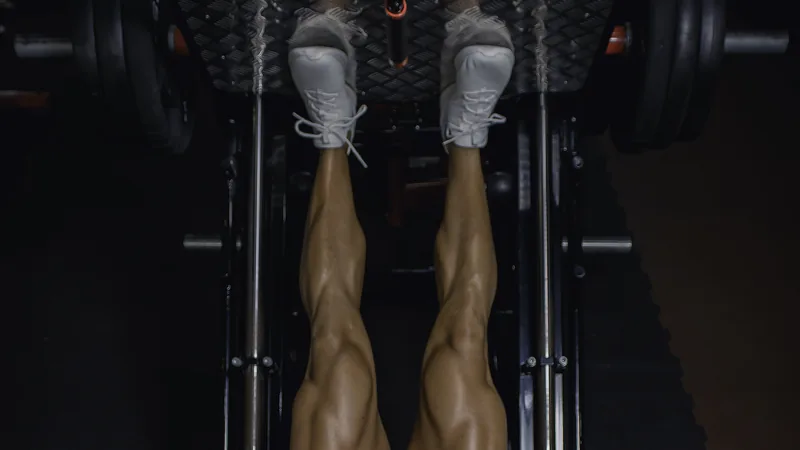
- Set the backrest so you can bring your knees deep towards your chest without your hips curling off the pad. Most people do best with the backrest at a middle setting.
- Sit with your lower back and hips firmly against the pad. Place your feet flat in the middle of the platform, about hip to shoulder width apart, toes turned out slightly.
- Grip the handles beside the seat. Press the platform up a little and release the safety catches.
- Set the safety stops just below the deepest point you plan to reach, if the machine has them.
Step by step
- Lower under control by bending your knees and hips. Take about 2 seconds and keep your knees pointing the same way as your toes.
- Go deep: stop when your thighs are close to your chest or just before your hips start to lift and your lower back rounds off the pad.
- Press the platform away through your whole foot, mid-foot to heel, without letting your heels lift.
- Stop just short of hard lockout at the top, then start the next rep. Keep your hips on the seat the whole time.
Coaching cues
- “Hips glued to the pad.”
- “Knees out over the toes.”
- “Push through the whole foot.”
- “Soft knees at the top.”
Common mistakes and fixes
Variations
| Variation | Why use it |
|---|---|
| Feet high and wide | More hip bend, so a little more glute and hamstring work. A good default for lifters with long legs or stiff ankles. |
| Feet low and narrow | More knee bend, so more quad emphasis. Needs good ankle and knee comfort. |
| Single-leg leg press | Fixes side-to-side differences and needs half the load. Keep the hips square. |
| Horizontal or selectorised leg press | Lighter loads and quick to adjust. Same technique; depth is limited by the machine. |
| Hack squat | A similar machine squat with the back supported. More upright torso, often more quad emphasis. |
How to program it
Use 3–4 sets of 8–15 reps with 0–2 reps in reserve and 2 minutes' rest. Because the back is supported and the load can't fall on you, the leg press is a good place to train close to failure. Put it first on a leg day for quad growth, or after squats as a second quad exercise, and pair it with a hinge like the Romanian deadlift and a leg curl for the hamstrings. Count each set as a hard set for the quads and half a set for the glutes; see fractional sets.
Leg press or squat for leg growth?
The leg press has a reputation as the “easy” alternative to the squat. For muscle growth, that reputation isn’t deserved.
- In 8 untrained women, one leg trained with an inclined leg press and the other with lunges for 9 weeks. Growth of the vastus lateralis and rectus femoris did not differ between the two legs at any of the measured sites (Amanuma et al., 2025).
- A 2023 meta-analysis of free-weight versus machine training found no difference in muscle growth between the two (Haugen et al., 2023). Our guide to machines vs free weights covers the details.
- In a 10-week trial comparing squats only, leg presses only and both, squat training transferred better to squat strength, while effect sizes for jump height favoured the squat groups and those for dynamic balance favoured the leg press groups; none of these functional differences was statistically significant (Rossi et al., 2018).
The back squat still gets more muscle activity. In 10 experienced lifters, the squat produced more quadriceps and hamstring activity and higher knee forces than leg presses with the feet high or low (Escamilla et al., 2001). An earlier study by the same group found that the squat produced about twice the hamstring activity of the leg press (Escamilla et al., 1998). But muscle activity in one set isn’t the same as growth over weeks, and the leg press has practical advantages: no balance demand, little load on the lower back and an easy way to train close to failure.
Evidence note (moderate): the leg-press-versus-squat data come from short trials, often in untrained people, plus single-session EMG studies. The leg press clearly builds the quads; whether it matches the squat for every muscle over long periods hasn’t been tested.
What the leg press doesn’t train well
Like the squat, the leg press trains the rectus femoris (the quad muscle that also crosses the hip) less than the other quad heads. Full squats grew the vasti, glutes and adductors over 10 weeks but did not grow the rectus femoris or hamstrings (Kubo et al., 2019), while knee extensions grew the rectus femoris relatively more than the vasti (Ema et al., 2013). Add leg extensions for the whole quad and a leg curl or Romanian deadlift for the hamstrings.
Foot placement: what it really changes
Foot position on the platform matters less than most gym advice suggests.
- High vs low: in 14 women, the rectus femoris and vastus lateralis were more active with the feet low on the platform, and the glutes more active with the feet high, at heavy loads (Da Silva et al., 2008).
- Wide vs narrow: a wide stance with the feet high produced more hamstring activity than a narrow stance with the feet high (Escamilla et al., 2001).
- Toes out vs straight: turning the feet out 30° changed neither muscle activity nor knee forces (Escamilla et al., 2001). In trained men and women on an inclined leg press, neither stance width (hip width or 1.5 times hip width) nor foot rotation (0° or 45°) changed muscle activity (Martín-Fuentes et al., 2022).
The practical rule: pick the foot position that lets you go deepest with your hips on the pad and your knees comfortable. For most people that’s the middle of the platform, about hip to shoulder width. Moving the feet higher shifts some work to the glutes; moving them lower shifts some to the quads, but both changes are small compared with depth and effort.
How deep should you go?
Deep. In squat studies, a deep range grew the glutes and adductors clearly more than a half-range (6.7% vs 2.2% for the glutes over 10 weeks), with similar quad growth (Kubo et al., 2019). Deep squats also grew the front thigh more than shallow squats over 12 weeks (Bloomquist et al., 2013). We assume the same applies to the leg press, but no leg-press-specific depth trial exists. In trained men, partial reps in the deep half of the leg press (together with leg extensions and leg curls) grew the vastus lateralis about as much as full reps (Plotkin et al., 2026), which suggests that the deep part of the rep is the part that counts.
Your depth limit is the point where your hips start to curl off the pad. Past that, the lower back rounds under load. A steeper backrest angle or a slightly higher foot position usually buys a few more centimetres. More on this in our guide to range of motion.
Seat angle
In 15 trained men, opening the angle between seat and backrest from 90° to 125° increased hip movement and vastus lateralis activity and lowered biceps femoris activity; glute activity didn’t change (Marchetti et al., 2023). Small differences like this matter less than reaching a deep, controlled range with the setting you use.
Safety and blood pressure
The leg press is one of the safest heavy exercises, but two points matter.
- Don’t lock the knees hard under heavy loads. Finish each rep with a slight bend.
- Blood pressure rises steeply during heavy sets. In a study with direct arterial measurements, a brief breath-hold (Valsalva manoeuvre) was unavoidable above about 80% of maximal effort, and the rise in blood pressure followed effort, not the actual force produced (MacDougall et al., 1992). That is normal for healthy people. If you have high blood pressure, heart disease or another medical condition, ask your doctor before doing heavy, grinding sets.
How many sets?
Leg pressing counts towards your weekly quad sets like any other squat pattern: count each set as one hard set for the quads and half a set for the glutes. For most lifters, 2–4 sets once or twice a week, alongside a squat or split squat, is plenty. In young women, rotating the leg press with a hack squat and Smith machine squat gave the same quad growth as doing the leg press every session (Kassiano et al., 2025), so you can vary the exercise without losing gains.
FAQ
Is the leg press as good as squats for building legs?
For quad growth, it appears to be similar; trials comparing machines and free weights found no difference in muscle growth. Squats transfer better to squat strength and train the hamstrings and trunk more. Many lifters do both.
What foot position on the leg press is best for glutes?
Feet higher on the platform gives slightly more glute activity, but depth matters more. Go as deep as you can with your hips on the pad; deep ranges grew the glutes much more than half reps in squat studies.
How deep should you go on the leg press?
Until your thighs are close to your chest or just before your hips curl off the pad and your lower back rounds. That is usually well below 90° of knee bend.
Should you lock your knees on the leg press?
No. Stop just short of a hard lockout. Keeping a slight bend at the top keeps tension on the quads and avoids slamming the knee joint under heavy load.
Is the leg press bad for your back?
Not when your hips stay on the pad. Problems come from going deeper than your hips allow, so the pelvis tucks and the lower back rounds under load. Stop the descent just before that point.
References
- Amanuma MT, Ikeda PLT, Sakamoto MT, et al. Comparable regional hypertrophy of the knee extensor muscles in response to resistance training with machines versus free weights: a randomized within-subject approach. J Bodyw Mov Ther. 2025;45:562-568. doi:10.1016/j.jbmt.2025.09.027. PubMed: 41316621
- Haugen ME, Vårvik FT, Larsen S, et al. Effect of free-weight vs. machine-based strength training on maximal strength, hypertrophy and jump performance - a systematic review and meta-analysis. BMC Sports Sci Med Rehabil. 2023;15(1):103. doi:10.1186/s13102-023-00713-4. PubMed: 37582807
- Rossi FE, Schoenfeld BJ, Ocetnik S, et al. Strength, body composition, and functional outcomes in the squat versus leg press exercises. J Sports Med Phys Fitness. 2018;58(3):263-270. doi:10.23736/S0022-4707.16.06698-6. PubMed: 27735888
- Escamilla RF, Fleisig GS, Zheng N, et al. Effects of technique variations on knee biomechanics during the squat and leg press. Med Sci Sports Exerc. 2001;33(9):1552-66. doi:10.1097/00005768-200109000-00020. PubMed: 11528346
- Escamilla RF, Fleisig GS, Zheng N, et al. Biomechanics of the knee during closed kinetic chain and open kinetic chain exercises. Med Sci Sports Exerc. 1998;30(4):556-69. doi:10.1097/00005768-199804000-00014. PubMed: 9565938
- Kubo K, Ikebukuro T, Yata H. Effects of squat training with different depths on lower limb muscle volumes. Eur J Appl Physiol. 2019;119(9):1933-1942. doi:10.1007/s00421-019-04181-y. PubMed: 31230110
- Ema R, Wakahara T, Miyamoto N, et al. Inhomogeneous architectural changes of the quadriceps femoris induced by resistance training. Eur J Appl Physiol. 2013;113(11):2691-703. doi:10.1007/s00421-013-2700-1. PubMed: 23949789
- Da Silva EM, Brentano MA, Cadore EL, et al. Analysis of muscle activation during different leg press exercises at submaximum effort levels. J Strength Cond Res. 2008;22(4):1059-65. doi:10.1519/JSC.0b013e3181739445. PubMed: 18545207
- Martín-Fuentes I, Oliva-Lozano JM, Muyor JM. Influence of Feet Position and Execution Velocity on Muscle Activation and Kinematic Parameters During the Inclined Leg Press Exercise. Sports Health. 2022;14(3):317-327. doi:10.1177/19417381211016357. PubMed: 34085847
- Bloomquist K, Langberg H, Karlsen S, et al. Effect of range of motion in heavy load squatting on muscle and tendon adaptations. Eur J Appl Physiol. 2013;113(8):2133-42. doi:10.1007/s00421-013-2642-7. PubMed: 23604798
- Plotkin DL, Tiede DR, Gotla T, et al. Acute Molecular and Chronic Vastus Lateralis Adaptations to Lengthened Partial versus Full Range of Motion Resistance Training in Trained Men. Med Sci Sports Exerc. 2026. Online ahead of print. doi:10.1249/MSS.0000000000004183. PubMed: 42841600
- Marchetti PH, Gomes WA, Da Silva JJ, et al. Backseat Inclination Affects the Myoelectric Activation During the Inclined Leg Press Exercise in Recreationally Trained Men. J Strength Cond Res. 2023;37(10):e541-e545. doi:10.1519/JSC.0000000000004504. PubMed: 37184975
- MacDougall JD, McKelvie RS, Moroz DE, et al. Factors affecting blood pressure during heavy weight lifting and static contractions. J Appl Physiol (1985). 1992;73(4):1590-7. doi:10.1152/jappl.1992.73.4.1590. PubMed: 1447109
- Kassiano W, Costa B, Kunevaliki G, et al. Muscle Hypertrophy and Strength Adaptations to Systematically Varying Resistance Exercises. Res Q Exerc Sport. 2025;96(2):371-381. doi:10.1080/02701367.2024.2409961. PubMed: 39388663