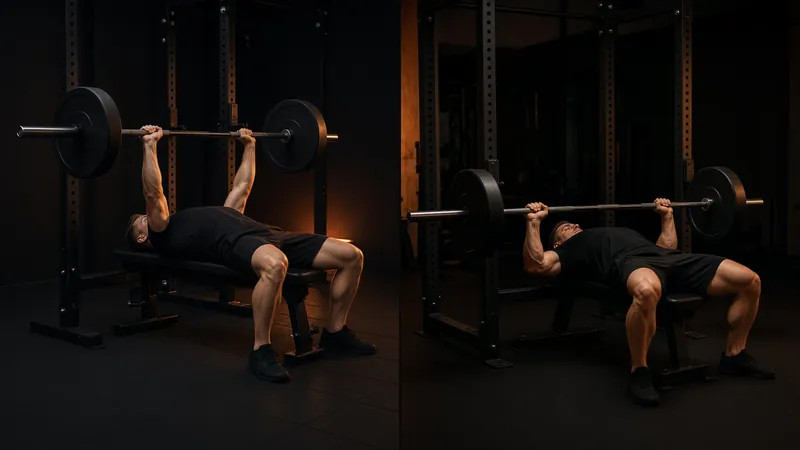
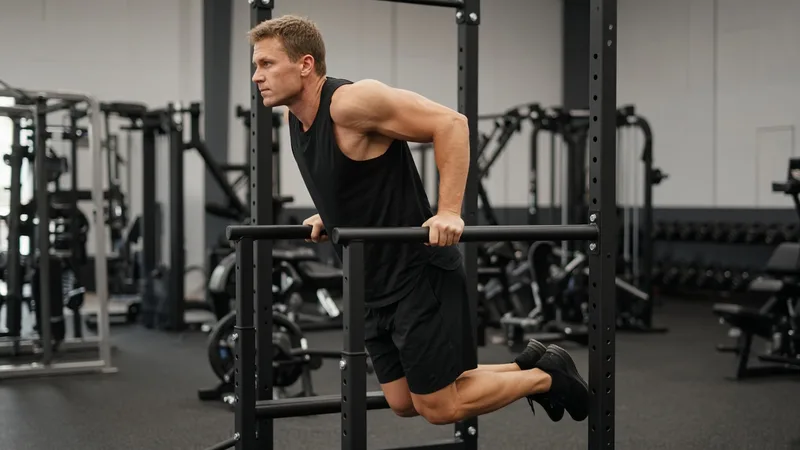
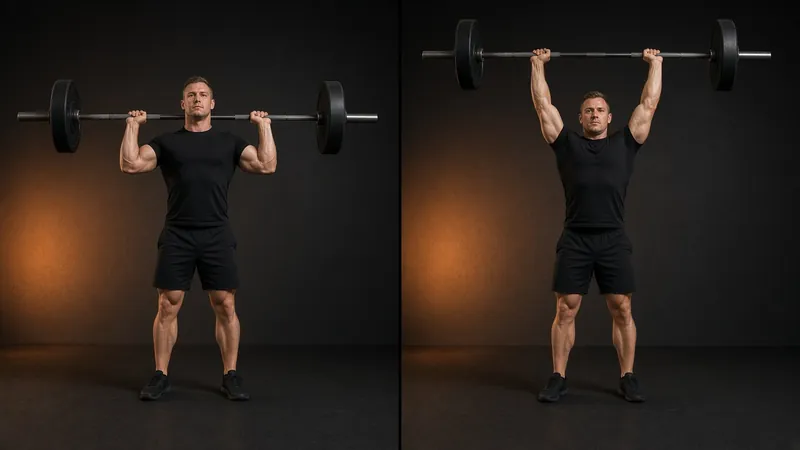
Incline Dumbbell Press
How to do the incline dumbbell press: the best bench angle for the upper chest, setup, step-by-step technique, form cues, common mistakes, variations, programming, and what the EMG and training studies actually show.
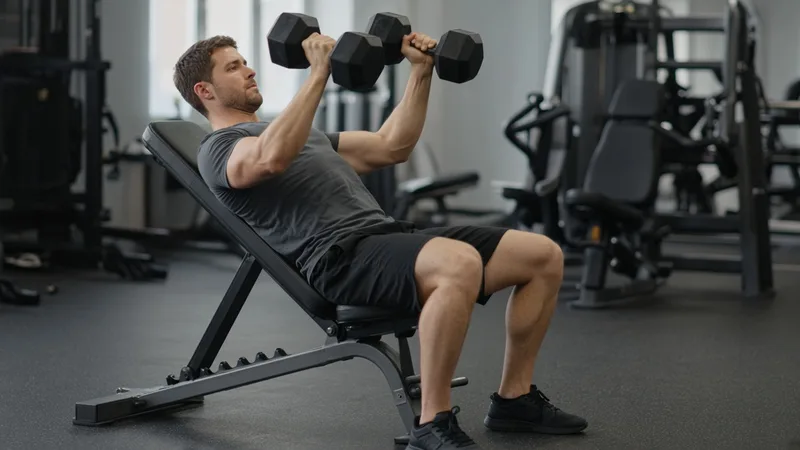
Primary muscles
Secondary muscles
Equipment
Two dumbbells and an adjustable bench; an incline bench in a rack works too
Level
Beginner–advanced
Setup
- Set an adjustable bench to a low incline, about 30 degrees (often the second or third notch). Higher angles shift more of the work to the front delts.
- Sit on the bench with a dumbbell on each thigh, close to the knee. Plant your feet flat and a little wider than hip width.
- Lie back and use your thighs to kick the dumbbells up one at a time as your back reaches the pad, so they arrive over your shoulders with straight arms.
- Pull your shoulder blades back and down into the bench and keep a small natural arch. Your head, upper back and glutes stay on the pad.
Step by step
- Start with the dumbbells over your upper chest, palms facing forward or turned slightly in, wrists stacked over the elbows.
- Lower under control for about two seconds. Let the elbows travel down and out at roughly 45–60 degrees from your torso, not flared straight out to the sides.
- Go deep: stop when the dumbbells are level with your upper chest and you feel a strong stretch across the pecs, without the shoulders rolling forward off the bench.
- Press up and slightly in until the arms are almost straight over the upper chest. The dumbbells come close but don't need to touch.
- Finish the set by bringing the dumbbells back to your thighs as you sit up, or lower them to the floor beside you with bent elbows. Don't drop them out wide from the top.
Coaching cues
- “Shoulder blades in your back pockets.”
- “Wrists over elbows the whole way.”
- “Deep stretch, then press up and in.”
- “Feet push the floor; butt stays on the bench.”
Common mistakes and fixes
Variations
| Variation | Why use it |
|---|---|
| Incline barbell press | Easier to load heavy and progress in small steps, but a shorter range at the bottom and a fixed hand position. |
| Low-incline (15 degree) dumbbell press | Sits between a flat and a 30-degree press. Good if steeper angles bother your shoulders. |
| Neutral-grip incline press | Palms facing each other. Often more comfortable for the shoulders, with a little more triceps work. |
| Incline machine or Smith press | No balance demand, so it's easy to take close to failure safely without a spotter. |
| Incline dumbbell fly or cable fly | An isolation option to add upper-chest volume without more triceps and shoulder work. |
How to program it
Use 3–4 sets of 6–12 reps with 1–2 reps in reserve and 2–3 minutes' rest. Put it first on an upper-chest focused day, or second after the bench press. Count each set as a hard chest set (and about half a set for the front delts and triceps) in your weekly volume. See the push/pull/legs and upper/lower programs for where it fits.
Does the incline press really hit the upper chest?
Yes, but less dramatically than gym folklore suggests. The pectoralis major has two main heads. The clavicular (upper) head attaches to the collarbone, and the sternocostal head makes up most of the chest. Tilting the bench moves the press closer to the line of the upper fibres.
Three lines of evidence point the same way:
- EMG at five angles. Rodríguez-Ridao et al. (2020) tested 30 trained adults at 60% of their one-rep max (1RM) with the bench at 0, 15, 30, 45 and 60 degrees. Upper-chest activity peaked at 30 degrees, the middle and lower chest were most active on the flat bench, and the front delts were most active at 60 degrees. Above 45 degrees the chest did less and the shoulders did more.
- EMG at four angles. Trebs et al. (2010) had 15 men press at 0, 28, 44 and 56 degrees at 70% of 1RM. Upper-chest activity was higher at 44 and 56 degrees than on the flat bench, while the sternocostal head was most active flat. Front-delt activity rose at every incline. The authors concluded that both flat and incline presses are needed to cover the whole muscle.
- Acute swelling by region. Albarello et al. (2022) measured 13 men with ultrasound before and after four sets of flat or 45-degree incline bench press. The incline press caused a bigger short-term increase in the cross-sectional area of the clavicular head, and the flat press a bigger one in the sternocostal head.
EMG and acute swelling only tell us which fibres are working during and right after a session. They don’t measure growth.
The training study
Chaves et al. (2020) randomised 47 untrained young men to 8 weeks of flat bench, incline bench, or a mix of both, trained once a week with the same number of sets. Strength gains were similar in all groups. Muscle thickness grew similarly at most sites, but at one site high on the chest (the second intercostal space) the incline group grew more than both the flat group and the combined group.
Evidence note (moderate for EMG, preliminary for growth): the angle-dependent shift in muscle activity is consistent across studies. For actual growth, there is one small 8-week training study in untrained men who trained the press once a week. It supports an incline for the upper chest, but we can’t say how big the advantage is for trained lifters.
What that means in practice
- 30 degrees is a good default. It gave the highest upper-chest EMG in the larger study and keeps the shoulders from taking over.
- Do both flat and incline work if a full, balanced chest is the goal. Both studies above suggest each angle covers a different part of the muscle best.
- Dumbbells let you go deeper. Without a bar stopping on your chest you can lower into a longer stretch. That fits the case for training muscles at long lengths, though dumbbell and barbell incline presses haven’t been compared head to head for growth.
Dumbbells or barbell?
Both work. The barbell is easier to load heavy and to progress in small steps. Dumbbells allow a deeper bottom position, let each arm find its own comfortable path, and expose a weaker side. Their main drawback is getting heavy dumbbells into position, which gets awkward as the weights climb.
A practical split is to run a barbell or machine press as your main strength lift and the incline dumbbell press as your hypertrophy press with moderate reps, or the other way round. Use whichever lets you train close to failure with good form and no shoulder pain.
How many sets?
Chest growth follows the same volume rules as every other muscle: more weekly hard sets tend to give more growth, up to a point (Schoenfeld et al., 2017). Most lifters do well with roughly 10–20 hard chest sets a week in total, spread over two or more sessions. Two to four sets of incline dumbbell press per session usually covers the upper chest. See how many sets per week for the full picture and progressive overload for how to keep adding reps and load.
Progression with dumbbells
Dumbbells jump in steps of 2–2.5 kg per hand, which is a big percentage at lighter weights. Use a double-progression rule: pick a rep range such as 8–12, add reps each week until every set reaches 12 with good form, then move up to the next dumbbell and start again near 8.
FAQ
What is the best incline angle for the upper chest?
About 30 degrees. In the largest EMG study, upper-chest activity peaked at 30 degrees, and at 45 degrees and above the front delts did more of the work (Rodríguez-Ridao et al., 2020). Go a bit lower (15–30 degrees) if steeper angles bother your shoulders.
Is the incline dumbbell press better than the flat bench press?
Not better, just different. The incline targets the upper chest more and the flat bench the middle and lower chest. For a complete chest, use both over a week.
Should the dumbbells touch at the top?
They don’t need to. Pressing up and slightly in until the arms are almost straight is enough. Clanking them together adds nothing and can cost you shoulder position.
Why do I feel the incline press mostly in my shoulders?
Usually the bench is too steep, the shoulder blades aren’t pinned back, or the elbows flare straight out. Lower the bench to about 30 degrees, set the shoulder blades and tuck the elbows to 45–60 degrees.
Can I do the incline press at home without an adjustable bench?
Yes. Prop a sturdy flat bench on a step or use a few firm cushions on the floor to make a low incline, and keep the reps a little higher. A floor press with a slight upper-back elevation is a reasonable stopgap.
References
- Rodríguez-Ridao D, Antequera-Vique JA, Martín-Fuentes I, Muyor JM. Effect of Five Bench Inclinations on the Electromyographic Activity of the Pectoralis Major, Anterior Deltoid, and Triceps Brachii during the Bench Press Exercise. Int J Environ Res Public Health. 2020;17(19):7339. doi:10.3390/ijerph17197339. PubMed: 33049982 ↩
- Trebs AA, Brandenburg JP, Pitney WA. An electromyography analysis of 3 muscles surrounding the shoulder joint during the performance of a chest press exercise at several angles. J Strength Cond Res. 2010;24(7):1925-1930. doi:10.1519/JSC.0b013e3181ddfae7. PubMed: 20512064 ↩
- Albarello JCDS, Cabral HV, Leitão BFM, Halmenschlager GH, Lulic-Kuryllo T, Matta TTD. Non-uniform excitation of pectoralis major induced by changes in bench press inclination leads to uneven variations in the cross-sectional area measured by panoramic ultrasonography. J Electromyogr Kinesiol. 2022;67:102722. doi:10.1016/j.jelekin.2022.102722. PubMed: 36334406 ↩
- Chaves SFN, Rocha-Júnior VA, Encarnação IGA, et al. Effects of Horizontal and Incline Bench Press on Neuromuscular Adaptations in Untrained Young Men. Int J Exerc Sci. 2020;13(6):859-872. doi:10.70252/FDNB1158. PubMed: 32922646 ↩
- Schoenfeld BJ, Ogborn D, Krieger JW. Dose-response relationship between weekly resistance training volume and increases in muscle mass: A systematic review and meta-analysis. J Sports Sci. 2017;35(11):1073-1082. doi:10.1080/02640414.2016.1210197. PubMed: 27433992 ↩