Barbell Bent-Over Row
How to do the barbell bent-over row with a solid hip hinge and a flat back: setup, technique, cues, common mistakes, muscles worked, variations and programming.
Primary muscles
Secondary muscles
Equipment
Barbell, plates, and a clear floor (a rack is optional)
Level
Beginner–advanced
Setup
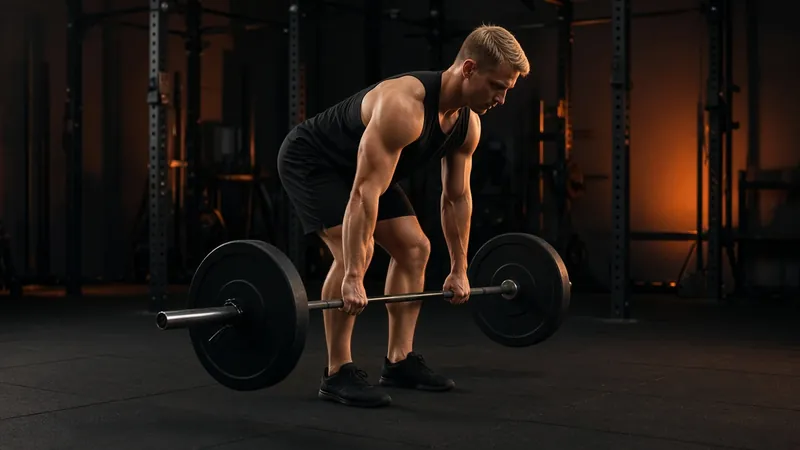
- Stand with your mid-foot under the bar, heels about hip-width.
- Hinge at the hips until your torso is roughly 15–45° above parallel, knees soft, spine long and unchanged.
- Grip the bar just outside your knees, palms down (or mixed if the load demands it).
- Pull the slack out of the bar and brace your trunk as you would for a deadlift.
Step by step
- Row: pull the bar toward your lower ribs or upper abdomen, elbows close to your sides.
- Squeeze: pause briefly with the shoulder blades together, without shrugging toward your ears.
- Lower: return the bar under control until the elbows are straight and the lats are stretched.
- Breathe and repeat. The torso angle should stay almost still from rep to rep.
Coaching cues
- “Hips back, chest proud.”
- “Pull elbows to your hip pockets.”
- “The bar travels in a straight, short line.”
- “Neck in line with your torso.”
Common mistakes and fixes
Variations
| Variation | Why use it |
|---|---|
| Pendlay row | Each rep starts from a dead stop on the floor, torso closer to parallel. Useful for strict back work; harder on the lower back. |
| Chest-supported dumbbell or machine row | Takes the lower back out of the lift so you can focus on the upper back. |
| Underhand (supinated) row | Usually lets the elbows stay closer and involves the biceps a little more. |
How to program it
For muscle growth, use 3–4 sets of 6–12 reps with 1–2 reps in reserve and 2–3 minutes’ rest. It is a main horizontal pull in the PPL, full-body and upper/lower programs. Add load once you hit the top of the range with a flat back.
Why the row matters
A bent-over row trains the upper back through a horizontal pull, which no amount of pulldowns fully replaces. It also asks your trunk to stay braced in a hinge, so the load has to match the quality of that position.
Evidence note: Sets taken close to failure grow muscle across a wide load range, while heavier loads still build more maximal strength (Schoenfeld et al., 2017). For the row, that means 6–12 hard reps is a practical range; stay heavier only if you can hold the hinge.
Use 2–3 minutes of rest on hard sets (Schoenfeld et al., 2016). See sets per week for how to count it (1.0 for the back, 0.5 for the rear delts and biceps).
Reference
Schoenfeld BJ, Grgic J, Ogborn D, Krieger JW. Strength and Hypertrophy Adaptations Between Low- vs. High-Load Resistance Training: A Systematic Review and Meta-analysis. J Strength Cond Res. 2017;31(12):3508-3523. doi:10.1519/JSC.0000000000002200. PubMed: 28834797
Schoenfeld BJ, Pope ZK, Benik FM, et al. Longer Interset Rest Periods Enhance Muscle Strength and Hypertrophy in Resistance-Trained Men. J Strength Cond Res. 2016;30(7):1805-1812. doi:10.1519/JSC.0000000000001272. PubMed: 26605807