Range of Motion for Hypertrophy: Full vs Partial Reps
Range of motion for hypertrophy: what the meta-analyses found for full vs partial reps, why the stretched half matters most, plus a depth guide per lift.
Key takeaways
- Full range of motion is the safe default for growth. In a 2021 meta-analysis of 16 studies, full reps beat partial reps for strength and for lower-body muscle growth (Pallarés et al., 2021).
- What matters most is the stretched part of the rep. Partials in the stretched half grew muscle about as well as full reps, and partials in the shortened half grew it less (Kassiano et al., 2023a).
- Go deep on squats and leg presses. Full squats grew the glutes about three times as much as half squats (6.7% vs 2.2%) in 10 weeks, with similar quad growth (Kubo et al., 2019).
- Upper-body results are mixed. One trial even found more triceps growth with mid-range partials in trained men (Goto et al., 2019), so treat upper-body rules as moderate, not settled.
- A simple rule: use the full range you can control, never cut the stretched end, and add lengthened partials only at the end of a set when you can't do more full reps.
Range of motion (ROM) is how far a joint moves during a rep. A squat to below parallel has a larger range than a quarter squat; a pull-up from a dead hang has a larger range than one that starts with bent arms. It is one of the easiest training variables to change, and one of the easiest to cheat: cutting the range is the fastest way to lift more weight.
This guide explains what the research found for full versus partial reps, why the stretched part of a rep seems to matter more than the rest, what “full range” means on each major lift, and when partial reps are a good idea. It ends with a 4-day plan that puts the findings into practice. It is part of our Training Methods section; for how methods fit into a weekly plan, see our pillar on every training split.
Evidence in one line: full range of motion is the reliable choice for growth, mainly because it includes the stretched position; partials can work if they stay in the stretched half, and clearly work less well if they stay in the shortened half.
What this page covers. This is our main guide to range of motion. Reps that stay in the stretched half on purpose have their own deep page: lengthened partials. Choosing exercises that load a muscle at long lengths is covered further down this page, and holding a stretch with load is covered in loaded stretching.
Key terms
- Range of motion (ROM): how far a joint moves in one rep, usually given in degrees.
- Full ROM: the largest range you can control with good technique on that exercise. It is not the same for everyone; hip and ankle mobility set your squat depth, for example.
- Partial ROM: any rep that uses only part of the full range.
- Initial or lengthened partial: a partial in the part of the range where the muscle is stretched (the bottom of a squat, curl or calf raise).
- Final or shortened partial: a partial in the part of the range where the muscle is short (the top half of a squat, the top of a curl).
- RIR (reps in reserve): how many more reps you could have done at the end of a set. See training to failure vs RIR.
What the research says
The reviews: full range wins, mainly for the legs
Three reviews now cover this question.
- A 2020 systematic review found six studies with 135 people (127 of them men). Full ROM gave more lower-body growth than partial ROM. For the upper body, the authors found only two studies with conflicting results, and no study on the trunk (Schoenfeld and Grgic, 2020).
- A 2021 meta-analysis of 16 studies found that full ROM gave more strength (effect size 0.56) and more lower-limb muscle growth (effect size 0.88) than partial ROM. There was no clear difference in muscle architecture (muscle thickness, pennation angle and fascicle length) (Pallarés et al., 2021).
- A 2023 systematic review of 11 studies sorted partials by where in the range they were done. Full ROM and partials in the initial (stretched) part of the range both grew muscle more than partials in the final (shortened) part. For the proximal rectus femoris, stretched-half partials even beat full ROM; for the triceps, mid-range partials beat full ROM in one study (Kassiano et al., 2023a).
That last point explains most of the confusion online. “Partial reps” can mean very different things. A half squat that skips the bottom is a partial in the shortened range. The bottom half of a calf raise is a partial in the lengthened range. They do not have the same effect.
Squats and leg training: depth matters
The clearest data come from squat depth.
- In 17 young men, 12 weeks of deep squats (0–120° of knee bend) increased front-thigh muscle size more than shallow squats (0–60°); the deep-squat group gained 4–7% across the measured sites. Each group got stronger mainly in the squat it trained (Bloomquist et al., 2013).
- In another 17 young men, 10 weeks of full squats and half squats grew the quads about equally (4.9% vs 4.6%), but full squats grew the glutes (6.7% vs 2.2%) and adductors (6.2% vs 2.7%) clearly more. Neither group grew the rectus femoris or hamstrings (Kubo et al., 2019).
- In recreationally active young adults who trained their legs for 8 weeks, the longer-range group gained more strength, more muscle size in the lower (distal) thigh and longer fascicles than the shorter-range group (McMahon et al., 2014).
On a single-joint exercise the pattern is the same. In 45 untrained women doing knee extensions, partials in the stretched half (100–65° of knee bend) gave more regional quad growth than full range or the shortened half (65–30°). The shortened-half group grew no more than controls at some sites (Pedrosa et al., 2022). On calf raises in 42 young women, stretched-half partials grew the medial gastrocnemius by 15.2%, versus 6.7% for full range and 3.4% for the shortened half (Kassiano et al., 2023b).
Evidence note (moderate): the leg data are fairly consistent, but most trials were 8–12 weeks long with 15–45 people, many of them untrained. Each one tested one exercise.
Upper body: less clear
The upper-body data are thinner and less consistent.
- In young men training elbow flexors for 10 weeks, full and partial ROM both grew the elbow flexors (9.65% vs 7.83%), with no clear difference between groups. Full ROM gave clearly more strength (25.7% vs 16.0%) (Pinto et al., 2012).
- In untrained young women doing curls for 8 weeks, partials in the initial (arms-straight) part of the range grew the lower biceps more than partials in the final part (Pedrosa et al., 2023). In untrained young adults training for 5 weeks, curls in the extended-elbow range (0–50°) grew the elbow flexors more than curls in the flexed range (80–130°): 8.9% vs 3.4% (Sato et al., 2021).
- One trial points the other way. In 44 trained men, mid-range triceps partials (45–90° of elbow bend) grew the triceps more than full-range reps over 8 weeks (48.7% vs 28.2%). The authors linked this to more continuous tension and less oxygen in the muscle (Goto et al., 2019). The growth numbers are unusually large for 8 weeks, and no one has repeated the result, so we treat it as an interesting outlier.
Lengthened partials in trained lifters
Several newer trials compared full reps with partials in the stretched half in trained or large groups. In 16 trained men doing leg presses, leg extensions and leg curls for 8 weeks, one leg trained with lengthened partials and the other with full reps; vastus lateralis growth did not differ (Plotkin et al., 2026). A pre-registered trial at 15 sites with about 300 participants found arm and thigh growth to be practically equivalent over 12 weeks (Gschneidner et al., 2025). These trials are covered in depth in our lengthened partials guide.
So the best summary is: the stretched part of the rep is the part you must not lose. Whether you add the shortened part on top seems to matter little for growth, but it does help you get stronger across the whole range.
Exercise choice works the same way
Range of motion is one way to train a muscle at long lengths; exercise choice is another. Seated leg curls (hips bent, hamstrings stretched) grew the whole hamstrings more than lying leg curls in 12 weeks (14% vs 9%) (Maeo et al., 2021). Overhead cable triceps extensions grew the whole triceps more than pushdown-style extensions with the arm at the side (19.9% vs 13.9%) (Maeo et al., 2023). A 2026 review concluded that the benefit of long-length training appears when there is real resistance in the stretched position (Pedrosa et al., 2026).
Two cautions keep this from turning into a rule for everything. A 2025 meta-analysis found only trivial differences in regional growth between longer and shorter muscle-length training overall (Varovic et al., 2025), and a 2026 systematic review called the evidence on longitudinal growth (fascicle length) mixed and the methods often weak (Wolf et al., 2026).
Strength: train the range you need
Strength gains follow range. In the squat trials above, each group improved most in the squat depth it trained (Bloomquist et al., 2013; Kubo et al., 2019). The 2026 ACSM position stand lists a complete range of motion among the variables that enhanced strength (Currier et al., 2026). A study of explosive leg presses found that very short partials were not inferior to full range for power (Werkhausen et al., 2021), but that is a power study, not a growth study.
Is deep training safe?
For healthy people, yes. A review of knee and spine loading found no evidence that deep squats raise the risk of injury to passive tissues when technique and loading are progressed sensibly. The authors argued that quarter and half squats with much heavier loads may be the riskier option for the knees and spine in the long run (Hartmann et al., 2013). If a joint is painful or injured, work with a clinician on the range you use.
Full range, exercise by exercise
Use this as a checklist. “Stretched end” is the part you should never cut.
| Exercise | Full range looks like | Stretched end | Partials that make sense |
|---|---|---|---|
| Back squat | Hip crease below the top of the knee, or as deep as you can keep a neutral back | Bottom | Lengthened partials are not worth it on heavy squats |
| Leg press | Knees towards the chest until your hips start to curl off the pad | Bottom | Bottom-half reps at the end of the last set |
| Bulgarian split squat | Back knee close to the floor | Bottom | Rarely needed |
| Romanian deadlift | Bar to mid-shin or until the hamstrings stop you, back neutral | Bottom | None; go only as low as your back stays neutral |
| Leg curl | Knee almost straight to fully bent; use a seated curl for more stretch | Legs straight | Long-length partials at the end of a set |
| Leg extension | Knee bent about 90° or more to straight | Knee bent | Bottom-half partials at the end of a set |
| Standing calf raise | Deep heel drop with a 1–2 s pause to full rise | Heel down | Bottom-half partials; they did best in one trial |
| Bench press | Bar to the lower chest, then press to lockout | Bar on chest | Avoid partial bench reps |
| Incline dumbbell press | Dumbbells level with the chest | Bottom | Rarely needed |
| Dips | Upper arm about parallel to the floor, or as deep as your shoulders tolerate | Bottom | Avoid forcing extra depth |
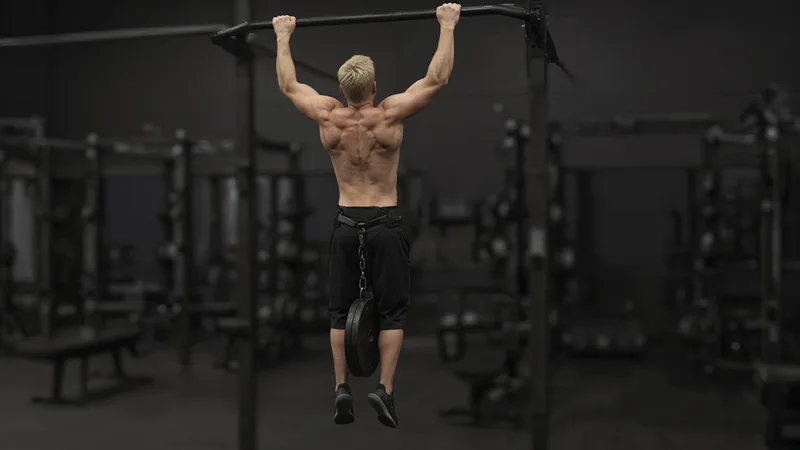
| Pull-up and lat pulldown | Arms straight at the top to chin over the bar or bar to upper chest | Arms straight | Top-half partials (arms straight to forehead) at the end of a set |
| Seated cable row | Arms long and shoulder blades forward to handle at the stomach | Arms long | Rarely needed |
| Overhead press | Bar from the upper chest to lockout | Bottom | Avoid |
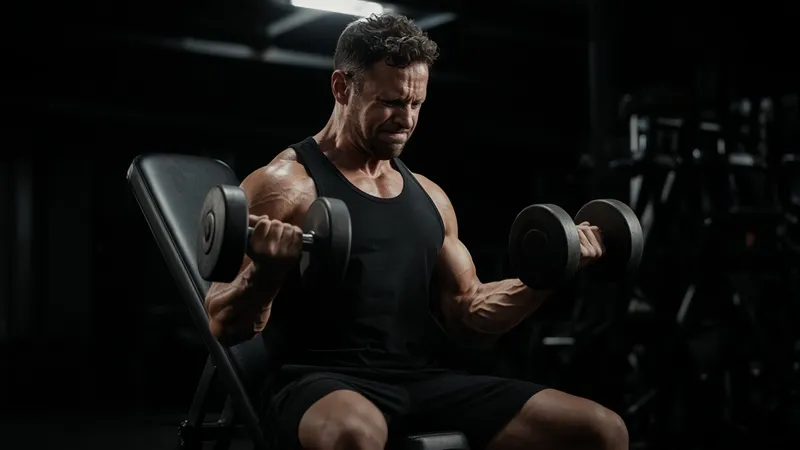
| Biceps curl | Elbows straight to fully bent; incline or preacher curls add stretch | Elbows straight | Bottom-half partials at the end of a set |
| Overhead triceps extension | Elbows fully bent behind the head to straight | Elbows bent | Bottom-half partials at the end of a set |
| Lateral raise | Arms at the sides to about shoulder height | Arms down | Bottom-half partials; cables keep tension at the bottom |
When partial reps are useful
Partial range is a tool, not a sin. These uses are reasonable:
- Extending a set. When you can no longer do a full rep, finish with 4–8 partials in the stretched half. This is the most practical way to use partials for growth; see lengthened partials.
- Working around pain. If the bottom of a press hurts your shoulder, a slightly shorter range you can train hard is better than skipping the lift. Raise the range back up as symptoms allow.
- Specific strength. Lockout work (board presses, rack pulls) has a place in powerlifting. It is a strength tool, not a growth tool.
- Machines with a bad strength curve. Some machines are almost weightless at one end. Then the hard part of the range is what counts.
Partials are a bad idea when they are just a way to use more weight. Quarter squats and half-rep bench presses with huge loads are the classic example: they train the shortened range, which grew muscle the least in the trials.
The plan: 4-day “full range” upper/lower
Four sessions a week (for example Monday, Tuesday, Thursday, Friday). Every exercise uses the full range from the table above. Effort is given as RIR. Do 1–3 lighter warm-up sets before the first exercise for each muscle group; see warm-up sets.
Upper A
| # | Exercise | Sets × reps | RIR | Rest | ROM cue |
|---|---|---|---|---|---|
| 1 | Bench press | 3 × 6–10 | 1–2 | 2–3 min | Touch the chest every rep |
| 2 | Chest-supported dumbbell row | 4 × 8–12 | 1–2 | 2 min | Let the arms hang long |
| 3 | Overhead triceps extension (cable) | 3 × 10–15 | 0–1 | 90 s | Deep bend behind the head |
| 4 | Incline dumbbell curl | 3 × 10–15 | 0–1 | 90 s | Elbows fully straight at the bottom |
| 5 | Lateral raise | 3 × 12–20 | 0–1 | 60–90 s | Last set: 4–8 bottom-half partials |
Lower A
| # | Exercise | Sets × reps | RIR | Rest | ROM cue |
|---|---|---|---|---|---|
| 1 | Back squat | 3 × 5–8 | 2 | 3 min | Hip crease below the knee |
| 2 | Romanian deadlift | 3 × 8–10 | 2 | 2–3 min | Lower until the hamstrings stop you |
| 3 | Seated leg curl | 3 × 10–15 | 0–1 | 90 s | Legs almost straight at the start |
| 4 | Standing calf raise | 3 × 10–15 | 0–1 | 90 s | 2-second pause in the stretch |
Upper B
| # | Exercise | Sets × reps | RIR | Rest | ROM cue |
|---|---|---|---|---|---|
| 1 | Pull-up (assisted if needed) | 3 × 6–10 | 1–2 | 2–3 min | Dead hang at the bottom |
| 2 | Incline dumbbell press | 3 × 8–12 | 1–2 | 2 min | Dumbbells level with the chest |
| 3 | Seated cable row | 3 × 10–12 | 1–2 | 2 min | Shoulder blades forward at the start |
| 4 | Dips | 3 × 8–12 | 1–2 | 2 min | Upper arm about parallel |
| 5 | Preacher curl | 3 × 10–15 | 0–1 | 90 s | Last set: 4–8 bottom-half partials |
| 6 | Lateral raise (cable) | 3 × 12–20 | 0–1 | 60–90 s | Start from the arm across the body |
Lower B
| # | Exercise | Sets × reps | RIR | Rest | ROM cue |
|---|---|---|---|---|---|
| 1 | Bulgarian split squat | 3 × 8–12 each leg | 1–2 | 2 min | Back knee near the floor |
| 2 | Leg press | 3 × 10–15 | 1–2 | 2 min | Deep, hips stay on the pad |
| 3 | Leg extension | 2 × 12–15 | 0–1 | 90 s | Last set: 4–8 bottom-half partials |
| 4 | Lying leg curl | 3 × 10–15 | 0–1 | 90 s | Full extension at the bottom |
| 5 | Standing calf raise | 3 × 10–15 | 0–1 | 90 s | Last set: 4–8 bottom-half partials |
Volume audit
Weekly hard sets per muscle, counted with our fractional method (1 for the main muscle, 0.5 for clear helpers; split squats counted per leg). Compare with the 10–20 set range from our guide to sets per week.
| Muscle | Upper A | Lower A | Upper B | Lower B | Week | Verdict |
|---|---|---|---|---|---|---|
| Quads | 0 | 3 | 0 | 8 | 11 | In range |
| Hamstrings | 0 | 6 | 0 | 3 | 9 | Just under; fine for most |
| Glutes | 0 | 3 | 0 | 3 | 6 | Low; add 2–3 hip thrust sets if glutes are a priority |
| Calves | 0 | 3 | 0 | 3 | 6 | Low-moderate; add a set to each day if calves lag |
| Chest | 3 | 0 | 6 | 0 | 9 | Just under; add a set of incline press if needed |
| Back | 4 | 0 | 6 | 0 | 10 | In range |
| Front delts | 1.5 | 0 | 3 | 0 | 4.5 | Fine; presses cover them |
| Side delts | 3 | 0 | 3 | 0 | 6 | Low; add sets if shoulders are a priority |
| Biceps | 5 | 0 | 6 | 0 | 11 | In range |
| Triceps | 4.5 | 0 | 3 | 0 | 7.5 | Slightly low; add 2 sets of overhead extensions to Upper B |
How we counted: back squat, Romanian deadlift, split squat and leg press each give 0.5 to the glutes; Romanian deadlifts count 1 for the hamstrings; rows and pull-ups give 0.5 to the biceps; bench press and incline press give 0.5 to the front delts and triceps; dips count 1 for the chest and 0.5 for the front delts and triceps.
Beginner and advanced versions
- Beginner (first 6–12 months): do 2 sets of each exercise at 2–3 RIR and skip the partials. Learn to own the full range with a load you control. If you cannot reach full squat depth with a neutral back, use a box or a goblet squat to the depth you can control and add depth over weeks.
- Advanced: add lengthened partials to the last set of every isolation exercise for one 4–6 week block, and see whether your logbook (and tape measure) improves. Keep the compound lifts full range.
Progression
- Range first, load second. Only add weight when every rep reaches the full range from the table. If the range shrinks as the set goes on, the set is over, or you finish it with partials on purpose.
- Double progression. When you hit the top of the rep range on all sets at the target RIR, add the smallest load available next session (about 2.5 kg on barbell lifts, 1–2 kg on dumbbells and machines). This is our standard rule; see progressive overload.
- Moving to a deeper range costs weight. When you deepen a squat or start pausing your calf raises, cut the load by about 10–20% and build it back. This is our rule of thumb, not a tested number.
- Deload every 6–8 weeks, or when reps fall two sessions in a row. See when and how to deload.
Range of motion compared with other “stretch” methods
| Method | What it is | Evidence for growth | Best use |
|---|---|---|---|
| Full ROM | Whole controllable range | Moderate: beats partials, especially for the legs | Default for every exercise |
| Lengthened partials | Only the stretched half | Moderate: about equal to full ROM in trained lifters | End of a set, or a short block |
| Shortened partials | Only the top half | Moderate, negative: less growth | Specific strength, pain workarounds |
| Loaded stretching | Holding a loaded stretch between or after sets | Preliminary | Calves, chest, lats as an add-on |
| Long-length exercise choice | Seated leg curls, overhead extensions, incline curls | Moderate for some muscles | Picking your isolation exercises |
Common mistakes
- Cutting depth to lift more. Fix: film a set from the side; if the hip crease isn’t below the knee on squats, lower the weight.
- Cutting the stretched end on isolation work. Fix: straighten the elbows on curls, let the heels drop on calf raises and let the arms go long on pulldowns.
- Bouncing out of the bottom. Fix: control the last part of the lowering; a short pause on calf raises and machine work keeps the stretch honest.
- Forcing range the joint doesn’t have. Fix: full range means the range you can control. Rounded lower backs at the bottom of squats or RDLs aren’t extra range, they are lost position.
- Doing partials from the first rep. Fix: use full reps first and add partials only when full reps are no longer possible.
- Treating one muscle’s result as a rule for all. Fix: the leg data are the strongest; for the upper body, full range is the default but the evidence is mixed.
- Changing range every week. Fix: keep the same range for a block, so your logbook shows real progress.
Make it better
- Pick the longer-length version of each isolation exercise: seated over lying leg curls, overhead over pushdown triceps work, incline over standing curls.
- Pause in the stretch on calf raises, leg presses and dumbbell flyes: 1–2 seconds kills the bounce and keeps tension where it counts.
- Add 4–8 lengthened partials to the last set of one isolation exercise per muscle; count it as one hard set.
Safety notes
- Deep ranges are safe for healthy people when you progress the load gradually. If you have a current injury, joint replacement or pain that worsens with depth, ask a physiotherapist or doctor which range to use.
- On the leg press, stop the descent before your lower back rounds and your hips lift off the pad.
- If you are pregnant or under 18, ask a qualified professional before you change your training.
FAQ
Is full range of motion better for muscle growth?
Mostly yes. A 2021 meta-analysis of 16 studies found more lower-body growth and more strength with full range than with partial range. The key is the stretched part of the rep; partials that keep the stretch can work about as well.
Are partial reps useless?
No. Partials in the stretched half grew muscle about as well as full reps in several trials, and sometimes better on calves and quads. Partials in the shortened half (half squats, top-half curls) grew muscle less.
How deep should I squat for hypertrophy?
As deep as you can with a neutral back, usually with the hip crease below the top of the knee. Full squats grew the glutes and adductors more than half squats in a 10-week study, with similar quad growth.
Should I lock out my reps?
On presses, a lockout is part of the full range and fine to keep. For growth, the bottom (stretched) part matters more than the top. On machines like the leg press, stop just short of hard knee lockout to keep tension and protect the knee.
Do partial reps build strength?
They build strength mainly in the range you train. In squat trials, each group improved most at the depth it trained. If you want strength across the whole range, train the whole range.
What are lengthened partials?
Reps in the stretched half of the movement only, such as the bottom half of a calf raise or curl. They are usually done at the end of a set. See our lengthened partials guide for the trials and a 4-week plan.
References
- Schoenfeld BJ, Grgic J. Effects of range of motion on muscle development during resistance training interventions: A systematic review. SAGE Open Med. 2020;8:2050312120901559. doi:10.1177/2050312120901559. PubMed: 32030125
- Pallarés JG, Hernández-Belmonte A, Martínez-Cava A, et al. Effects of range of motion on resistance training adaptations: A systematic review and meta-analysis. Scand J Med Sci Sports. 2021;31(10):1866-1881. doi:10.1111/sms.14006. PubMed: 34170576
- Kassiano W, Costa B, Nunes JP, et al. Which ROMs Lead to Rome? A Systematic Review of the Effects of Range of Motion on Muscle Hypertrophy. J Strength Cond Res. 2023;37(5):1135-1144. doi:10.1519/JSC.0000000000004415. PubMed: 36662126
- Bloomquist K, Langberg H, Karlsen S, et al. Effect of range of motion in heavy load squatting on muscle and tendon adaptations. Eur J Appl Physiol. 2013;113(8):2133-42. doi:10.1007/s00421-013-2642-7. PubMed: 23604798
- Kubo K, Ikebukuro T, Yata H. Effects of squat training with different depths on lower limb muscle volumes. Eur J Appl Physiol. 2019;119(9):1933-1942. doi:10.1007/s00421-019-04181-y. PubMed: 31230110
- McMahon GE, Morse CI, Burden A, et al. Impact of range of motion during ecologically valid resistance training protocols on muscle size, subcutaneous fat, and strength. J Strength Cond Res. 2014;28(1):245-55. doi:10.1519/JSC.0b013e318297143a. PubMed: 23629583
- Pedrosa GF, Lima FV, Schoenfeld BJ, et al. Partial range of motion training elicits favorable improvements in muscular adaptations when carried out at long muscle lengths. Eur J Sport Sci. 2022;22(8):1250-1260. doi:10.1080/17461391.2021.1927199. PubMed: 33977835
- Kassiano W, Costa B, Kunevaliki G, et al. Greater Gastrocnemius Muscle Hypertrophy After Partial Range of Motion Training Performed at Long Muscle Lengths. J Strength Cond Res. 2023;37(9):1746-1753. doi:10.1519/JSC.0000000000004460. PubMed: 37015016
- Pinto RS, Gomes N, Radaelli R, et al. Effect of range of motion on muscle strength and thickness. J Strength Cond Res. 2012;26(8):2140-5. doi:10.1519/JSC.0b013e31823a3b15. PubMed: 22027847
- Pedrosa GF, Simões MG, Figueiredo MOC, et al. Training in the Initial Range of Motion Promotes Greater Muscle Adaptations Than at Final in the Arm Curl. Sports (Basel). 2023;11(2). doi:10.3390/sports11020039. PubMed: 36828324
- Sato S, Yoshida R, Kiyono R, et al. Elbow Joint Angles in Elbow Flexor Unilateral Resistance Exercise Training Determine Its Effects on Muscle Strength and Thickness of Trained and Non-trained Arms. Front Physiol. 2021;12:734509. doi:10.3389/fphys.2021.734509. PubMed: 34616309
- Goto M, Maeda C, Hirayama T, et al. Partial Range of Motion Exercise Is Effective for Facilitating Muscle Hypertrophy and Function Through Sustained Intramuscular Hypoxia in Young Trained Men. J Strength Cond Res. 2019;33(5):1286-1294. doi:10.1519/JSC.0000000000002051. PubMed: 31034463
- Plotkin DL, Tiede DR, Gotla T, et al. Acute Molecular and Chronic Vastus Lateralis Adaptations to Lengthened Partial versus Full Range of Motion Resistance Training in Trained Men. Med Sci Sports Exerc. 2026. Online ahead of print. doi:10.1249/MSS.0000000000004183. PubMed: 42841600
- Gschneidner D, Carlson L, Steele J, et al. The effects of lengthened-partial range of motion resistance training of the limbs on arm and thigh muscle area: A multi-site randomised trial. J Sports Sci. 2025;43(23):2963-2976. doi:10.1080/02640414.2025.2567805. PubMed: 41055237
- Maeo S, Huang M, Wu Y, et al. Greater Hamstrings Muscle Hypertrophy but Similar Damage Protection after Training at Long versus Short Muscle Lengths. Med Sci Sports Exerc. 2021;53(4):825-837. doi:10.1249/MSS.0000000000002523. PubMed: 33009197
- Maeo S, Wu Y, Huang M, et al. Triceps brachii hypertrophy is substantially greater after elbow extension training performed in the overhead versus neutral arm position. Eur J Sport Sci. 2023;23(7):1240-1250. doi:10.1080/17461391.2022.2100279. PubMed: 35819335
- Pedrosa GF, Pereira MR, Kassiano W. The interplay between muscle length, range of motion, and exercise selection: a review. Sports Med Int Open. 2026;10:a27337605. doi:10.1055/a-2733-7605. PubMed: 41777276
- Varovic D, Wolf M, Schoenfeld BJ, et al. Does Muscle Length Influence Regional Hypertrophy? A Systematic Review and Meta-Analysis. Int J Sports Med. 2025;46(14):1027-1036. doi:10.1055/a-2615-4935. PubMed: 40570881
- Wolf M, Korakakis PA, Roberts MD, et al. Does longer-muscle length resistance training cause greater longitudinal growth in humans? A systematic review. Sports Med Health Sci. 2026;8(1):34-42. doi:10.1016/j.smhs.2025.03.001. PubMed: 41646176
- Currier BS, D’Souza AC, Singh MAF, et al. American College of Sports Medicine Position Stand. Resistance Training Prescription for Muscle Function, Hypertrophy, and Physical Performance in Healthy Adults: An Overview of Reviews. Med Sci Sports Exerc. 2026;58(4):851-872. doi:10.1249/MSS.0000000000003897. PubMed: 41843416
- Werkhausen A, E Solberg C, Paulsen G, et al. Adaptations to explosive resistance training with partial range of motion are not inferior to full range of motion. Scand J Med Sci Sports. 2021;31(5):1026-1035. doi:10.1111/sms.13921. PubMed: 33465838
- Hartmann H, Wirth K, Klusemann M. Analysis of the load on the knee joint and vertebral column with changes in squatting depth and weight load. Sports Med. 2013;43(10):993-1008. doi:10.1007/s40279-013-0073-6. PubMed: 23821469