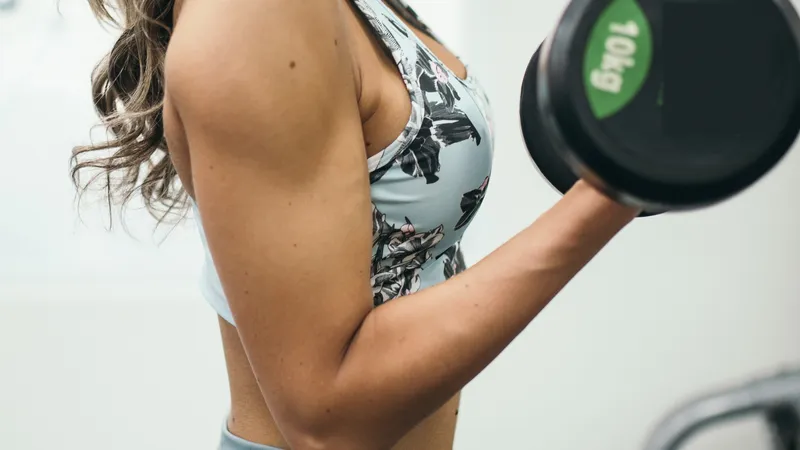
Unilateral Training: Single-Arm and Single-Leg Work for Size
Unilateral training for muscle growth: what single-leg and single-arm studies show on size, strength and imbalances, plus a 4-day plan of one-sided lifts.
Key takeaways
- One-sided and two-sided lifts build muscle about equally: in a 12-week trial in women, knee-extensor thickness grew similarly with unilateral and bilateral training (Botton et al., 2016).
- Strength is specific: bilateral training builds bilateral strength a little better, and unilateral training builds single-leg jumps much better (Liao et al., 2022). Train the pattern you want to be strong in.
- Single-leg lifts let you load the legs with much less weight on your back. A rear-foot-elevated split squat at half the squat load produced similar quadriceps and glute activity to a heavy back squat (DeForest et al., 2014).
- Training one limb makes the other a bit stronger (about 12% on average; Manca et al., 2017), but it does not grow the untrained muscle. It is a rehab tool, not a growth shortcut.
- Use unilateral work for 2–4 exercises per week per region, start with the weaker side, and match reps on the stronger side. Expect sessions to take longer.
Unilateral training means working one arm or one leg at a time: split squats, single-leg Romanian deadlifts, one-arm rows, single-arm presses and curls. Bilateral training uses both sides together, as in the back squat, bench press or barbell row. Bodybuilders have always used both, but there is a lot of noise about one-sided work “fixing imbalances”, “building more muscle” or “sparing the spine”.
This guide sorts out what the research shows for muscle size, strength, imbalances and cross-education, when unilateral lifts are the better choice, and how to build them into a complete program. It is part of our Training Methods section; for how sessions fit into a week, see our pillar on every training split.
Evidence in one line: single-limb and two-limb lifts grow muscle about equally; pick unilateral work for comfort, balance, spinal load and specific strength, not because it builds more size.
What this page covers. How to perform the key single-leg lift is covered on our Bulgarian split squat page. Machines versus free weights is covered in machines vs free weights. This page is about one side versus both sides.
Key terms
- Unilateral: one limb works at a time (or each limb moves independently, as with two dumbbells). Examples: split squat, one-arm row, single-leg leg press.
- Bilateral: both limbs push or pull together against one load. Examples: back squat, bench press, leg press.
- Bilateral deficit: the force both limbs produce together is often less than the sum of each limb working alone.
- Cross-education: training one limb increases strength in the opposite, untrained limb.
- Asymmetry: a difference in strength or size between the left and right side.
- RIR (reps in reserve): how many more reps you could have done at the end of a set. See training to failure vs RIR.
What the research says
Muscle growth: unilateral vs bilateral
Few studies have measured muscle size, but the ones that did point the same way:
- Botton et al. (2016): 43 recreationally active young women trained their knee extensors twice a week for 12 weeks, either one leg at a time or both legs together. Muscle thickness increased similarly in both groups, and so did 1RM and isometric strength. The unilateral group gained more single-leg isometric strength (Botton et al., 2016).
- Núñez et al. (2018): 27 young male team-sport players did 6 weeks of flywheel (eccentric overload) training with either a lateral lunge or a half-squat. Both groups gained lower-limb muscle volume, but in different places: the lunge group grew more in the adductor magnus (+11.1%) and vastus medialis (+12.6%), and the squat group more in the vastus lateralis (+9.9%) and lateral calf (Núñez et al., 2018).
The second study hints at something useful: unilateral and bilateral exercises are different exercises that load muscles in slightly different ways, more than they are better or worse versions of each other.
Strength and performance: each wins its own test
- A meta-analysis of 14 studies (392 people aged 16–26) found that bilateral training improved bilateral strength a little more (effect size −0.43 in favour of bilateral), while unilateral training improved single-leg jumps much more (effect size 0.89). Single-leg strength, two-leg jumps, sprint speed and change of direction did not differ significantly (Liao et al., 2022).
- In 18 academy rugby players, 5 weeks of rear-foot-elevated split squats or back squats improved back squat strength, split squat strength, 40 m sprint and agility equally (Speirs et al., 2016).
- In 33 developmental rugby players, volume-matched back squats or step-ups for 8 weeks both increased strength, with transfer to the exercise they did not train; the step-up group gained more step-up strength (Appleby et al., 2019).
- In 38 untrained men and women, 8 weeks of unilateral or bilateral free-weight training improved strength and power equally, except that the unilateral group improved single-leg jump height and power more (McCurdy et al., 2005).
- In 28 untrained young men, 8 weeks of unilateral or bilateral eccentric-accentuated leg press training gave similar gains in bilateral leg press 1RM (about 13–15%), knee strength and jump height (Sato et al., 2026).
The bilateral deficit
Many people can produce more total force with each leg separately than with both together. A review found the bilateral deficit is real but inconsistent: its size varies between people and tasks, it can turn into a bilateral facilitation with training, and balance demands during one-legged tasks affect it a lot (Škarabot et al., 2016). In the Botton trial, the unilateral group developed a bilateral deficit while the bilateral group developed a facilitation; each group got better at what it practised (Botton et al., 2016).
What it means: the deficit is mainly a neural and skill effect. It is not evidence that unilateral training builds more muscle.
Less load on the spine
Single-leg lifts can hit the legs hard with a fraction of the bar weight. In nine resistance-trained men, a rear-foot-elevated split squat and a split squat at 50% of the back squat load produced muscle activity similar to a back squat at 85% 1RM in most leg muscles; the rear-foot-elevated version produced more biceps femoris (hamstring) activity (DeForest et al., 2014). In 11 moderately trained adults working to failure with 6–8RM loads, the split squat, single-leg squat and rear-foot-elevated split squat gave similar glute and quadriceps activity, with more glute medius activity in the single-leg squat (Mausehund et al., 2019).
These are EMG studies. Muscle activity is a hint about the training stimulus, not proof of growth. Still, they support a practical point: if your lower back, a barbell or heavy loads limit you, single-leg work can keep your legs growing.
Cross-education: the untrained side gets stronger
- A meta-analysis of 31 randomised trials (785 people) found that unilateral training increased strength in the untrained limb by 11.9% on average (9.4% in arms, 16.4% in legs), with the largest effects from eccentric training. Risk of bias was high (Manca et al., 2017).
- In 115 people training elbow flexion for 6 weeks, three sets per session increased strength in the untrained arm by about 7%, while one slow set did not (Munn et al., 2005).
- The effect is mostly neural: 4 weeks of one-wrist training increased voluntary activation of the opposite, untrained wrist (Lee et al., 2009). Both heavy and light loads produce it, with heavier loads working faster (Pelet & Orsatti, 2021).
- It does not build muscle in the untrained limb. A 2026 meta-analysis of 31 upper-limb studies found small contralateral strength gains but no significant change in muscle thickness (Hernando-Garijo et al., 2026).
- It may help during injury. When one arm was immobilised, training the other arm reduced strength loss in the immobilised arm and slightly preserved its muscle size (Rodríguez-Coloma et al., 2026).
An expert consensus recommends at least 13–18 sessions or 4–6 weeks of training, with high intensity and eccentric contractions, to get a meaningful transfer (Manca et al., 2021).
Imbalances and injury
A systematic review of 18 studies found that strength differences between limbs may hurt jumping, kicking and cycling performance, but all the data were associative and the findings for sprinting and change of direction were inconsistent (Bishop et al., 2018). No trial has shown that “fixing” a small left–right difference builds more muscle or prevents gym injuries.
The position stand view
The 2026 ACSM position stand, based on 137 systematic reviews, found that most program variables, including equipment type and exercise complexity, did not consistently change training outcomes; volume, load and effort mattered more (Currier et al., 2026). Unilateral versus bilateral is one more choice that matters less than total hard sets.
Evidence grade and gaps
- Moderate: unilateral and bilateral training build strength about equally, each favouring its own test; cross-education increases strength but not size in the untrained limb.
- Preliminary: unilateral and bilateral training build muscle about equally (two small trials; regional differences in one).
- No direct evidence: that unilateral work builds more muscle in trained bodybuilders, or that correcting small imbalances improves growth.
- Most trials used young adults, legs only, and 5–12 weeks.
When unilateral work is the better choice
| Situation | Why unilateral helps | Example |
|---|---|---|
| Lower back or spine limits squats and deadlifts | Much less external load for the same leg effort | Bulgarian split squat, single-leg leg press |
| Home gym with light dumbbells | Light loads feel heavy on one leg | Split squats, single-leg RDLs |
| Clear left–right difference (more than about 10–15% in reps; our rule of thumb) | Each side does its own work | One-arm rows, single-arm presses |
| Sports that use one leg at a time | Specific strength and balance | Step-ups, lunges |
| Injury or surgery on one limb | Cross-education keeps some strength in the injured side | Train the healthy limb (with your physio’s approval) |
| Extra range of motion | Dumbbells and cables allow a longer stretch | One-arm cable row, single-arm lat pulldown |
When bilateral work is the better choice: when you want maximal two-leg strength (powerlifting, testing), when time is short, and when balance limits how hard you can push a set.
Our unilateral training rules
- Keep at least one heavy bilateral lift per region (squat or leg press, bench or row) unless something stops you.
- Add 2–4 unilateral exercises per week for each half of the body.
- Start with your weaker side and do the same reps on the stronger side, even if it could do more.
- Use support for single-leg work (a hand on a rack or bench) so balance doesn’t end the set before your muscles do.
- Alternate sides without rest between them; rest after both sides are done. This keeps sessions shorter.
- Count one set per side as one hard set for that muscle; a set of split squats is one set for each leg’s quads.
- Progress by reps first, because small load jumps are big on one limb.
The numbers in rules 2 and 7 are our conventions; rule 6 matches how we count sets in the fractional set method.
A 4-day upper/lower plan with unilateral emphasis
About half the lifts are one-sided. “Per side” means each set is done on both sides. For the split itself, see our upper/lower guide.
Lower A
| Exercise | Sets × reps | Effort | Rest |
|---|---|---|---|
| Back squat | 3 × 6–8 | RIR 2 | 3 min |
| Bulgarian split squat | 3 × 8–12 per leg | RIR 1–2 | 90 s after both legs |
| Single-leg Romanian deadlift (dumbbell) | 3 × 8–12 per leg | RIR 2 | 90 s |
| Single-leg leg curl | 3 × 10–15 per leg | RIR 1 | 60 s |
| Single-leg calf raise | 3 × 10–15 per leg | RIR 0–1 | 60 s |
Upper A
| Exercise | Sets × reps | Effort | Rest |
|---|---|---|---|
| Bench press | 4 × 6–8 | RIR 2 | 3 min |
| One-arm dumbbell row | 3 × 8–12 per side | RIR 1–2 | 90 s |
| Half-kneeling one-arm dumbbell press | 2 × 8–12 per side | RIR 2 | 90 s |
| Single-arm lat pulldown | 2 × 10–15 per side | RIR 1 | 60 s |
| One-arm cable lateral raise | 4 × 12–20 per side | RIR 0–1 | 45–60 s |
| Alternating dumbbell curl | 3 × 10–15 | RIR 1 | 60 s |
| Single-arm cable overhead triceps extension | 2 × 10–15 per side | RIR 1 | 60 s |
Lower B
| Exercise | Sets × reps | Effort | Rest |
|---|---|---|---|
| Romanian deadlift | 3 × 6–10 | RIR 2 | 2–3 min |
| Single-leg leg press | 3 × 10–15 per leg | RIR 1–2 | 90 s |
| Walking lunge or step-up | 2 × 10–12 per leg | RIR 2 | 90 s |
| Single-leg leg extension | 2 × 12–20 per leg | RIR 0–1 | 60 s |
| Hip thrust | 3 × 10–15 | RIR 1 | 2 min |
| Lying leg curl | 2 × 10–15 | RIR 0–1 | 60 s |
| Standing calf raise | 3 × 12–20 | RIR 0–1 | 60 s |
Upper B
| Exercise | Sets × reps | Effort | Rest |
|---|---|---|---|
| Incline dumbbell press | 4 × 8–12 | RIR 1–2 | 2 min |
| Pull-up | 3 × 6–10 | RIR 1–2 | 2 min |
| Single-arm seated cable row | 3 × 10–15 per side | RIR 1 | 60–90 s |
| Dips | 2 × 8–12 | RIR 1–2 | 2 min |
| Dumbbell lateral raise | 3 × 12–20 | RIR 0–1 | 60 s |
| Concentration curl | 2 × 10–15 per side | RIR 0–1 | 45 s |
| Overhead dumbbell triceps extension | 2 × 10–15 | RIR 1 | 60 s |
Volume audit
Weekly hard sets per muscle, per side. Direct sets count 1; compound lifts count 0.5 for helper muscles (see fractional sets).
| Muscle | Direct sets | Indirect (× 0.5) | Total | vs 10–20 range |
|---|---|---|---|---|
| Quads | Squat 3 + split squat 3 + single-leg press 3 + lunge 2 + leg extension 2 = 13 | — | 13 | In range |
| Hamstrings | Single-leg RDL 3 + RDL 3 + single-leg curl 3 + lying curl 2 = 11 | — | 11 | In range |
| Glutes | Hip thrust 3 | Squat, split squat, both RDLs, single-leg press, lunge 17 × 0.5 = 8.5 | 11.5 | In range |
| Calves | 3 + 3 = 6 | — | 6 | Low; add sets if lagging |
| Chest | Bench 4 + incline 4 + dips 2 = 10 | — | 10 | Low end |
| Back | One-arm row 3 + single-arm pulldown 2 + pull-up 3 + single-arm cable row 3 = 11 | — | 11 | In range |
| Side delts | Cable lateral raise 4 + dumbbell lateral raise 3 = 7 | One-arm press 2 × 0.5 = 1 | 8 | Slightly low |
| Front delts | One-arm press 2 | Bench, incline, dips 10 × 0.5 = 5 | 7 | Fine (heavy pressing) |
| Biceps | Curls 3 + 2 = 5 | Rows, pulldowns, pull-ups 11 × 0.5 = 5.5 | 10.5 | In range |
| Triceps | Extensions 2 + 2 = 4 | Bench, press, incline, dips 12 × 0.5 = 6 | 10 | Low end |
Sessions run about 60–75 minutes because one-sided sets take longer.
How to fix a left–right difference
- Measure it simply: do a one-arm or single-leg set to RIR 1 on each side with the same weight and note the reps.
- If the gap is 1–2 reps, ignore it; that is normal day-to-day noise.
- If the gap is bigger, start every one-sided exercise with the weaker side and stop the stronger side at the same reps.
- Optionally add one extra set for the weaker side on one exercise (for 4–8 weeks), then retest.
- If the gap comes with pain or follows an injury, see a physiotherapist.
The rep thresholds above are our conventions. No study has tested this protocol.
Progression
- Double progression: when all sets reach the top of the rep range at the target RIR, add the smallest available load (1–2 kg dumbbells, or 2.5 kg on machines).
- For balance-limited lifts, progress range of motion first (deficit split squat, lower step), then load.
- Every 4–6 weeks, keep the same one-sided lifts so you can compare numbers; swap at most one. See progressive overload.
Swaps and home version
| Gym lift | Home version | Keeps |
|---|---|---|
| Single-leg leg press | Bulgarian split squat with dumbbells or a backpack | Single-leg quad work |
| Single-leg leg curl | Sliding single-leg curl on a towel | Knee-flexion hamstring work |
| Single-arm lat pulldown | One-arm band pulldown | Vertical pull |
| One-arm cable row | One-arm dumbbell row on a chair | Horizontal pull |
| One-arm cable lateral raise | One-arm dumbbell lateral raise leaning on a door frame | Side delts with more stretch |
Unilateral vs bilateral compared
| Unilateral | Bilateral | Combination (our default) | |
|---|---|---|---|
| Muscle growth | Similar | Similar | Similar, with more variety of loading |
| Two-leg / two-arm strength | Slightly less | Slightly more | Good |
| Single-leg performance | Better | Less | Good |
| Load on the spine | Low | High (squat, deadlift) | Moderate |
| Time per session | Longer | Shorter | Moderate |
| Balance demand | Higher | Lower | Moderate |
Common mistakes
- Replacing all heavy bilateral lifts with light single-leg work. Fix: keep one heavy compound per region.
- Letting balance end the set. Fix: hold a rack or bench and push the working leg close to failure.
- Doing more reps on the strong side. Fix: match reps to the weaker side.
- Resting fully between sides. Fix: alternate sides, then rest; sessions stay manageable.
- Chasing tiny asymmetries. Fix: only act on gaps bigger than 1–2 reps.
- Expecting cross-education to grow the injured limb. Fix: it preserves strength, not size; follow your physio’s plan.
- Using too much load on split squats and shortening the range. Fix: use full depth before adding weight.
Make it better
- Use the longer stretch: one-arm cable rows and single-arm pulldowns let the shoulder blade move further, which suits training at long muscle lengths; see range of motion.
- Add a lengthened partial to the last set of Bulgarian split squats; see lengthened partials.
- Pair one-sided lifts with a bilateral lift for the same muscle in the same week, as the plan does, to get both the strength and the variety.
Safety notes
- Single-leg lifts need balance: use support and start light, especially if you are older or have had ankle or knee problems.
- After an injury or surgery, train the healthy limb only with your doctor’s or physiotherapist’s approval.
- Stop if a one-sided lift causes sharp pain in the knee, hip or lower back; check depth and stance width first.
- Under-18s and pregnant women should get individual advice before heavy single-leg loading.
FAQ
Is unilateral training better for muscle growth?
No, it is about equal. In a 12-week trial, one-leg and two-leg knee extension training grew muscle thickness similarly (Botton et al., 2016). Unilateral exercises may load muscles in slightly different regions, which adds variety.
Should I train one side at a time?
Use both. Keep at least one heavy two-sided lift per region and add 2–4 one-sided exercises per week. One-sided lifts help with spinal load, home training and clear imbalances.
Do single-leg exercises build as much muscle as squats?
They can. Split squats at half the squat load produced similar leg muscle activity to heavy back squats (DeForest et al., 2014), and unilateral and bilateral training produced similar growth in trials that measured it.
Does training one arm make the other arm stronger?
Yes, a little. Training one limb increased the strength of the untrained limb by about 12% on average (Manca et al., 2017), but it does not increase that limb’s muscle size.
How do I fix a muscle imbalance between sides?
Start one-sided exercises with the weaker side, do the same reps with the stronger side and, if the gap is bigger than 1–2 reps, add one extra set for the weaker side for a few weeks.
Should I start with my weaker side?
Yes. Starting with the weaker side lets it work while you are fresh, and you can then match the reps on the stronger side.
References
- Botton CE, Radaelli R, Wilhelm EN, et al. Neuromuscular Adaptations to Unilateral vs. Bilateral Strength Training in Women. J Strength Cond Res. 2016;30(7):1924-32. doi:10.1519/JSC.0000000000001125. PubMed: 26348920 ↩
- Núñez FJ, Santalla A, Carrasquila I, et al. The effects of unilateral and bilateral eccentric overload training on hypertrophy, muscle power and COD performance, and its determinants, in team sport players. PLoS One. 2018;13(3):e0193841. doi:10.1371/journal.pone.0193841. PubMed: 29590139 ↩
- Liao KF, Nassis GP, Bishop C, et al. Effects of unilateral vs. bilateral resistance training interventions on measures of strength, jump, linear and change of direction speed: a systematic review and meta-analysis. Biol Sport. 2022;39(3):485-497. doi:10.5114/biolsport.2022.107024. PubMed: 35959319
- Speirs DE, Bennett MA, Finn CV, et al. Unilateral vs. Bilateral Squat Training for Strength, Sprints, and Agility in Academy Rugby Players. J Strength Cond Res. 2016;30(2):386-92. doi:10.1519/JSC.0000000000001096. PubMed: 26200193
- Appleby BB, Cormack SJ, Newton RU. Specificity and Transfer of Lower-Body Strength: Influence of Bilateral or Unilateral Lower-Body Resistance Training. J Strength Cond Res. 2019;33(2):318-326. doi:10.1519/JSC.0000000000002923. PubMed: 30688873
- McCurdy KW, Langford GA, Doscher MW, et al. The effects of short-term unilateral and bilateral lower-body resistance training on measures of strength and power. J Strength Cond Res. 2005;19(1):9-15. doi:10.1519/14173.1. PubMed: 15705051
- Sato S, Nosaka K, Murakami Y, et al. Comparison Between Bilateral and Unilateral Leg-Press Resistance Exercise Training for Their Effects on Muscle Strength and Jump Performance. J Strength Cond Res. 2026;40(9):1035-1042. doi:10.1519/JSC.0000000000005446. PubMed: 42479598
- Škarabot J, Cronin N, Strojnik V, et al. Bilateral deficit in maximal force production. Eur J Appl Physiol. 2016;116(11-12):2057-2084. doi:10.1007/s00421-016-3458-z. PubMed: 27582260
- DeForest BA, Cantrell GS, Schilling BK. Muscle Activity in Single- vs. Double-Leg Squats. Int J Exerc Sci. 2014;7(4):302-310. doi:10.70252/MXVZ7653. PubMed: 27182408 ↩
- Mausehund L, Skard AE, Krosshaug T. Muscle Activation in Unilateral Barbell Exercises: Implications for Strength Training and Rehabilitation. J Strength Cond Res. 2019;33 Suppl 1:S85-S94. doi:10.1519/JSC.0000000000002617. PubMed: 29870422
- Manca A, Dragone D, Dvir Z, et al. Cross-education of muscular strength following unilateral resistance training: a meta-analysis. Eur J Appl Physiol. 2017;117(11):2335-2354. doi:10.1007/s00421-017-3720-z. PubMed: 28936703 ↩
- Munn J, Herbert RD, Hancock MJ, et al. Training with unilateral resistance exercise increases contralateral strength. J Appl Physiol (1985). 2005;99(5):1880-4. doi:10.1152/japplphysiol.00559.2005. PubMed: 16024518
- Lee M, Gandevia SC, Carroll TJ. Unilateral strength training increases voluntary activation of the opposite untrained limb. Clin Neurophysiol. 2009;120(4):802-8. doi:10.1016/j.clinph.2009.01.002. PubMed: 19230754
- Pelet DCS, Orsatti FL. Effects of resistance training at different intensities of load on cross-education of muscle strength. Appl Physiol Nutr Metab. 2021;46(10):1279-1289. doi:10.1139/apnm-2021-0088. PubMed: 33984253
- Hernando-Garijo I, de-Miguel-Hernando N, Fraca-Fernández E, et al. Cross-education of upper-limb strength and muscle thickness following unilateral resistance training: a systematic review and meta-analysis. Physiother Theory Pract. 2026. Online ahead of print. doi:10.1080/09593985.2026.2689440. PubMed: 42323824
- Rodríguez-Coloma M, Scott LD, Bascour-Sandoval C, et al. Cross-education of unilateral resistance training as a strategy to mitigate immobilization-induced neuromuscular decline: a systematic review and meta-analysis. J Appl Physiol (1985). 2026;140(6):1813-1834. doi:10.1152/japplphysiol.00081.2026. PubMed: 42141765
- Manca A, Hortobágyi T, Carroll TJ, et al. Contralateral Effects of Unilateral Strength and Skill Training: Modified Delphi Consensus to Establish Key Aspects of Cross-Education. Sports Med. 2021;51(1):11-20. doi:10.1007/s40279-020-01377-7. PubMed: 33175329
- Bishop C, Turner A, Read P. Effects of inter-limb asymmetries on physical and sports performance: a systematic review. J Sports Sci. 2018;36(10):1135-1144. doi:10.1080/02640414.2017.1361894. PubMed: 28767317
- Currier BS, D’Souza AC, Singh MAF, et al. American College of Sports Medicine Position Stand. Resistance Training Prescription for Muscle Function, Hypertrophy, and Physical Performance in Healthy Adults: An Overview of Reviews. Med Sci Sports Exerc. 2026;58(4):851-872. doi:10.1249/MSS.0000000000003897. PubMed: 41843416