Barbell Hip Thrust
How to do the barbell hip thrust: bench and foot setup, step-by-step technique, lockout cues, common mistakes, what the MRI research says versus squats, variations and programming for glute growth.
Primary muscles
Secondary muscles
Equipment
Barbell, a bench about knee height and a bar pad; a hip thrust machine or Smith machine works too
Level
Beginner–advanced
Setup
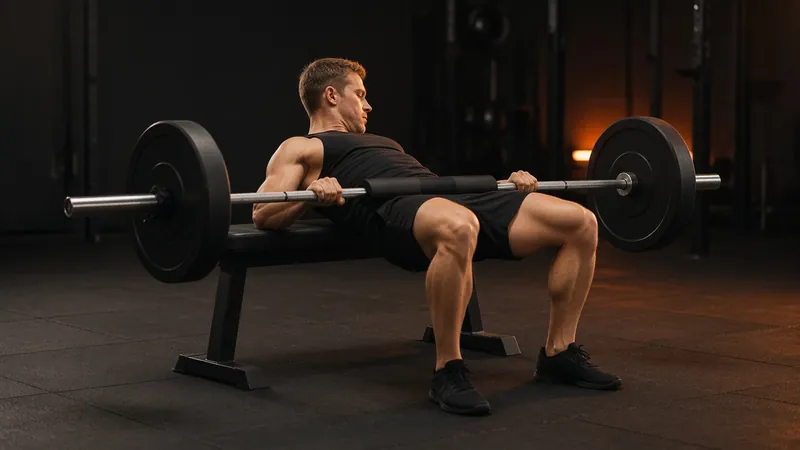
- Sit on the floor with the lower edge of your shoulder blades against a stable bench, about knee height. Put the bench against a wall or rack so it can't slide.
- Roll a padded barbell over your legs until it sits in the crease of your hips. Hold it with both hands just outside your hips.
- Plant your feet flat, about shoulder width apart, toes turned out slightly. Place them so your shins are close to vertical at the top.
- Tuck your chin slightly and look forward rather than at the ceiling.
Step by step
- Brace your trunk and push through the whole foot, heels in particular.
- Drive the hips up until your thighs and torso form a straight line. Your upper back pivots on the bench; your neck stays in line with your trunk.
- Lock out with the glutes, not the lower back: ribs down and a slight posterior pelvic tilt at the top. Hold for a one-second squeeze.
- Lower under control until the plates are just above the floor or lightly touch it, then start the next rep without relaxing.
Coaching cues
- “Ribs down, squeeze the glutes.”
- “Shins vertical at the top.”
- “Eyes forward: the head moves with the torso.”
- “Push the floor away through your heels.”
Common mistakes and fixes
Variations
| Variation | Why use it |
|---|---|
| Hip thrust machine | Fastest to set up and easy to load. Good for higher-rep sets close to failure. |
| Smith machine hip thrust | A fixed path removes the balance demand; set it up the same way. |
| Dumbbell or single-leg hip thrust | Good home option. The single-leg version doubles the load per side without a heavy bar. |
| Glute bridge | Shoulders on the floor, so a shorter range. Fine as a beginner step or a finisher. |
| Band-resisted hip thrust | Adds resistance at the top, where the movement is easiest with free weights. |
How to program it
Use 3–4 sets of 8–15 reps with 1–3 reps in reserve and 2 minutes' rest. Pair it with a squat or lunge pattern for the quads and a hinge like the Romanian deadlift for the hamstrings. Count each set as a hard glute set in your weekly volume and see the full-body program for one place to slot it in.
Hip thrust or squat for glute growth?
The hip thrust became popular because it lights up the glutes. In an EMG study of 13 trained women using 10RM loads, the barbell hip thrust produced higher mean and peak gluteus maximus activity than the back squat (Contreras et al., 2015). EMG measures electrical activity during a set. It doesn’t measure growth, and the authors themselves said training studies were needed.
That training study arrived in 2023. Plotkin et al. randomised untrained college-aged adults to 9 weeks of set-equated training with either the hip thrust (n = 18) or the back squat (n = 16) and measured the muscles with MRI. Glute growth was similar in both groups. The squat group grew more in the quadriceps and adductors, and each group got stronger mostly at the lift it trained. Deadlift strength improved similarly in both. Higher glute EMG during the first hip thrust session did not consistently predict who grew the most glute muscle (Plotkin et al., 2023).
Evidence note (moderate): one MRI training study, in untrained young adults, over 9 weeks. We don’t yet know if the result holds for advanced lifters or over longer blocks. Two of the authors, who sell training products, helped design the study and partly funded it through a gift to the lab; the paper discloses this.
What that means in practice
- The hip thrust is a good glute exercise, but it isn’t magic. Deep squats also build the glutes well: in Kubo et al. (2019), full squats grew the gluteus maximus by about 6.7% in 10 weeks versus about 2.2% for half squats.
- Choose by goal and joint comfort. If you want glutes without much extra quad and knee loading, or squats bother your back, the hip thrust is an easy way to add glute volume. If you want the whole thigh, squats or lunges give you more per set.
- Use both if you want to specialise. Many lifters do a squat or split squat plus a hip thrust each week. The hip thrust is easy to recover from, so you can add sets without much extra fatigue.
Getting the setup right
Most problems with the hip thrust come from the setup, not the effort. A bench that slides, feet that are too far forward or a bar sitting on the stomach will move the work away from the glutes. Spend the first two sessions with light loads and film yourself from the side. At lockout you should see a straight line from shoulders to knees, shins close to vertical and no extra arch in the lower back.
Loading a heavy bar while sitting on the floor is awkward. Use large-diameter plates (bumper plates if you have them) so the bar clears your legs, or start on a hip thrust machine or Smith machine.
How many sets?
Glute volume follows the same rules as every other muscle: more weekly hard sets tend to give more growth, up to a point (Schoenfeld et al., 2017). If you squat or lunge and do RDLs, your glutes already get work. Two to four sets of hip thrusts once or twice a week is plenty for most lifters; a glute specialisation block can go higher.
FAQ
Are hip thrusts better than squats for glutes?
Not clearly. The one MRI study that compared them found similar glute growth over 9 weeks, while squats also grew the quads and adductors more (Plotkin et al., 2023). Pick the one that fits your goals, or do both.
How heavy should hip thrusts be?
Heavy enough that the last reps of a set of 8–15 are hard, with 1–3 reps left in reserve. Many lifters end up hip thrusting more than they squat, so the load on the bar can look big. Keep full range and a clean lockout first.
Why do I feel hip thrusts in my lower back or hamstrings?
Lower back: you are probably arching to finish the rep, so keep the ribs down and stop when the hips are level. Hamstrings: your feet are likely too far from the bench. Bring them in until the shins are vertical at the top.
Can I do hip thrusts at home?
Yes. Use a sturdy sofa or bench and a dumbbell, a backpack or a band, or do single-leg hip thrusts. Take sets close to failure; lighter loads still build muscle when the effort is high.
References
- Contreras B, Vigotsky AD, Schoenfeld BJ, Beardsley C, Cronin J. A Comparison of Gluteus Maximus, Biceps Femoris, and Vastus Lateralis Electromyographic Activity in the Back Squat and Barbell Hip Thrust Exercises. J Appl Biomech. 2015;31(6):452-458. doi:10.1123/jab.2014-0301. PubMed: 26214739 ↩
- Plotkin DL, Rodas MA, Vigotsky AD, et al. Hip thrust and back squat training elicit similar gluteus muscle hypertrophy and transfer similarly to the deadlift. Front Physiol. 2023;14:1279170. doi:10.3389/fphys.2023.1279170. PubMed: 37877099 ↩
- Kubo K, Ikebukuro T, Yata H. Effects of squat training with different depths on lower limb muscle volumes. Eur J Appl Physiol. 2019;119(9):1933-1942. doi:10.1007/s00421-019-04181-y. PubMed: 31230110 ↩
- Schoenfeld BJ, Ogborn D, Krieger JW. Dose-response relationship between weekly resistance training volume and increases in muscle mass: A systematic review and meta-analysis. J Sports Sci. 2017;35(11):1073-1082. doi:10.1080/02640414.2016.1210197. PubMed: 27433992 ↩