Dips (Parallel Bar Dips)
How to do parallel bar dips: setup, step-by-step technique, chest-focused versus triceps-focused dips, a safe depth for your shoulders, progressions from bench to weighted dips, common mistakes and what the research shows.
Primary muscles
Secondary muscles
Equipment
Parallel dip bars or a dip station; a dip belt for added load, a band or assisted dip machine to make it easier
Level
Intermediate–advanced
Setup
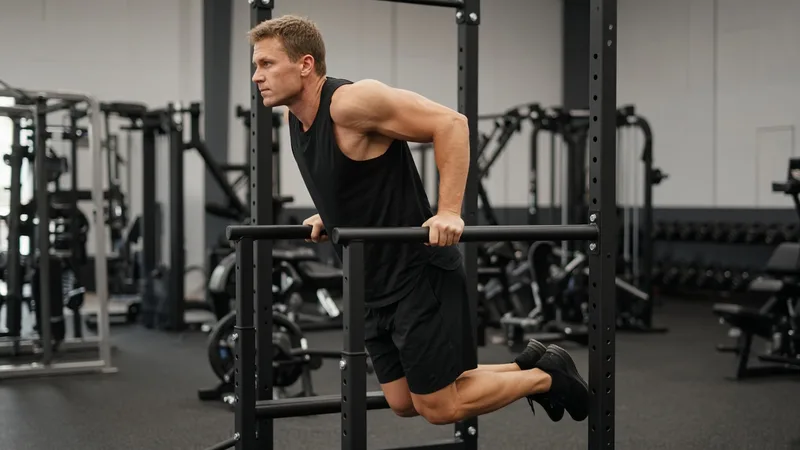
- Use bars about shoulder width apart, or a little wider. Bars that are much wider than your shoulders put more stress on the front of the shoulder.
- Grip the bars with your palms facing in and jump or step up to straight arms. Wrists stay stacked over the elbows.
- Push the shoulders down away from the ears and keep the chest up. Bend the knees and cross the ankles behind you if your feet would hit the floor.
- Choose your lean before the first rep: torso more upright for triceps, leaning forward around 20–30 degrees for chest.
Step by step
- Brace your trunk and keep the shoulders down and back.
- Lower under control for two to three seconds by bending the elbows. They track backwards, not flared out to the sides.
- Stop at a depth your shoulders tolerate: for most lifters that is when the upper arms are about parallel to the floor and you feel a stretch across the chest. Go no deeper than you can control without the shoulders rolling forward.
- Press back up by driving the hands down into the bars until the arms are straight, without shrugging the shoulders up to the ears.
Coaching cues
- “Shoulders away from the ears.”
- “Lean in for chest, stay tall for triceps.”
- “Elbows back, not out.”
- “Slow down, push the bars into the floor.”
Common mistakes and fixes
Variations
| Variation | Why use it |
|---|---|
| Bench dip | Hands on a bench behind you, feet on the floor. Easier to load lightly, but it needs more shoulder extension, so it often bothers the shoulders more. Use it as a short-term step, not a long-term staple. |
| Assisted dip (band or machine) | The best way to learn a full-range bar dip and to reach the rep target with good form. |
| Weighted dip | Add load with a dip belt, a dumbbell between the feet or a weight vest once bodyweight reps are easy. |
| Ring dip | Harder to stabilise. Muscle activity is similar to the bar dip, with some muscles working harder. Learn the bar dip first. |
| Machine dip or decline press | A similar downward-pushing pattern with no balance demand, good for high-rep sets close to failure. |
How to program it
Use 3–4 sets of 6–15 reps with 1–3 reps in reserve and 2 minutes' rest. Put chest-focused dips after your main press, or use upright dips as the first triceps exercise. Count each set as a hard set for the chest or triceps, depending on your lean, and about half a set for the other. Pair them with the incline dumbbell press for the upper chest and the overhead triceps extension for the long head of the triceps.
Chest or triceps: what the dip actually trains
The parallel bar dip is a compound push where you lower and raise your own body weight. The pectoralis major (especially the lower fibres), the triceps and the front delts do most of the work. Your torso angle decides the balance: leaning forward puts more of the load on the chest, while staying upright shifts it toward the triceps. That’s the standard coaching view, and it follows from the mechanics, but we found no study that measured chest and triceps activity across different lean angles. Treat it as coaching experience, not a measured result.
What the research shows
Research on the dip itself is thin. The two most detailed studies come from one research group in Australia.
- Bench vs bar vs ring dips. McKenzie et al. (2022) filmed 13 experienced men with 3D motion capture and measured muscle activity in all three versions. The bench dip mainly targets the triceps but needs a larger range of shoulder extension. Peak triceps activity was lower on the bench (0.83 mV) than on the bar (1.04 mV) or rings (1.05 mV). The authors called the bar dip an appropriate progression from the bench dip. The ring dip had similar peak activity to the bar dip, with three muscles working harder.
- What happens when you get tired. In a second study, 15 healthy men did one set of bar dips to exhaustion (McKenzie et al., 2022). As fatigue set in, each rep got slower and peak activity of the chest and triceps rose, but the maximum joint angles didn’t change. In other words, the dip didn’t fall apart as the set got hard, and it worked the chest and triceps effectively right to the end.
Evidence note (preliminary): two small EMG and motion-capture studies in men, from one lab. They describe how the dip is performed and which muscles work, but no study has measured muscle growth from dips specifically. We recommend dips because they load the chest and triceps through a long range with a simple progression, not because of a dip-specific growth trial.
Are dips bad for your shoulders?
Dips put the shoulder into extension under load, and the bench dip needs even more shoulder extension than the bar dip (McKenzie et al., 2022). Lifters with a history of shoulder pain often find deep or fast dips uncomfortable. That doesn’t make dips dangerous for everyone. It means depth and control matter:
- Lower slowly and stop around the point where the upper arms are parallel to the floor, or a bit higher if that’s what your shoulders tolerate.
- Keep the shoulders down and the elbows tracking back.
- Build up from assisted reps instead of grinding out ugly bodyweight reps.
- If dips hurt the front of the shoulder even with good technique, swap them for a machine dip, a decline press or close-grip pressing. See a physiotherapist or doctor if the pain persists.
How to progress, from zero to weighted dips
- Can’t do one yet? Use an assisted dip machine or a band looped over the bars. Do 3 sets of 8–12 reps and reduce the assistance over time. Slow negatives (lowering for 3–5 seconds and stepping back up) also work.
- Bodyweight dips. Use double progression: aim for 3 sets of 6–12, add reps each week, and move on when every set reaches 12–15 controlled reps.
- Weighted dips. Add a small load with a dip belt (2.5–5 kg), drop back to about 6–8 reps, and build up again. Keep the same depth on every rep.
For more on adding load and reps over time, see progressive overload. Count dip sets toward your weekly chest and triceps volume. More weekly hard sets tend to give more growth, up to a point (Schoenfeld et al., 2017), and most lifters do well with roughly 10–20 hard sets per muscle per week. Our guide to sets per week explains how to count them.
FAQ
Do dips build the chest or the triceps?
Both. In coaching practice, a forward lean shifts more work to the chest and a more upright torso to the triceps, although no study has measured lean angle directly. Measured activity in the chest and triceps is high in bar dips, and it rises further as a set nears failure (McKenzie et al., 2022).
How deep should you go on dips?
Most lifters do well stopping when the upper arms are about parallel to the floor and the chest feels stretched. Go only as deep as you can control without the shoulders rolling forward or hurting.
Are bench dips as good as bar dips?
Not quite. Bench dips produced lower peak triceps activity than bar dips and needed more shoulder extension (McKenzie et al., 2022). Use them as a stepping stone and move to assisted or full bar dips.
How many dips should I be able to do?
There’s no single standard. A good practical target is three sets of 12–15 controlled bodyweight reps before you add weight.
Can dips replace the bench press?
They can cover a lot of the same chest and triceps work, especially at home or with limited equipment. If you also want a big bench press for strength, keep benching, because strength gains are most specific to the lift you train.
References
- McKenzie A, Crowley-McHattan Z, Meir R, Whitting J, Volschenk W. Bench, Bar, and Ring Dips: Do Kinematics and Muscle Activity Differ? Int J Environ Res Public Health. 2022;19(20):13211. doi:10.3390/ijerph192013211. PubMed: 36293792 ↩
- McKenzie A, Crowley-McHattan Z, Meir R, Whitting J, Volschenk W. Fatigue Increases Muscle Activations but Does Not Change Maximal Joint Angles during the Bar Dip. Int J Environ Res Public Health. 2022;19(21):14390. doi:10.3390/ijerph192114390. PubMed: 36361276
- Schoenfeld BJ, Ogborn D, Krieger JW. Dose-response relationship between weekly resistance training volume and increases in muscle mass: A systematic review and meta-analysis. J Sports Sci. 2017;35(11):1073-1082. doi:10.1080/02640414.2016.1210197. PubMed: 27433992 ↩