Bulgarian Split Squat
How to do the Bulgarian split squat (rear-foot-elevated split squat): bench height and foot distance, quad vs glute bias, technique, cues, common mistakes, what the research shows, variations and programming.
Primary muscles
Secondary muscles
Equipment
A bench or box about knee height and a pair of dumbbells; a barbell or Smith machine also works
Level
Beginner–advanced
Setup
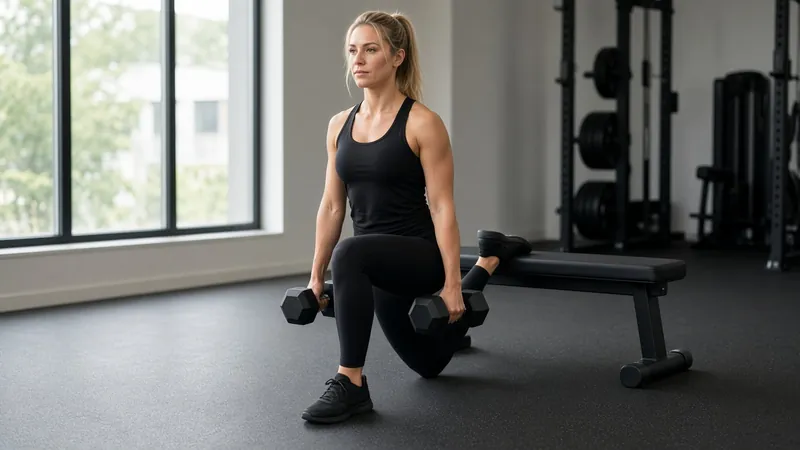
- Stand about one long stride in front of a bench that is roughly knee height or a little lower.
- Reach one foot back and rest the top of it (laces down) or the ball of the foot on the bench.
- Hold a dumbbell in each hand at your sides. Your front foot points forward and stays flat on the floor.
- Do one bodyweight rep to check the distance: at the bottom, your front heel stays down and you feel the work in the front leg, not a strain at the front of the back hip.
Step by step
- Brace and keep most of your weight on the front foot. The back leg is mainly for balance.
- Lower by bending the front knee and hip until the back knee is just above the floor, or the front thigh is about parallel or a little below.
- Let the front knee travel forward over the toes if it's comfortable. That's normal and loads the quads.
- Drive up through the whole front foot to standing, without pushing off the back foot.
- Finish all reps on one side, then switch. Start each set with your weaker leg.
Coaching cues
- “Front foot does the work, back foot just balances.”
- “Straight down, like an elevator.”
- “Whole foot on the floor.”
- “Slight lean for glutes, tall torso for quads.”
Common mistakes and fixes
Variations
| Variation | Why use it |
|---|---|
| Smith machine Bulgarian split squat | Less balance demand, so you can push the legs closer to failure. |
| Goblet Bulgarian split squat | One dumbbell at the chest; easy to load for beginners, but grip and upper back may limit heavy sets. |
| Front-foot-elevated split squat | A small plate under the front foot adds depth and stretch for the quads and glutes. |
| Static split squat | Both feet on the floor. Easier to balance and a good first step before the Bulgarian version. |
| Walking or reverse lunge | Similar muscles with more balance and coordination; better when you want a conditioning effect. |
How to program it
Use 3–4 sets of 6–12 reps per leg with 1–3 reps in reserve and 2 minutes' rest between rounds. It works as the main leg exercise on a home or low-back-friendly day, or as a second quad and glute exercise after squats. Pair it with a Romanian deadlift or a leg curl for the hamstrings, and see the upper/lower program for a lower day that fits it.
Why the Bulgarian split squat is worth the suffering
The Bulgarian split squat loads one leg at a time through a long range of motion. The front leg’s quads and glutes do most of the work, and the deep bottom position puts those muscles under load at long lengths. You can get a lot of training out of light dumbbells, and the spine carries far less load than in a heavy back squat.
What the research says
There are no long-term studies we could find that measured muscle growth from the Bulgarian split squat on its own, so the case for it rests on related evidence.
- It builds strength about as well as squats. In a 5-week study of 18 academy rugby players, training the rear-foot-elevated split squat improved back squat strength, split squat strength, 40 m sprint and agility about as much as training the back squat (Speirs et al., 2016). That’s a short study in young athletes and it didn’t measure muscle size.
- Depth matters for the glutes and adductors. When 17 men trained the squat at full or half depth for 10 weeks, both groups grew their quads by a similar amount, but the full-depth group grew the glutes and adductors more (Kubo et al., 2019). A full-range split squat gives you that deep position on each leg.
- Volume still drives growth. Count each set per leg as a hard set for the quads and glutes. More weekly hard sets tend to bring more growth (Schoenfeld et al., 2017).
Evidence note (no direct hypertrophy data): we found no training study measuring muscle growth from the Bulgarian split squat itself. The recommendation is based on studies of squat depth, a short strength study of the exercise and coaching experience.
Quads or glutes: adjusting the lean
You can shift the emphasis with small changes. A more upright torso with the front knee travelling forward biases the quads. A slight forward lean from the hips, with a slightly longer stance, gives the glutes and adductors more of the work. Both versions train both muscles; the differences are modest, so choose the one that feels right in your hips and knees and stay with it so you can track progress.
How to progress it
Start with bodyweight until you can do 3 sets of 12 per leg with steady balance. Then add load in small steps: when you reach the top of your rep range on every set with 1–2 reps left, move up to the next dumbbells. When grip limits you, use straps or switch to a Smith machine or barbell version.
FAQ
Is the Bulgarian split squat better than the back squat?
Neither is clearly better. A short study found similar strength gains from either (Speirs et al., 2016). The split squat needs less load and is easier on the lower back, while the back squat is easier to load very heavily. Many programs use both.
How far should my front foot be from the bench?
Far enough that your front heel stays flat and your back knee drops toward the floor without the knee crowding over the foot. For most people that’s roughly one long stride. A slightly longer stance biases the glutes; a shorter one biases the quads.
Why do I feel it in my back leg’s hip flexor?
The stance is probably too long or the bench too high, which stretches the front of the back hip. Shorten the stance, use a lower bench and keep more weight on the front foot.
How do I stop losing my balance?
Use a slightly wider stance (feet not on one line), look at a fixed point, start with the static split squat or hold a rack with one hand. The Smith machine version removes most of the balance demand.
References
- Speirs DE, Bennett MA, Finn CV, Turner AP. Unilateral vs. Bilateral Squat Training for Strength, Sprints, and Agility in Academy Rugby Players. J Strength Cond Res. 2016;30(2):386-392. doi:10.1519/JSC.0000000000001096. PubMed: 26200193 ↩
- Kubo K, Ikebukuro T, Yata H. Effects of squat training with different depths on lower limb muscle volumes. Eur J Appl Physiol. 2019;119(9):1933-1942. doi:10.1007/s00421-019-04181-y. PubMed: 31230110 ↩
- Schoenfeld BJ, Ogborn D, Krieger JW. Dose-response relationship between weekly resistance training volume and increases in muscle mass: A systematic review and meta-analysis. J Sports Sci. 2017;35(11):1073-1082. doi:10.1080/02640414.2016.1210197. PubMed: 27433992 ↩