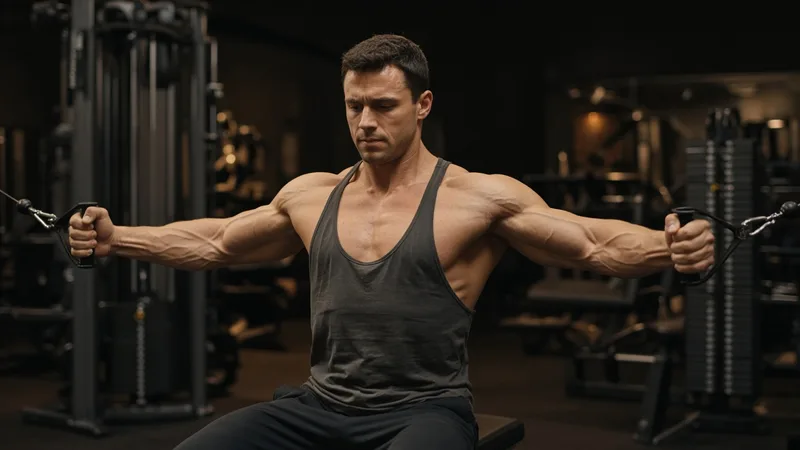
Lengthened Partials: Training in the Stretch
Lengthened partials explained: what the 2025–2026 trials found against full reps, which exercises suit them, and a simple 4-week plan to start using them.
Key takeaways
- A lengthened partial is a rep that stays in the stretched half of the movement: the bottom of a calf raise, the arms-straight half of a pulldown, the deep half of a fly.
- In trained lifters, four recent trials found lengthened partials gave about the same growth as full reps (Wolf et al., 2025; Havers et al., 2025; Gschneidner et al., 2025; Plotkin et al., 2026).
- Partials in the shortened (top) half grow muscle less. Full range beat partial range in a 2021 meta-analysis, and studies where partials beat full reps used the stretched half (Pallarés et al., 2021; Kassiano et al., 2023).
- The easiest way to start is an extended set: full reps to about 0–1 RIR, then 4–8 lengthened partials. Count it as one hard set.
- Use them on exercises that are hard in the stretch (calf raises, leg extensions, preacher curls, pulldowns, cable flyes), not on heavy squats and deadlifts.
Lengthened partials are reps where you only use the stretched half of an exercise. On a calf raise you stay between a deep stretch and halfway up. On a lat pulldown you work from arms straight to roughly forehead height. On a preacher curl you stay in the bottom half. Lifters often call them “long-length partials” or, when they come at the end of a set, “extended sets”.
They went from gym curiosity to one of the most studied training ideas in just a few years. This guide explains what the trials found (including several from 2025 and 2026), where the evidence is still thin, which exercises suit lengthened partials, and how to add them to your program without wrecking your recovery. It sits in our Training Methods section, and if you want the bigger picture of how methods fit into a weekly plan, start with our pillar on every training split.
Evidence in one line: in trained lifters, lengthened partials build about as much muscle as full reps, and clearly more than partials in the top half. Whether they beat full reps is still uncertain.
What this page covers. This page is about the partial-range technique itself. Choosing exercises that load a muscle at long lengths (overhead triceps extensions, seated leg curls, incline curls) is a related but separate topic, covered in our guide to training at long muscle lengths. Drop sets, supersets and rest-pause are covered in our guide to intensity techniques.
Key terms
- Range of motion (ROM): how far a joint moves during a rep. Full ROM means the whole safe range the exercise allows.
- Lengthened partial: a rep that only uses the part of the range where the target muscle is stretched (long).
- Shortened partial: a rep that only uses the part where the muscle is short and contracted (the top of a curl, the lockout of a press).
- Extended set (past-failure partials): a set of full reps taken close to failure, followed straight away by lengthened partials with the same weight.
- RIR (reps in reserve): how many more reps you could have done before failure. 1 RIR means you stopped one rep short. See our guide to training to failure vs RIR.
- Regional hypertrophy: growth that differs along the length of a muscle (for example more growth near the knee than near the hip).
Three ways to use lengthened partials
| Method | How it works | Best for |
|---|---|---|
| Straight lengthened-partial sets | Every rep stays in the stretched half, for the whole set | Calf raises, leg extensions, preacher curls, machine flyes |
| Extended set | Full reps to about 0–1 RIR, then 4–8 lengthened partials without resting | The last set of an isolation exercise; the easiest place to start |
| Mixed ROM | Alternate full-range sessions and lengthened-partial sessions, or do some sets each way | Lifters who want variety and to keep full-range strength |
All three keep the part of the rep most studies suggest matters: tension on the muscle while it is long. The difference is how much of the full range you keep.
What the research says
Older studies: full range usually beat “partials”
For years the advice was simple: use full range of motion. A 2020 systematic review found that full-range training gave more lower-body growth than partial-range training, while upper-body results were limited and conflicting (Schoenfeld & Grgic, 2020). A 2021 meta-analysis of 16 studies reached a similar conclusion: full range produced more strength and more lower-limb hypertrophy than partial range (Pallarés et al., 2021).
The catch is that those reviews pooled partials done in very different parts of the range. In an 8-week trial, the group using a shorter knee range grew much less at the distal thigh than the group using a longer range (McMahon et al., 2014). So the old conclusion was really “full range beats short-range partials”, not “full range beats every partial”.
When the partial is in the stretch
Once researchers started comparing the stretched half with the contracted half, the picture changed:
- Pedrosa et al. (2022): 45 untrained women trained the knee extension with full range, the initial (knee-bent, stretched) half, the final (knee-straight) half, or alternated the two. The initial-half group gained more muscle in several regions of the thigh than the full-range and final-half groups. The final-half group grew no more than the non-training control group at two of the four measured sites.
- Kassiano et al. (2023): 42 young women did calf raises 3 times a week for 8 weeks. Training only the stretched (dorsiflexed) half increased medial gastrocnemius thickness by 15.2%, compared with 6.7% for full range and 3.4% for the top half.
- Pedrosa et al. (2025): a second knee-extension trial in 50 untrained women found that initial-half, full-range and alternating groups grew most (13.2–17%), and all three beat training only the final half.
- McMahon et al. (2026): 45 people trained knee extensions for 8 weeks. Lengthened partials at 55% of 1RM gave similar quadriceps growth to full range at 80% of 1RM, more than shortened partials at some sites, and larger increases in fascicle length (the length of muscle fibre bundles).
One older trial is an outlier worth knowing about. Goto et al. (2019) had 44 trained men do triceps extensions over either a middle range (45–90° at the elbow) or a full range. The partial group gained more triceps area (48.7% vs 28.2%). Those gains are unusually large for 8 weeks, the partial was mid-range rather than lengthened, and the result has not been repeated. Treat it as a curiosity, not a rule.
Trained lifters: about the same as full reps
The most relevant studies for experienced lifters come from 2025 and 2026, and they agree closely:
- Wolf et al. (2025): 30 resistance-trained adults trained one arm with lengthened partials and the other with full range, in an 8-week upper-body program (four exercises, four sets each, twice a week). Growth of the elbow flexors and extensors and lat-pulldown performance were similar. The authors concluded lifters should emphasise the stretched position, either with full range or with lengthened partials. One co-author (Jeff Nippard) runs a fitness business, as disclosed in the paper.
- Havers et al. (2025): 13 trained lifters did preacher curls with one arm in the stretched half (0–70°) and the other through full range (0–140°) for 8 weeks. Growth at mid-arm was similar. The partial arm had a trivial to small advantage nearer the elbow, while full range gave negligibly better strength.
- Gschneidner et al. (2025): the largest study so far, with 297 people across 15 training sites over 12 weeks. The authors judged the differences in arm and thigh muscle size between lengthened partials and full range to be small and practically equivalent.
- Plotkin et al. (2026): 16 trained men (about 8 years of training) used lengthened partials on one leg and full range on the other, on the leg press, leg extension and lying leg curl, twice a week for 8 weeks. Quadriceps growth measured by MRI did not differ, and neither did fibre size, myonuclei or satellite cells. The authors call the study exploratory.
Past-failure partials (extended sets)
Three calf studies tested adding lengthened partials after failure:
- Larsen et al. (2025a): 23 untrained men did standing calf raises to failure on one leg, and to failure plus lengthened partials on the other, for 10 weeks. The extra partials gave more growth (+9.6% vs +6.7%), with strong statistical support.
- Larsen et al. (2025b): in 23 trained men and women, one leg did stretched-half partials only and the other did full reps plus past-failure partials. Both grew well. The partials-only leg had a slight, uncertain edge.
- Goli et al. (2026): 16 untrained men matched total volume load. One leg did normal sets to failure; the other did half as many sets, each extended with partials to a second failure. Growth was the same (about 8% in both), so the extended sets got the same result from fewer sets.
The big-picture reviews
- Varovic et al. (2025) pooled 12 studies that trained muscles at longer versus shorter average lengths. Differences in regional growth were trivial, with a slight trend in favour of longer lengths near the end of the muscle (distal sites). The authors note that the “long” and “short” conditions in most studies were not very different.
- Wolf et al. (2026), a systematic review of 8 studies (120 people), concluded that training at longer muscle lengths may give more growth and longer fascicles, but the evidence is mixed and the measurement methods have limits.
- Pedrosa et al. (2026) reviewed isometric, range-of-motion and exercise-selection studies. Their key point: the extra growth seen at long lengths appears when there is real resistance in the stretched position. A partial in a part of the range where the exercise is easy does little.
Evidence grade
| Question | Evidence | Grade |
|---|---|---|
| Do lengthened partials build muscle? | Many RCTs, including large and trained samples | Strong |
| Are they as good as full reps? | 4 trials in trained lifters, 1 large multi-site trial | Moderate |
| Are they better than full reps? | Some positive studies (mostly untrained women, calves, quadriceps); meta-analysis shows trivial differences | Uncertain |
| Are they better than top-half partials? | Several RCTs agree | Moderate |
| Do extended sets add growth? | 3 calf studies, mixed designs | Promising / preliminary |
| Upper chest, back, shoulders, glutes? | Very little direct data | No direct evidence |
Why the stretched position might matter
Nobody knows the full mechanism yet. The ideas researchers discuss are:
- Tension at long lengths: a muscle that produces force while stretched experiences both active and passive tension. Mechanical tension is the main driver of growth (see how muscle grows).
- Longer fascicles: some studies found fascicle length increased more after training at long lengths (McMahon et al., 2026; Wolf et al., 2026), which may mean sarcomeres are being added in series.
- Where fatigue happens: at the end of a hard set you can usually still move the weight through the stretched part when you can no longer lock it out, so lengthened partials let you keep working the muscle where it is weakest.
These are plausible explanations, not proven ones. The outcome studies above are what matter.
Which exercises suit lengthened partials
The rule from Pedrosa et al. (2026) is the one to use: the exercise must be hard in the stretched position. If an exercise is easy at the bottom, partials there are mostly wasted effort.
| Exercise | Lengthened half | Why it works | Notes |
|---|---|---|---|
| Standing calf raise | Deep stretch to halfway up | Strongest evidence of any muscle | Pause 1 s at the bottom; no bouncing |
| Leg extension | Knees bent to about halfway | Two trials in favour (Pedrosa et al., 2022; 2025) | Set the seat so you start deep |
| Seated or lying leg curl | Legs straight to about halfway | Tested in Plotkin et al. (2026) | Seated curls gave more hamstring growth than lying curls (Maeo et al., 2021) |
| Preacher curl / biceps curl | Arms straight to about halfway | Tested in Havers et al. (2025) | Preacher or incline curls load the stretch best |
| Lat pulldown and pull-ups | Arms straight to bar at forehead | Pulldown performance improved similarly in Wolf et al. (2025) | Let the shoulder blades rise at the top |
| Overhead triceps extension | Deep stretch to about halfway | The overhead position gave more triceps growth than arms at the sides (Maeo et al., 2023) | Use cables or a light dumbbell |
| Cable or machine fly | Arms wide to about halfway in | Cables keep tension in the stretch | Don’t force the shoulder past a comfortable depth |
| Leg press / hack squat | Deep half | Tested in Plotkin et al. (2026) | Keep your lower back on the pad |
| Romanian deadlift | Bottom half | Hamstrings at long length | Use moderate loads; stop if your back rounds |
Poor choices:
- Heavy barbell squats, deadlifts and bench presses: grinding partials at the bottom of heavy free-weight compounds under fatigue adds injury risk for little gain. Use full reps there.
- Dumbbell lateral raises: the bottom of the movement has almost no resistance, so partials there do little. Use a cable lateral raise from behind the body instead.
- Exercises that hurt in the stretch: a deep stretch under load should feel strong, not sharp. Shorten the range if a joint complains.
Practical protocols
Protocol A: extended sets (start here)
| Step | What to do |
|---|---|
| Load | A weight you can lift for about 8–15 full reps |
| Full reps | Stop at about 0–1 RIR (one rep short of failure, or at failure on safe machines) |
| Partials | Without resting, do 4–8 reps in the stretched half, until you can’t move the weight halfway |
| Where | The last set of 1–2 isolation exercises per session |
| Rest | 1.5–3 minutes before the next exercise |
| Counting | Count each extended set as one hard set in your weekly volume. That is our counting rule, not a measured value |
Protocol B: straight lengthened-partial sets
| Exercise | Sets × reps | Effort | Rest |
|---|---|---|---|
| Standing calf raise (deep half) | 3 × 10–15 | 0–1 RIR | 1.5–2 min |
| Leg extension (knees-bent half) | 3 × 10–15 | 1 RIR | 1.5–2 min |
| Seated leg curl (legs-straight half) | 3 × 10–12 | 1 RIR | 1.5–2 min |
| Preacher curl (bottom half) | 3 × 10–15 | 1 RIR | 1.5 min |
| Cable overhead triceps extension (deep half) | 3 × 10–15 | 1 RIR | 1.5 min |
Use the same weight you would use for full reps or slightly more. Many lifters find they can handle a little more load in the stretched half, because the top of the movement, where they would normally fail, is removed. Add load only if you go past the top of the rep range.
Protocol C: mixed ROM
The alternating groups in the knee-extension trials grew as well as the best groups and kept strength across the whole range (Pedrosa et al., 2022; Pedrosa et al., 2025). A simple way to copy that:
- Session 1 of the week: full-range sets.
- Session 2 of the week: lengthened-partial sets on the same exercise.
Sample week (upper/lower, 4 days)
| Day | Where lengthened partials go |
|---|---|
| Upper A | Lat pulldown: last set extended. Preacher curl: 3 straight lengthened-partial sets |
| Lower A | Leg extension: last set extended. Standing calf raise: 3 straight lengthened-partial sets |
| Upper B | Cable fly: last set extended. Overhead triceps extension: last set extended |
| Lower B | Seated leg curl: last set extended. Calf raise: full range |
Everything else (squats, presses, rows, deadlifts) stays full range. For a complete four-day template, see our upper/lower split guide.
A 4-week block to try
| Week | Change | Notes |
|---|---|---|
| 1 | Extended set on the last set of 2 isolation exercises per session | Learn where “halfway” is on each exercise |
| 2 | Same, take full reps to 0–1 RIR before the partials | Write down full reps + partials (for example “10 + 6”) |
| 3 | Switch calves and one arm exercise to straight lengthened-partial sets | Keep the extended sets elsewhere |
| 4 | Keep the setup and try to add reps or load | If joints or tendons feel irritated, go back to week 2 |
How to count volume and fit them in
- Weekly sets: most hypertrophy programs land in the 10–20 hard sets per muscle per week range (see sets per week for muscle growth). A straight lengthened-partial set counts as a normal set.
- Extended sets: count each one as one set. Adding them to your last set usually does not require cutting other volume. If recovery suffers, drop one set of that exercise.
- Combining with myo-reps: lengthened partials pair well with myo-reps. Do the activation set through full range, then do the mini-sets as lengthened partials. This combination has not been studied; it is a coaching idea.
Progression
- Track both numbers. Log extended sets as “full reps + partials” (for example 12 + 6). Your goal is to beat either number at the same weight.
- Add weight when the full reps reach the top of the range (for example 15 full reps), then build up again.
- For straight lengthened-partial sets, use double progression: add reps to the top of the range on all sets, then add the smallest load jump available.
- Keep the range honest. Mark the halfway point with a pin, a pad or a mirror reference so the range doesn’t shrink as you fatigue.
- Deload when reps fall for two sessions in a row on several exercises: return to full-range sets at 2–3 RIR for a week. See progressive overload for more options.
Lengthened partials compared with other options
| Lengthened partials | Full ROM | Shortened partials | Extended sets | |
|---|---|---|---|---|
| Hypertrophy evidence | About equal to full ROM in trained lifters | Gold standard | Clearly worse | Promising (calves) |
| Strength across the full range | Slightly lower at the top end | Best | Best at the top only | Good, because full reps are kept |
| Joint and tendon stress | Higher in the stretch | Moderate | Low in the stretch | Moderate to high |
| Best use | Isolation and machines | Everything | Lockout work for strength sports | Last set of isolation work |
Common mistakes
- Doing partials in the wrong half. Half reps at the top of a curl or a calf raise are shortened partials. Stay near the stretch.
- Choosing exercises that are easy in the stretch. Dumbbell lateral raises and kickbacks have little resistance at the long position. Pick cables or machines that load the bottom.
- Bouncing. A fast bounce out of the stretch uses tendon recoil instead of muscle. Control the lowering and pause briefly at the bottom.
- Letting the range shrink. Under fatigue, “half” turns into a few centimetres. Use a fixed reference point.
- Using them on heavy barbell compounds. Save them for machines, cables and dumbbells where failure is safe.
- Doing everything as partials. Full range still builds strength through the whole movement and is just as good for growth. Lengthened partials are a tool, not a replacement.
- Ignoring joint signals. Loaded stretching can irritate tendons and shoulders if you add it all at once. Introduce it over a few weeks.
Make it better
- Pick the right exercise first. An overhead triceps extension or seated leg curl already trains the muscle long. Our guide to long muscle lengths covers exercise selection in depth.
- Combine with a slow eccentric. Lower for 2–3 seconds into the stretch on each partial. It makes the set harder at lighter loads and keeps the range honest.
- Try BFR for joint-friendly volume. On arm and leg isolation work, light-load blood flow restriction training is another way to get hard sets without heavy weights.
Safety notes
- Training in a loaded stretch puts more strain on tendons and joints at their end range. Start lighter than you think and build up over 2–3 weeks.
- Stop and shorten the range if you feel sharp pain, pinching or nerve-like symptoms.
- If you have a current injury, joint replacement or hypermobility, or are under 18, talk to a doctor or physiotherapist before adding loaded end-range work.
FAQ
Are lengthened partials better than full reps?
Not clearly. In trained lifters, four recent trials found about the same muscle growth with lengthened partials and full range (Wolf et al., 2025; Havers et al., 2025; Gschneidner et al., 2025; Plotkin et al., 2026). A few studies in untrained women found more growth with lengthened partials on the calves and quadriceps, but a 2025 meta-analysis found only trivial differences overall (Varovic et al., 2025).
Which exercises are best for lengthened partials?
Exercises that are hard in the stretched position: calf raises, leg extensions, seated leg curls, preacher curls, lat pulldowns, overhead triceps extensions and cable flyes. Avoid heavy barbell squats and deadlifts.
How many lengthened partials should I do?
For extended sets, 4–8 partials after your full reps, on the last set of one or two isolation exercises per session. For straight lengthened-partial sets, use normal hypertrophy ranges (about 10–15 reps, 3 sets).
Do lengthened partials work for the calves?
The calves have the best evidence. Stretched-half calf raises beat full range in young women (Kassiano et al., 2023), and adding partials after failure gave extra growth in untrained men (Larsen et al., 2025a).
Are lengthened partials the same as half reps?
Only if the half reps are in the stretched half. Half reps at the top (shortened partials) build less muscle than full reps.
Can beginners use lengthened partials?
Beginners grow well with full-range training and need to learn technique first. Lengthened partials are safe on machines once you can control the stretch, but they are not necessary in your first months.
References
- Schoenfeld BJ, Grgic J. Effects of range of motion on muscle development during resistance training interventions: A systematic review. SAGE Open Med. 2020;8:2050312120901559. doi:10.1177/2050312120901559. PubMed: 32030125
- Pallarés JG, Hernández-Belmonte A, Martínez-Cava A, et al. Effects of range of motion on resistance training adaptations: A systematic review and meta-analysis. Scand J Med Sci Sports. 2021;31(10):1866-1881. doi:10.1111/sms.14006. PubMed: 34170576
- McMahon GE, Morse CI, Burden A, et al. Impact of range of motion during ecologically valid resistance training protocols on muscle size, subcutaneous fat, and strength. J Strength Cond Res. 2014;28(1):245-55. doi:10.1519/JSC.0b013e318297143a. PubMed: 23629583
- Pedrosa GF, Lima FV, Schoenfeld BJ, et al. Partial range of motion training elicits favorable improvements in muscular adaptations when carried out at long muscle lengths. Eur J Sport Sci. 2022;22(8):1250-1260. doi:10.1080/17461391.2021.1927199. PubMed: 33977835 ↩
- Kassiano W, Costa B, Kunevaliki G, et al. Greater Gastrocnemius Muscle Hypertrophy After Partial Range of Motion Training Performed at Long Muscle Lengths. J Strength Cond Res. 2023;37(9):1746-1753. doi:10.1519/JSC.0000000000004460. PubMed: 37015016 ↩
- Pedrosa GF, Simões MG, Rezende Pereira M, et al. From full to partials: Investigating the impact of range of motion training on maximum isometric action, and muscle hypertrophy in young women. J Sports Sci. 2025;43(15):1440-1451. doi:10.1080/02640414.2025.2502895. PubMed: 40366729 ↩
- McMahon G, Morse C, Burden A, et al. Moderate Intensity Resistance Training With Partial Range-of-Motion at Long Muscle Lengths Elicits Similar Hypertrophy and Architectural Adaptations as High Intensity Resistance Training Using Full Range-of-Motion. J Strength Cond Res. 2026. Online ahead of print. doi:10.1519/JSC.0000000000005561. PubMed: 42392615 ↩
- Goto M, Maeda C, Hirayama T, et al. Partial Range of Motion Exercise Is Effective for Facilitating Muscle Hypertrophy and Function Through Sustained Intramuscular Hypoxia in Young Trained Men. J Strength Cond Res. 2019;33(5):1286-1294. doi:10.1519/JSC.0000000000002051. PubMed: 31034463 ↩
- Wolf M, Androulakis Korakakis P, Piñero A, et al. Lengthened partial repetitions elicit similar muscular adaptations as full range of motion repetitions during resistance training in trained individuals. PeerJ. 2025;13:e18904. doi:10.7717/peerj.18904. PubMed: 39959841 ↩
- Havers T, Wagner N, Held S, et al. Partial Range, Full Gains? The Effect of 8 Weeks of Partial Range of Motion Training at Long Muscle Lengths on Elbow Flexor Hypertrophy and Strength in Trained Individuals. Eur J Sport Sci. 2025;25(12):e70087. doi:10.1002/ejsc.70087. PubMed: 41247250 ↩
- Gschneidner D, Carlson L, Steele J, et al. The effects of lengthened-partial range of motion resistance training of the limbs on arm and thigh muscle area: A multi-site randomised trial. J Sports Sci. 2025;43(23):2963-2976. doi:10.1080/02640414.2025.2567805. PubMed: 41055237 ↩
- Plotkin DL, Tiede DR, Gotla T, et al. Acute Molecular and Chronic Vastus Lateralis Adaptations to Lengthened Partial versus Full Range of Motion Resistance Training in Trained Men. Med Sci Sports Exerc. 2026. Online ahead of print. doi:10.1249/MSS.0000000000004183. PubMed: 42841600 ↩
- Larsen S, Swinton PA, Sandberg NØ, et al. Resistance training beyond momentary failure: the effects of past-failure partials on muscle hypertrophy in the gastrocnemius. Front Psychol. 2025;16:1494323. doi:10.3389/fpsyg.2025.1494323. PubMed: 39995432
- Larsen S, Sandberg NØ, Schoenfeld BJ, et al. Resistance Training Beyond Momentary Failure: The Effects of Past-Failure Partials Versus Initial Partials on Calf Muscle Hypertrophy Among a Resistance-Trained Cohort. Eur J Sport Sci. 2025;25(9):e70030. doi:10.1002/ejsc.70030. PubMed: 40850937
- Goli A, Attarieh P, Nunes JP, et al. Does Performing Partial Repetitions Beyond Momentary Failure Enhance Muscle Hypertrophy in Volume-Load-Equated Calf-Raise Resistance Training? Int J Exerc Sci. 2026;19(4):4003. doi:10.70252/IJES2026403. PubMed: 42006449 ↩
- Varovic D, Wolf M, Schoenfeld BJ, et al. Does Muscle Length Influence Regional Hypertrophy? A Systematic Review and Meta-Analysis. Int J Sports Med. 2025;46(14):1027-1036. doi:10.1055/a-2615-4935. PubMed: 40570881 ↩
- Wolf M, Korakakis PA, Roberts MD, et al. Does longer-muscle length resistance training cause greater longitudinal growth in humans? A systematic review. Sports Med Health Sci. 2026;8(1):34-42. doi:10.1016/j.smhs.2025.03.001. PubMed: 41646176 ↩
- Pedrosa GF, Pereira MR, Kassiano W. The interplay between muscle length, range of motion, and exercise selection: a review. Sports Med Int Open. 2026;10:a27337605. doi:10.1055/a-2733-7605. PubMed: 41777276 ↩
- Maeo S, Huang M, Wu Y, et al. Greater Hamstrings Muscle Hypertrophy but Similar Damage Protection after Training at Long versus Short Muscle Lengths. Med Sci Sports Exerc. 2021;53(4):825-837. doi:10.1249/MSS.0000000000002523. PubMed: 33009197 ↩
- Maeo S, Wu Y, Huang M, et al. Triceps brachii hypertrophy is substantially greater after elbow extension training performed in the overhead versus neutral arm position. Eur J Sport Sci. 2023;23(7):1240-1250. doi:10.1080/17461391.2022.2100279. PubMed: 35819335 ↩