Pre-Exhaust Training: Does It Work?
Pre-exhaust training tested: what three long-term trials found for muscle growth, why compound-first usually wins, and when pre-exhaust still makes sense.
Key takeaways
- Pre-exhaust means doing an isolation exercise for a muscle right before a compound lift for the same muscle, for example leg extensions straight into leg presses.
- In three long-term trials, pre-exhaust did not build more muscle or strength than traditional training; the newest trial in trained lifters leaned slightly towards traditional sets (Hermann et al., 2026).
- It costs reps and load on the compound lift: after leg extensions, lifters did fewer leg-press reps and their quads were less active, not more (Augustsson et al., 2003).
- Strength gains are largest in the exercises you do first in a session (Nunes et al., 2021), so put the lift you most want to get stronger on at the start.
- Pre-exhaust is still useful as a tool, not a rule: to train a muscle hard with lighter loads on the compound, to save time, or to work around a joint that dislikes heavy weights.
Pre-exhaust training is one of the classic bodybuilding methods: you tire a muscle with an isolation exercise, then go straight into a compound lift that uses the same muscle. Leg extensions into leg presses. Flyes into bench presses. Pullovers into rows. The idea is that the compound lift will then be limited by the target muscle, not by a weaker helper muscle, so the target muscle gets more work.
It sounds logical, and it was popularised by Arthur Jones and later by Mike Mentzer’s high-intensity training (see our guide to HIT and Mentzer). The question is whether it actually builds more muscle. This guide covers what the long-term trials and the muscle-activity studies found, why the logic does not quite hold, when pre-exhaust is still worth using, and how to program it if you want to. It is part of our Training Methods section; for how methods fit into a whole plan, see our pillar on every training split.
Evidence in one line: pre-exhaust does not build more muscle than doing the compound lift first, and it costs you load on the compound. Use it for practical reasons, not as a growth booster.
What this page covers. This is the guide to pre-exhaust as an exercise-order method. Other ways to make a set harder (drop sets, supersets, rest-pause) are in intensity techniques, and a same-weight, easier-variation method has its own page: mechanical drop sets. For exercise order in general, see exercise order.
Key terms
- Isolation (single-joint) exercise: moves one joint, for example the leg extension (knee only) or the dumbbell fly (shoulder only).
- Compound (multi-joint) exercise: moves several joints and several muscles, for example the leg press, the bench press or the lat pulldown.
- Pre-exhaust: isolation exercise for a muscle, then a compound lift for the same muscle with little or no rest (usually under 10–15 seconds).
- Post-exhaust (reverse pre-exhaust): the compound lift first, then straight into an isolation exercise for the same muscle.
- Failure: the point where you cannot finish another full rep with good form. RIR (reps in reserve) is how many more reps you could have done; see training to failure vs RIR.
- EMG (electromyography): electrodes on the skin that measure electrical activity in a muscle. It tells you how active a muscle is during a set, not how much it will grow.
- Volume load: sets × reps × weight, a rough measure of total work.
The logic behind pre-exhaust (and where it breaks)
The classic argument goes like this. In a bench press, the triceps and front delts help the chest. If the triceps give out first, the set ends before the chest has been worked hard. So you pre-tire the chest with flyes, and now the chest, not the triceps, will be the limiting muscle during the bench press. More chest work, more chest growth.
There are three problems with that argument:
- The compound lift gets weaker. A pre-tired muscle produces less force, so you lift less weight or do fewer reps. That is the whole point of the method, but it also means less load and less total work on the compound lift.
- The body shifts the work. When the target muscle is tired, the nervous system tends to lean more on the fresh helper muscles. Several EMG studies found exactly that: the pre-tired muscle was not more active during the compound lift, and sometimes less.
- It is not clear that helper muscles limit growth in the first place. A set taken close to failure already recruits the high-threshold motor units in the main muscle. The best long-term predictors of growth are hard sets per week and how close you train to failure (see our guides to sets per week and how muscle grows), not which muscle gives out first.
So the theory is shaky. What matters more is what happens over weeks of training.
What the research says
Long-term trials: no extra growth
Three randomised trials have compared pre-exhaust with traditional training over at least eight weeks.
| Study | Who | Length | What they compared | Main result |
|---|---|---|---|---|
| Fisher et al. (2014) | 39 trained adults (30 women, 9 men) | 12 weeks | Pre-exhaust full-body routine vs same order with rest vs compound lifts first | No difference in strength (chest press, leg press, pulldown) or body composition |
| Trindade et al. (2019) | 31 untrained men (12 pre-exhaust, 12 traditional, 7 controls) | 9 weeks, 1 session a week | Leg press only vs a set of leg extensions to failure, then leg press | Both groups grew their quadriceps and gained similar strength; pre-exhaust used lower training loads |
| Hermann et al. (2026) | 48 resistance-trained young adults | 8 weeks, 2 sessions a week | Leg extension → Smith squat and hamstring curl → Romanian deadlift (under 10 s between) vs traditional order with ~2 min rest | Slightly larger gains in muscle size for traditional, with statistical uncertainty; strength, endurance and jump height similar |
The most informative of these is the newest. Hermann et al. (2026) used trained lifters, measured muscle thickness of the quadriceps and hamstrings, and matched sets: four sets per exercise, 8–12 repetition maximum (RM), twice a week. The pre-exhaust group did a set of the isolation lift and then, within 10 seconds, a set of the matching compound. The traditional group did all sets of one exercise before moving on. The result: muscle size and body composition changes slightly favoured the traditional group, though the authors could not rule out that the true difference is zero. Their conclusion was that traditional training looks like the better option for hypertrophy, while pre-exhaust is a viable alternative for strength, power and muscular endurance. Two of the authors reported commercial links (a former advisory role with a fitness-equipment maker and ownership of a fitness media company); neither has an obvious stake in the result.
Trindade et al. (2019) is interesting for a different reason. Their untrained men gained similar strength in the leg press (16% with pre-exhaust, 15% traditional) and in the leg extension (17% vs 11%), and both groups grew their quadriceps, but the pre-exhaust group got there with lower loads on the leg press. The study was small, trained only once a week and used beginners, so treat it as preliminary. It does hint at one practical use: you can get a similar training effect on a compound lift while moving less weight.
Fisher et al. (2014) found no difference in any strength test or in body composition after 12 weeks, whether lifters did pre-exhaust, the same exercise order with rest in between, or compound lifts first. Most participants were women, and the study reported body composition rather than direct measures of muscle size, so it says more about strength than about hypertrophy.
A 2022 narrative review of the pre-exhaust literature reached the same overall verdict: current evidence does not support a benefit for strength, hypertrophy or body composition, although differences in study designs make firm conclusions difficult (Trindade et al., 2022).
Exercise order in general
Pre-exhaust is a special case of putting an isolation exercise before a compound one. The wider exercise-order research helps here. A meta-analysis of 11 good-quality studies found that strength gains are largest in the exercises done first in a session: starting with compound lifts gave better compound-lift strength, and starting with isolation lifts gave better isolation strength. For muscle growth, the order made no measurable difference (Nunes et al., 2021).
One six-week trial in young men is a small warning sign for the lower body: both orders grew the biceps similarly (about 14%), but mid-thigh muscle thickness only increased significantly when the compound lifts came first (7.2% vs 3.9%) (Avelar et al., 2019). It is one short study, and the abstract reports changes within each group rather than a clear difference between them, so it is a hint, not proof.
Muscle-activity (EMG) studies: mixed, and not about growth
Most pre-exhaust research measures EMG in a single session. The results do not support the classic claim that pre-exhaust makes the target muscle work harder during the compound lift:
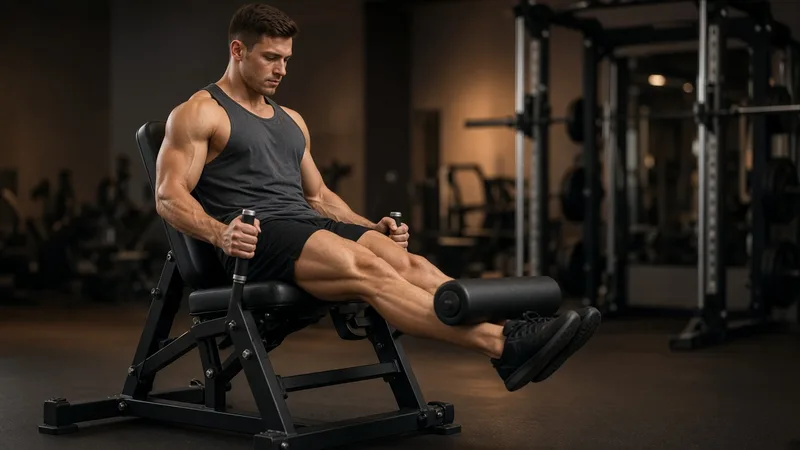
- Leg extension → leg press: in 17 healthy men, quadriceps activity during the leg press was lower after pre-exhaust, and they did fewer reps. Glute activity did not change (Augustsson et al., 2003).
- Pullover → seated row: in 20 untrained adults, pre-exhaust did not increase activity in the latissimus dorsi; it mostly tired the rear delts (Fujita et al., 2022).
- Triceps pushdown → bench press: in 14 trained men, pre-exhaust reduced the total weight lifted compared with fresh sets, without changing muscle activity, lactate or effort ratings compared with the traditional order (Soares et al., 2016).
- Isolation lifts → heavy bench press (95% of 1RM): in eight experienced lifters, pre-tiring the triceps increased triceps activity in the bench press; pre-tiring the chest or front delts changed nothing measurable (Gołaś et al., 2017).
- Triceps to failure → bench press (with 5 minutes rest in between): in 30 trained lifters, chest activity rose in both women and men, and triceps activity rose only in women (Olsson et al., 2026). Note that a 5-minute rest is not classic pre-exhaust.
The pattern: pre-tiring a muscle often makes the other muscles work harder, not the one you pre-tired. And EMG is not growth. These studies explain why pre-exhaust does not beat traditional training; they cannot show that it would.
Evidence grade
Moderate that pre-exhaust does not build more muscle or strength than traditional exercise order. The long-term trials are few, small and mostly on the legs; there are no long-term trials on the chest, back or shoulders, and data in older adults are missing. What the research does not show is that pre-exhaust is harmful for growth when sets and effort are matched; it is mainly less efficient for the compound lift.
When pre-exhaust still makes sense
Pre-exhaust is not a growth hack, but it can be the right tool in a few situations. These uses are reasoned from the studies above and from coaching practice; none has been tested directly.
| Situation | Why pre-exhaust helps | Example |
|---|---|---|
| You want a hard set with less weight | A pre-tired muscle reaches failure with a lighter load (as in Trindade et al., 2019), which can be easier on joints and the lower back | Leg extensions into leg press for someone with cranky knees or a back that dislikes heavy squats |
| Short on time | Pairing two exercises with no rest cuts session time | A 45-minute upper/lower day |
| A target muscle you barely “feel” | Isolation work first can help some lifters learn where the target muscle is; no trial shows this grows it more | Straight-arm pulldowns before lat pulldowns |
| Home gym with light weights | Pre-tiring makes light dumbbells or bodyweight challenging enough | Flyes into push-ups |
| Isolation strength matters | Strength rises most in the first exercise (Nunes et al., 2021) | A bodybuilder who wants a stronger leg extension or lateral raise |
When not to use it: when compound-lift strength is your goal (powerlifting, strength phases, testing a 1RM), for heavy free-weight squats or bench presses without safeties, and on every exercise in every session.
Three ways to run pre-exhaust
The set and rest numbers below are our conventions, built from the protocols in the studies (8–12 RM loads, under 10 seconds between exercises in the classic version).
| Protocol | How it works | Best for |
|---|---|---|
| Classic pre-exhaust | Isolation set to 1–2 RIR, under 10–15 s transition, compound set to 1–2 RIR; rest 2–3 min, repeat for 2–4 rounds | Machines and stable lifts (leg press, Smith machine, chest press, pulldown) |
| Light pre-activation | One easy isolation set at ~3–4 RIR, rest 1–2 min, then normal compound sets | Lifters who want the “feel” without losing much load |
| Post-exhaust (reverse) | Compound set to 1–2 RIR, then straight into an isolation set for the same muscle | Keeping compound strength while adding extra hard work for the target muscle |
Good pairings
| Target muscle | Isolation first | Then compound |
|---|---|---|
| Quadriceps | Leg extension | Leg press, hack squat or Smith machine squat |
| Hamstrings | Leg curl | Romanian deadlift (moderate load) |
| Chest | Dumbbell fly or pec deck | Machine chest press, incline dumbbell press or push-ups |
| Lats | Straight-arm cable pulldown or pullover | Lat pulldown or seated cable row |
| Side delts | Lateral raise | Machine or dumbbell overhead press |
Prefer machines and stable compound lifts for the second exercise. A barbell back squat or a heavy barbell bench straight after a set to near failure is where form breaks down.
Example: 4-day upper/lower block with one pre-exhaust pair per session
This plan follows the structure of our upper/lower split and uses pre-exhaust on one muscle per session. The rest of the session keeps compound lifts first, so you still build strength on your main lifts. Rest 2–3 minutes between pre-exhaust rounds and between compound sets, 1–2 minutes on isolation lifts.
Lower A
| Exercise | Sets × reps | Effort | Rest |
|---|---|---|---|
| A1. Leg extension | 3 × 10–15 | 1–2 RIR | under 15 s |
| A2. Leg press | 3 × 8–12 | 1–2 RIR | 2–3 min |
| Romanian deadlift | 3 × 8–10 | 2 RIR | 2–3 min |
| Leg curl | 3 × 10–12 | 1 RIR | 1–2 min |
| Standing calf raise | 4 × 10–15 | 1 RIR | 1 min |
Upper A
| Exercise | Sets × reps | Effort | Rest |
|---|---|---|---|
| A1. Straight-arm cable pulldown | 3 × 12–15 | 1–2 RIR | under 15 s |
| A2. Lat pulldown | 3 × 8–12 | 1–2 RIR | 2–3 min |
| Bench press | 4 × 6–8 | 2 RIR | 2–3 min |
| Seated cable row | 3 × 10–12 | 1–2 RIR | 2 min |
| Lateral raise | 4 × 12–15 | 1 RIR | 1 min |
| Overhead triceps extension | 2 × 10–12 | 1 RIR | 1 min |
| Biceps curl | 2 × 10–12 | 1 RIR | 1 min |
Lower B
| Exercise | Sets × reps | Effort | Rest |
|---|---|---|---|
| Back squat | 3 × 5–8 | 2 RIR | 3 min |
| A1. Leg curl | 3 × 10–12 | 1–2 RIR | under 15 s |
| A2. Romanian deadlift (moderate load) | 3 × 8–10 | 2 RIR | 2–3 min |
| Bulgarian split squat | 2 × 8–10 per leg | 2 RIR | 2 min |
| Standing calf raise | 4 × 10–15 | 1 RIR | 1 min |
Upper B
| Exercise | Sets × reps | Effort | Rest |
|---|---|---|---|
| A1. Dumbbell fly | 3 × 10–15 | 1–2 RIR | under 15 s |
| A2. Incline dumbbell press | 3 × 8–12 | 1–2 RIR | 2–3 min |
| Pull-up | 3 × 6–10 | 1–2 RIR | 2–3 min |
| Overhead press | 3 × 6–8 | 2 RIR | 2–3 min |
| Barbell row | 3 × 8–10 | 2 RIR | 2 min |
| Lateral raise | 4 × 12–15 | 1 RIR | 1 min |
| Overhead triceps extension | 2 × 10–12 | 1 RIR | 1 min |
| Biceps curl | 2 × 10–12 | 1 RIR | 1 min |
Volume audit
We count every set taken to 1–2 RIR as one hard set for the muscle it mainly trains. In a pre-exhaust pair, both the isolation set and the compound set count for the target muscle. Indirect work (for example triceps in pressing) is not counted.
| Muscle | Direct hard sets per week | Where they come from |
|---|---|---|
| Quadriceps | 11 | Leg extension 3, leg press 3, squat 3, split squat 2 |
| Hamstrings | 12 | Romanian deadlift 3 + 3, leg curl 3 + 3 |
| Chest | 10 | Bench press 4, fly 3, incline dumbbell press 3 |
| Back (lats and upper back) | 15 | Straight-arm pulldown 3, lat pulldown 3, cable row 3, pull-up 3, barbell row 3 |
| Side delts | 8 | Lateral raise 4 + 4 (plus overhead press) |
| Biceps | 4 | Curls 2 + 2 (plus pulldowns, rows, pull-ups) |
| Triceps | 4 | Overhead extension 2 + 2 (plus pressing) |
| Calves | 8 | Calf raise 4 + 4 |
Most major muscles land in or near the 10–20 hard sets per week range that we use as a guide (see sets per week). Arms and side delts are lower in direct sets but get a lot of indirect work; add a set or two if they are a priority.
Progression
- Progress the compound lift on its own terms. Your leg-press numbers after leg extensions will be lower than when fresh. Log them separately and beat them from week to week; do not compare them with your fresh numbers.
- Double progression: when you hit the top of the rep range on all rounds at the target RIR, add the smallest load step to that exercise (often 2.5–5 kg on machines).
- Keep the transition the same. If you rest 10 seconds this week and 60 seconds next week, your numbers are not comparable.
- Rotate after a block. Run a pre-exhaust pair for 4–8 weeks, then switch it to post-exhaust or a normal order. Changing exercises now and then helps growth across different regions of a muscle; see our progressive overload guide.
- Deload when performance drops for two sessions in a row; see when and how to deload.
Pre-exhaust compared with other options
| Method | Growth evidence | Effect on compound strength | Time | Best use |
|---|---|---|---|---|
| Compound first, then isolation | Reference option | Best | Normal | Default for most lifters |
| Pre-exhaust | No extra growth; possibly slightly less (Hermann et al., 2026) | Lower loads on the compound | Saves time if paired | Joint-friendly loading, home gyms, short sessions |
| Post-exhaust | Not tested in long-term trials | Compound stays fresh | Saves time if paired | Extra hard work on a muscle without losing compound strength |
| Mechanical drop sets | No direct trials | Not affected | Saves time | Fixed weights, isolation work |
Common mistakes
- Expecting a strength record after pre-exhaust. You will be weaker on the compound. Fix: judge progress within the same setup, not against fresh sets.
- Using it on heavy free-weight lifts. Failing a barbell squat after leg extensions to failure is a safety problem. Fix: use machines, the Smith machine or dumbbells, and safeties.
- Pre-tiring the wrong muscle. Pre-tiring the triceps before a bench press makes the triceps work more, not the chest (Gołaś et al., 2017). Fix: pre-tire the muscle you actually want to train, and know that it may not get more work anyway.
- Using it on every exercise. Every compound lift then suffers. Fix: one pre-exhaust pair per session is plenty.
- Taking the isolation set to failure every time. It eats into the compound set and adds fatigue. Fix: stop the isolation set at 1–2 RIR.
- Not counting the sets. Both sets in the pair are hard sets. Fix: count both in your weekly volume.
- Choosing pre-exhaust for growth alone. The best evidence says it does not add growth. Fix: use it for a practical reason, or do the compound first.
Make it better
- Try post-exhaust instead. Do the compound first while fresh, then go straight into the isolation lift. You keep compound strength and still finish the muscle off.
- Pick a stretch-focused isolation lift (incline curls, overhead triceps extensions, seated leg curls), since training at long muscle lengths tends to favour growth; see our guide to lengthened partials.
- Use pre-exhaust as a light pre-activation set (3–4 RIR) if you mainly want to feel the target muscle, so the compound loses as little load as possible.
Safety notes
- Pre-exhaust raises fatigue fast. Use a spotter or safeties on any free-weight compound lift.
- If you have a joint or back injury, ask a physiotherapist or doctor before training near failure; the lighter compound loads of pre-exhaust may help, but get advice first.
- Under 18, pregnant, or managing a medical condition? Talk to your doctor before starting a new high-effort method.
FAQ
Does pre-exhaust build more muscle?
No. Three long-term trials found similar or slightly smaller muscle gains with pre-exhaust than with traditional exercise order (Fisher et al., 2014; Trindade et al., 2019; Hermann et al., 2026), and a meta-analysis of exercise order found no difference in hypertrophy (Nunes et al., 2021).
Should I do flyes before bench press?
Only if you have a reason, such as wanting a hard chest session with lighter bench weights. Your bench press will be weaker, and the studies do not show extra chest growth. For bench strength, press first.
What is the difference between pre-exhaust and post-exhaust?
Pre-exhaust puts the isolation exercise right before the compound lift; post-exhaust puts it right after. Post-exhaust keeps the compound lift fresh, which is why we prefer it when strength matters.
How long should you rest between the isolation and compound exercise?
In the classic method, almost none: the trials used under 10 seconds. If you rest a few minutes, it is closer to normal exercise order with an isolation lift first.
Is pre-exhaust good for beginners?
It works, but it is not needed. Beginners gain best from learning the compound lifts and adding load. Trindade et al. (2019) found beginners grew with pre-exhaust too, using lighter loads, which can help if heavy weights are a problem.
Did Mike Mentzer use pre-exhaust?
Yes. Pre-exhaust pairs were a common part of the high-intensity training style that Arthur Jones and Mike Mentzer promoted; see our HIT and Mentzer guide for the full method.
References
- Fisher JP, Carlson L, Steele J, et al. The effects of pre-exhaustion, exercise order, and rest intervals in a full-body resistance training intervention. Appl Physiol Nutr Metab. 2014;39(11):1265-70. doi:10.1139/apnm-2014-0162. PubMed: 25092528 ↩
- Trindade TB, Prestes J, Neto LO, et al. Effects of Pre-exhaustion Versus Traditional Resistance Training on Training Volume, Maximal Strength, and Quadriceps Hypertrophy. Front Physiol. 2019;10:1424. doi:10.3389/fphys.2019.01424. PubMed: 31824336 ↩
- Hermann T, Mohan AE, Piñero A, et al. Front-Loading Fatigue: Does the Pre-exhaustion Method influence Resistance Training-induced Muscular Adaptations? Int J Exerc Sci. 2026;19(1):1008. doi:10.70252/IJES2026108. PubMed: 42516618 ↩
- Trindade TB, Alves RC, DE Castro BM, et al. Pre-exhaustion Training, a Narrative Review of the Acute Responses and Chronic Adaptations. Int J Exerc Sci. 2022;15(3):507-525. doi:10.70252/CEVS9112. PubMed: 35516415 ↩
- Nunes JP, Grgic J, Cunha PM, et al. What influence does resistance exercise order have on muscular strength gains and muscle hypertrophy? A systematic review and meta-analysis. Eur J Sport Sci. 2021;21(2):149-157. doi:10.1080/17461391.2020.1733672. PubMed: 32077380 ↩
- Avelar A, Ribeiro AS, Nunes JP, et al. Effects of order of resistance training exercises on muscle hypertrophy in young adult men. Appl Physiol Nutr Metab. 2019;44(4):420-424. doi:10.1139/apnm-2018-0478. PubMed: 30248269 ↩
- Augustsson J, Thomeé R, Hörnstedt P, et al. Effect of pre-exhaustion exercise on lower-extremity muscle activation during a leg press exercise. J Strength Cond Res. 2003;17(2):411-6. doi:10.1519/1533-4287(2003)017<0411:eopeol>2.0.co;2. PubMed: 12741886 ↩
- Fujita RA, Silva NRS, Bedo BLS, et al. The Pre-Exhaustion Method Does Not Increase Muscle Activity in Target Muscle During Strength Training in Untrained Individuals. J Hum Kinet. 2022;82:17-26. doi:10.2478/hukin-2022-0027. PubMed: 36157003 ↩
- Soares EG, Brown LE, Gomes WA, et al. Comparison Between Pre-Exhaustion and Traditional Exercise Order on Muscle Activation and Performance in Trained Men. J Sports Sci Med. 2016;15(1):111-7. PubMed: 26957933 ↩
- Gołaś A, Maszczyk A, Pietraszewski P, et al. Effects of Pre-exhaustion on the Patterns of Muscular Activity in the Flat Bench Press. J Strength Cond Res. 2017;31(7):1919-1924. doi:10.1519/JSC.0000000000001755. PubMed: 27984499 ↩
- Olsson MC, Fälth J, Ahlebrand A, et al. Sex Differences in Bench Press Muscle Activation With and Without Pre-Exhaustion of Triceps Brachii. Eur J Sport Sci. 2026;26(12). doi:10.1002/ejsc.70290. PubMed: 42998306 ↩