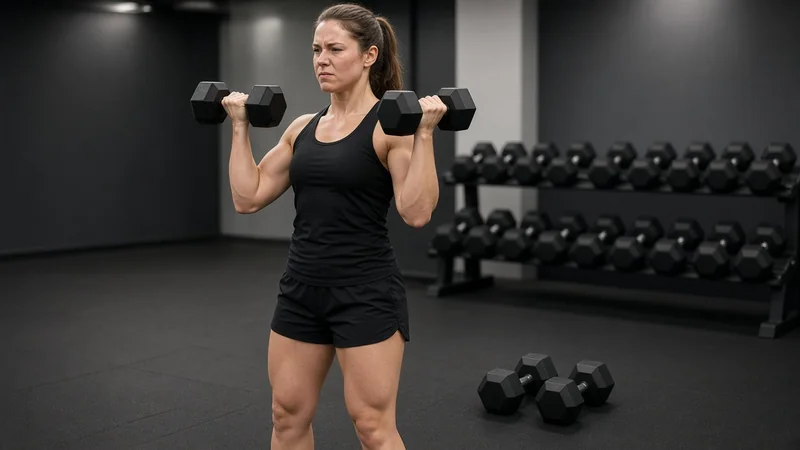
Mechanical Drop Sets
Mechanical drop sets explained: same weight, easier variation, no rest. Eight ready-made sequences, how to count them as sets and what the evidence says.
Key takeaways
- A mechanical drop set keeps the same weight but switches to an easier variation when you near failure, for example incline curl → standing curl → hammer curl.
- No study has tested mechanical drop sets directly. Ordinary drop sets build about the same muscle as traditional sets in less time (Sødal et al., 2023; Havers et al., 2026), and mechanical drop sets work on the same idea.
- Order the variations from weakest to strongest leverage, and put the version that loads the muscle in the stretch first.
- They are most useful when you cannot change the weight easily: home gyms, fixed dumbbells, bodyweight and crowded gyms.
- Our counting rule: one mechanical drop set with two switches ≈ two hard sets. That is our convention, not a measured value.
A mechanical drop set is a drop set where the weight stays the same and the exercise gets easier. When you near failure on the hardest version of a movement, you switch, with no rest, to a version where you are stronger: a better leverage, a different grip, a shorter lever arm or a bench angle that brings in more muscle. Then you keep going to near failure again.
A classic example: incline dumbbell curl → standing dumbbell curl → hammer curl, all with the same dumbbells. You run out of strength in the hardest position first, then keep training the biceps in positions where you can still move the weight.
This guide explains how mechanical drop sets work, what evidence there is (honestly: none on the method itself), eight ready-made sequences, how to count them in your weekly volume and when they are worth using. It is part of our Training Methods section; for how methods like this fit into a full plan, see our pillar on every training split.
Evidence in one line: there are no trials of mechanical drop sets. The method borrows its logic from ordinary drop sets, which build about as much muscle as normal sets in less time. Treat it as a practical tool, not a proven growth booster.
What this page covers. This is the guide to mechanical drop sets (same weight, easier variation). Ordinary drop sets (same exercise, lighter weight), supersets and rest-pause are covered in intensity techniques, and rest-pause has its own guide: rest-pause training done right.
Key terms
- Drop set: a set taken close to failure, then continued immediately with a lighter weight. Sometimes called a “weight drop set” to separate it from the mechanical version.
- Mechanical drop set: a set taken close to failure, then continued immediately with the same weight in an easier variation of the movement.
- Mechanical advantage: how easy a position is for your muscles. A shorter lever (bent elbows on a raise), a better joint angle or help from more muscles all make a lift easier.
- Switch (or drop): each change to an easier variation.
- Long muscle length (stretch position): the part of the movement where the muscle is most stretched, such as the bottom of an incline curl.
- RIR (reps in reserve): how many reps you had left. 0 RIR means failure. See training to failure vs RIR.
How a mechanical drop set works
- Choose a sequence of 2–3 variations that train the same muscle with the same weight, ordered from hardest to easiest.
- Start with the hardest variation and go to 1–0 RIR. Use a weight you can lift for about 8–12 reps in that variation (our usual range).
- Switch immediately, ideally within 5–10 seconds, by changing your grip, body angle, bench angle or exercise.
- Go to 1–0 RIR again in the easier variation.
- Make one more switch if your sequence has three steps, then stop.
A typical result on the curl sequence: 8 incline curls, 6 standing curls, 6 hammer curls, about 20 reps with one pair of dumbbells, most of them hard reps.
What makes a good sequence
These are our design rules, based on the research below and on exercise mechanics:
- Same target muscle. Each step must still train the muscle you started with. Switching from lateral raises to squats is not a drop set.
- Same weight. No reloading, no walking across the gym.
- Hardest leverage first. If you start with the easy variation, you will reach failure there and get nothing from the harder one.
- Stretch first when possible. Exercises that load the muscle at long lengths have built more muscle in several trials (Maeo et al., 2021; Maeo et al., 2023), so put that variation at the start, when you are fresh.
- Fast, safe transitions. If changing the bench angle takes 40 seconds, it is just a new set with short rest.
What the research says
Direct evidence: none
We searched PubMed (November 2026) and found no trial that tested mechanical drop sets against traditional sets, and no study that measured muscle growth after them. Everything below is indirect. Apply it with that in mind.
Ordinary drop sets: similar growth in less time
- Sødal et al. (2023) pooled drop-set studies (6 studies, 142 participants aged about 19–27). Muscle growth was similar with drop sets and traditional sets, and some drop-set protocols took half to one-third of the time.
- Havers et al. (2026) pooled 12 studies (274 participants). Long-term growth, strength and muscle endurance were similar to traditional sets. Drop sets caused higher effort ratings and lactate in the session.
A mechanical drop set does the same job as a weight drop set: it lets you continue a set past the first point of fatigue without a rest. So the most reasonable expectation is similar growth to normal sets, in less time, not more. That is an inference, not a measured result.
Closeness to failure
Muscle growth tends to increase as sets end closer to failure (Robinson et al., 2024), but going all the way to momentary failure has no clear advantage over stopping just short of it (Refalo et al., 2023). Mechanical drop sets keep you close to failure for more reps, which is useful, but they are not needed to grow.
Exercise variation
Mechanical drop sets are a form of exercise variation inside one set. Research on variation across sessions is mixed:
- A systematic review of 8 studies (241 young men) concluded that systematic variation that changes the stimulus can help regional growth and strength, while excessive, random variation may compromise gains (Kassiano et al., 2022).
- In 70 young women training for 10 weeks, varying the leg exercises across the week or keeping them constant gave virtually the same growth and strength (Kassiano et al., 2025).
- In 21 trained men, randomly varying exercises each session gave similar growth and strength to a fixed program and improved motivation to train (Baz-Valle et al., 2019).
- In young men, varying exercises for the same muscle across the week gave similar 1RM gains to fixed exercises (Costa et al., 2022).
- Different exercises for the same muscle can grow different regions of it: leg extensions grew all three measured regions of the rectus femoris, while Smith machine squats did not (Zabaleta-Korta et al., 2021).
What this means: a well-chosen sequence may spread the stimulus across a muscle a little more, and some lifters find it motivating. But there is no evidence that it builds more total muscle than simply doing more sets of one good exercise.
Bench angle and muscle activity
In 10 competitive bodybuilders, the incline bench press excited the clavicular (upper) head of the chest more than the flat and decline press, while the flat press excited the sternocostal (middle and lower) head more than the incline (Coratella et al., 2020). This supports chest sequences that move from incline to flat. Remember that muscle activity (EMG) in one session is not the same as long-term growth.
Evidence grade
No direct evidence. The method is reasonable and low-risk, and its parts (drop sets, closeness to failure, exercise selection) are well studied. Whether mechanical drop sets add anything beyond ordinary drop sets or extra straight sets is unknown.
Eight mechanical drop sequences
All eight are our own templates. Use the same weight throughout, move quickly between steps and stop each step at about 1–0 RIR.
| # | Muscle | Step 1 (hardest) | Step 2 | Step 3 (easiest) | Equipment |
|---|---|---|---|---|---|
| 1 | Biceps | Incline dumbbell curl | Standing dumbbell curl | Hammer curl | Dumbbells, adjustable bench |
| 2 | Chest | Incline dumbbell fly | Incline dumbbell press | Flat dumbbell press | Dumbbells, adjustable bench |
| 3 | Chest/triceps (bodyweight) | Feet-elevated push-up | Push-up | Incline push-up (hands on bench) | Bench or box |
| 4 | Side delts | Strict lateral raise | Lateral raise with elbows bent to about 90° | Dumbbell overhead press | Light dumbbells |
| 5 | Triceps | Overhead triceps extension | Lying triceps extension | Close-grip press | EZ bar or dumbbells |
| 6 | Lats/upper back | Wide-grip pull-up | Neutral-grip pull-up | Chin-up | Pull-up bar |
| 7 | Hamstrings/glutes | Single-leg Romanian deadlift | Romanian deadlift | Hip hinge with a shorter range | Dumbbells or barbell |
| 8 | Quads/glutes | Front-foot-elevated split squat | Bulgarian split squat | Reverse lunge | Dumbbells, step and bench |
Notes on the sequences
- Biceps (1): the incline curl loads the biceps with the shoulder behind the body, so the muscle is more stretched. Start there, then switch to standing curls, then to hammer curls, where the brachialis and forearm muscles help more.
- Chest (2): flyes are the hardest because the lever arm is long. Pressing with the same dumbbells is much easier. Moving from incline to flat shifts more work to the middle and lower chest (Coratella et al., 2020).
- Push-ups (3): raising the hands makes the push-up easier; raising the feet makes it harder. This is the most useful home sequence on this page.
- Side delts (4): bending the elbows shortens the lever and makes the raise easier. The press at the end adds the front delts and triceps; stop it when the side delts are no longer the limit.
- Triceps (5): the overhead position loads the long head in the stretch, which built more triceps muscle than the arms-down position in one trial (Maeo et al., 2023). The close-grip press brings in the chest and shoulders.
- Pull-ups (6): most lifters are stronger on chin-ups than on wide-grip pull-ups (coaching experience, not a measured value). If you cannot do 5+ wide-grip reps, use a band or a lat pulldown with the same logic.
- Hamstrings (7): single-leg RDLs are harder for the same weight. Keep a neutral spine in the last step; shorten the range, do not round your back.
- Quads (8): the front-foot-elevated split squat has the deepest knee bend. Use dumbbells you can set down safely. Stop with 1–2 RIR rather than 0, because balance gets worse with fatigue.
Exercises that do not work well
- Barbell squats and deadlifts: there is no safe, fast “easier variation” with the same bar, and failure under heavy spinal loading is risky.
- Machines with fixed paths: most machines allow only one variation. Use an ordinary drop set (lower the pin) instead.
- Olympic lifts and technical movements: fatigue ruins technique.
How to count mechanical drop sets
| Structure | Our count |
|---|---|
| 2 steps (one switch), both near failure | About 1.5 hard sets |
| 3 steps (two switches), all near failure | About 2 hard sets |
| 3 steps, but steps 2–3 are easy (2+ RIR) | About 1 hard set |
These numbers are our convention, the same rule we use for weight drop sets and rest-pause on our intensity techniques and rest-pause pages. The steps after a switch are hard reps, but they are short, so they count for less than a full set.
If a step mainly trains a different muscle (the press at the end of the lateral-raise sequence, for example), count it as half a set for that muscle, in line with the “fractional” counting method, which best predicted results in a large 2026 meta-regression (Pelland et al., 2026).
Example: 3-day home dumbbell plan with mechanical drop sets
A full-body plan for a home gym with adjustable dumbbells, a bench and a pull-up bar (see our guide to full-body training). Mechanical drop sets (MDS) are used once per muscle per session, as the last set. Rest 2 minutes between normal sets and 2–3 minutes after an MDS.
Day A
| # | Exercise | Sets × reps | RIR | Rest |
|---|---|---|---|---|
| 1 | Goblet squat | 3 × 10–12 | 1–2 | 2 min |
| 2 | Incline dumbbell press | 2 × 8–10, then 1 MDS (#2: fly → incline press → flat press) | 1–2; MDS 0–1 | 2 min |
| 3 | Dumbbell row | 3 × 10–12 | 1–2 | 2 min |
| 4 | Biceps MDS (#1: incline → standing → hammer) | 1 MDS | 0–1 | — |
Day B
| # | Exercise | Sets × reps | RIR | Rest |
|---|---|---|---|---|
| 1 | Romanian deadlift | 2 × 8–10, then 1 MDS (#7) | 2; MDS 1 | 2–3 min |
| 2 | Pull-up | 2 × 6–10, then 1 MDS (#6) | 1–2; MDS 0–1 | 2–3 min |
| 3 | Push-up MDS (#3) | 1 MDS | 0–1 | 2 min |
| 4 | Lateral raise MDS (#4) | 1 MDS | 0–1 | — |
Day C
| # | Exercise | Sets × reps | RIR | Rest |
|---|---|---|---|---|
| 1 | Bulgarian split squat | 2 × 8–10, then 1 MDS (#8) | 1–2 | 2 min |
| 2 | Flat dumbbell press | 3 × 8–10 | 1–2 | 2 min |
| 3 | Dumbbell row | 3 × 10–12 | 1–2 | 2 min |
| 4 | Triceps MDS (#5) | 1 MDS | 0–1 | — |
Volume audit (our counting rule)
| Muscle | Day A | Day B | Day C | Week |
|---|---|---|---|---|
| Quads | Goblet squat 3 | — | Split squat 2 + MDS 2 = 4 | about 7 |
| Hamstrings/glutes | — | RDL 2 + MDS 2 = 4 | Split squat (glutes, ½) ≈ 2 | about 6 |
| Chest | Press 2 + MDS 2 = 4 | Push-up MDS 2 | Press 3 | about 9 |
| Back/lats | Row 3 | Pull-up 2 + MDS 2 = 4 | Row 3 | about 10 |
| Side delts | — | Lateral MDS ≈ 1.5 (the press step counts toward the front delts) | — | about 1.5 + indirect |
| Biceps | MDS 2 + rows (½) 1.5 = 3.5 | Pull-ups (½) ≈ 2 | Rows (½) ≈ 1.5 | about 7 |
| Triceps | Presses (½) ≈ 2 | Push-ups (½) ≈ 1 | MDS 2 + press (½) 1.5 = 3.5 | about 6.5 |
This is a time-efficient plan of roughly 45 minutes per session, with 6–10 sets per week for most muscles. That is enough to grow, especially for beginners and busy lifters, but below the 10–20 sets many experienced lifters use. Side delts and quads are the weak spots: add a second lateral-raise MDS on Day A and a third goblet squat set on Day B if you want more. Weekly volume shows diminishing returns at higher levels (Pelland et al., 2026), so add sets gradually.
Progression
- Write down all steps: “8 + 6 + 6”. Beat the total next time.
- Add weight when the first step hits the top of its rep range (for example 12 reps on incline curls). Expect the later steps to drop when you do. This is our rule of thumb.
- Keep transitions short and timed. If transitions creep past 15–20 seconds, it is turning into a rest-pause or a new set.
- Do not add more steps to progress. Three steps is enough. Add reps or weight instead.
- Rotate sequences every 4–8 weeks if you get bored. Systematic, not random, variation is the better bet (Kassiano et al., 2022).
- Deload when progress stalls for 2–3 weeks. See when and how to deload.
Mechanical drop sets compared with other methods
| Straight sets | Mechanical drop set | Weight drop set | Rest-pause | Superset | |
|---|---|---|---|---|---|
| What changes | Nothing | Exercise variation | Load | Short pause | Exercise (often other muscle) |
| Needs extra equipment | No | No (same weight) | Yes (lighter weight ready) | No | Two stations |
| Direct growth evidence | Reference | None | Similar to straight sets | Similar, maybe slightly more | Similar |
| Best for | Everything | Home gyms, fixed dumbbells, bodyweight | Machines, cables | Machines, isolation | Saving time |
| Main downside | Takes longest | Not studied; transitions can slow it | Equipment needed | Feels hard | Fatigue overlaps |
Sources: Sødal et al. (2023); Havers et al. (2026). Rest-pause and superset evidence is on our rest-pause and intensity techniques pages.
Common mistakes
- Going from easy to hard. You fail in the easy variation and the hard one is wasted. Fix: hardest leverage first.
- Slow transitions. Walking to another station or rebuilding a bench takes too long. Fix: choose sequences you can switch in under 10 seconds.
- Changing the target muscle. Lateral raises into squats is not a drop set. Fix: every step must still load the muscle you started with.
- Sloppy last steps. Fatigue turns curls into swings and push-ups into sags. Fix: stop each step when a rep is no longer clean.
- Doing them on every exercise. They are fatiguing; ordinary drop sets raise effort ratings and lactate (Havers et al., 2026), and mechanical ones are likely similar. Fix: one per muscle per session, last set only.
- Counting a three-step drop set as one set. Fix: count it as about two hard sets.
- Expecting extra growth. No study shows that they beat normal sets. Fix: use them to save time or to get more out of limited equipment.
Make it better
- Start in the stretch. Begin each sequence with the variation that loads the muscle most at long lengths: incline curls, overhead extensions, deep split squats. See our guide to long muscle lengths.
- Finish with lengthened partials. When full reps run out in the last step, do 3–5 partial reps in the stretched half of the range. See lengthened partials.
- Combine with a pause. If you reach the last step with nothing left, take 10–15 seconds and do one rest-pause mini-set. See rest-pause.
Safety notes
- Choose sequences you can switch safely. Never drop to a variation where a failed rep traps you under a weight.
- Keep a neutral spine on hinge sequences and stop with 1–2 RIR on single-leg and balance-heavy lifts.
- If you have high blood pressure, heart disease, a hernia, or are pregnant, talk to your doctor before training close to failure.
- Anyone under 18, recovering from injury or using performance-enhancing drugs should get individual advice before using intensity techniques.
FAQ
What is a mechanical drop set?
A set where you keep the same weight and switch to an easier variation of the exercise when you near failure, then keep going. For example: incline curl, then standing curl, then hammer curl with the same dumbbells.
Do mechanical drop sets build more muscle?
There is no evidence that they do. No trial has tested them. Ordinary drop sets build about the same muscle as traditional sets in less time (Sødal et al., 2023; Havers et al., 2026), and mechanical drop sets are likely similar.
What is the difference between a mechanical drop set and a normal drop set?
In a normal drop set you lower the weight and keep doing the same exercise. In a mechanical drop set you keep the weight and change to a variation with better leverage. The mechanical version is handy when you cannot change the weight quickly.
How do you do a mechanical drop set for lateral raises?
Do strict lateral raises to near failure, then bend your elbows to about 90° to shorten the lever and continue, then finish with a few overhead presses. Use the same light dumbbells throughout and move without rest.
Can you do mechanical drop sets with push-ups?
Yes. Start with feet-elevated push-ups, then normal push-ups, then hands-elevated push-ups on a bench. It is one of the best bodyweight sequences for the chest and triceps.
How many mechanical drop sets should I do?
One per muscle per session is enough for most people, usually as the last set of that muscle. Count each three-step drop set as about two hard sets in your weekly volume.
References
- Maeo S, Huang M, Wu Y, et al. Greater Hamstrings Muscle Hypertrophy but Similar Damage Protection after Training at Long versus Short Muscle Lengths. Med Sci Sports Exerc. 2021;53(4):825-837. doi:10.1249/MSS.0000000000002523. PubMed: 33009197
- Maeo S, Wu Y, Huang M, et al. Triceps brachii hypertrophy is substantially greater after elbow extension training performed in the overhead versus neutral arm position. Eur J Sport Sci. 2023;23(7):1240-1250. doi:10.1080/17461391.2022.2100279. PubMed: 35819335 ↩
- Sødal LK, Kristiansen E, Larsen S, et al. Effects of Drop Sets on Skeletal Muscle Hypertrophy: A Systematic Review and Meta-analysis. Sports Med Open. 2023;9(1):66. doi:10.1186/s40798-023-00620-5. PubMed: 37523092 ↩
- Havers T, Micke F, Geisler S, et al. Acute and Chronic Effects of Drop-Set Training: A Meta-Analysis and Systematic Review. Sports Med Open. 2026;12(1). doi:10.1186/s40798-026-01012-1. PubMed: 41920484 ↩
- Robinson ZP, Pelland JC, Remmert JF, et al. Exploring the Dose-Response Relationship Between Estimated Resistance Training Proximity to Failure, Strength Gain, and Muscle Hypertrophy: A Series of Meta-Regressions. Sports Med. 2024;54(9):2209-2231. doi:10.1007/s40279-024-02069-2. PubMed: 38970765
- Refalo MC, Helms ER, Trexler ET, et al. Influence of Resistance Training Proximity-to-Failure on Skeletal Muscle Hypertrophy: A Systematic Review with Meta-analysis. Sports Med. 2023;53(3):649-665. doi:10.1007/s40279-022-01784-y. PubMed: 36334240
- Kassiano W, Nunes JP, Costa B, et al. Does Varying Resistance Exercises Promote Superior Muscle Hypertrophy and Strength Gains? A Systematic Review. J Strength Cond Res. 2022;36(6):1753-1762. doi:10.1519/JSC.0000000000004258. PubMed: 35438660 ↩
- Kassiano W, Costa B, Kunevaliki G, et al. Muscle Hypertrophy and Strength Adaptations to Systematically Varying Resistance Exercises. Res Q Exerc Sport. 2025;96(2):371-381. doi:10.1080/02701367.2024.2409961. PubMed: 39388663
- Baz-Valle E, Schoenfeld BJ, Torres-Unda J, et al. The effects of exercise variation in muscle thickness, maximal strength and motivation in resistance trained men. PLoS One. 2019;14(12):e0226989. doi:10.1371/journal.pone.0226989. PubMed: 31881066
- Costa BDV, Kassiano W, Nunes JP, et al. Does Varying Resistance Exercises for the Same Muscle Group Promote Greater Strength Gains? J Strength Cond Res. 2022;36(11):3032-3039. doi:10.1519/JSC.0000000000004042. PubMed: 35481889
- Zabaleta-Korta A, Fernández-Peña E, Torres-Unda J, et al. The role of exercise selection in regional Muscle Hypertrophy: A randomized controlled trial. J Sports Sci. 2021;39(20):2298-2304. doi:10.1080/02640414.2021.1929736. PubMed: 34743671
- Coratella G, Tornatore G, Longo S, et al. Specific prime movers’ excitation during free-weight bench press variations and chest press machine in competitive bodybuilders. Eur J Sport Sci. 2020;20(5):571-579. doi:10.1080/17461391.2019.1655101. PubMed: 31397215 ↩
- Pelland JC, Remmert JF, Robinson ZP, et al. The Resistance Training Dose Response: Meta-Regressions Exploring the Effects of Weekly Volume and Frequency on Muscle Hypertrophy and Strength Gains. Sports Med. 2026;56(2):481-505. doi:10.1007/s40279-025-02344-w. PubMed: 41343037