Conventional Deadlift
How to deadlift with good form: setup, step-by-step technique, coaching cues, common mistakes, muscles worked, variations and how to program it for strength and size.
Primary muscles
Secondary muscles
Equipment
Barbell, bumper or iron plates
Level
Beginner–advanced
Setup
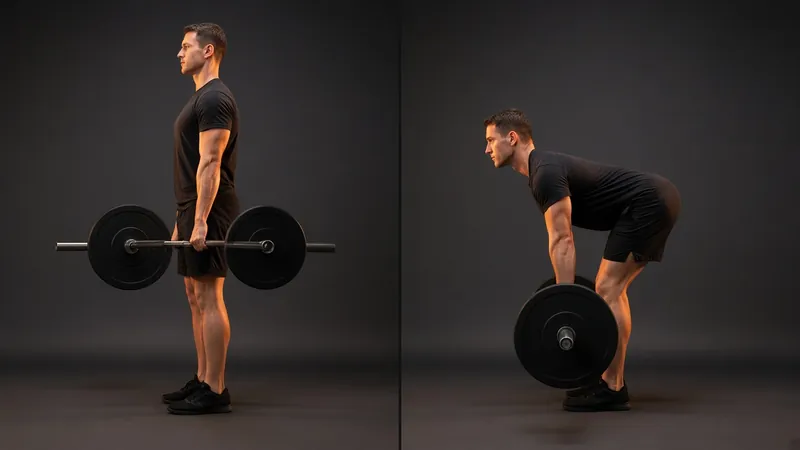
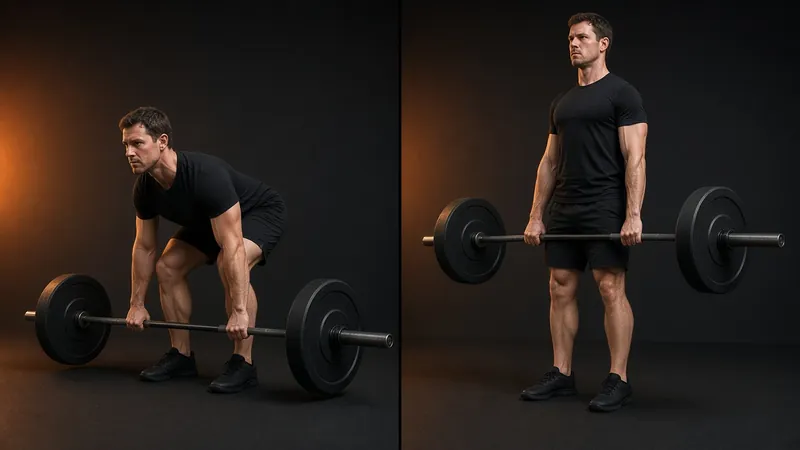
- Stand with the bar over your mid-foot — about 2–3 cm from your shins — feet roughly hip-width apart.
- Hinge down and grip the bar just outside your legs with a double-overhand grip (switch to mixed grip or straps only when grip limits you).
- Bend your knees until your shins touch the bar. Your hips will be higher than your knees and lower than your shoulders.
- Flatten your back and pull your chest up. Your shoulders should be just in front of the bar.
Step by step
- Brace: breathe into your belly and tighten your core hard.
- Take the slack out: pull up on the bar until you hear the plates click, without the bar leaving the floor.
- Push the floor away: drive through your whole foot; hips and shoulders rise at the same rate.
- Keep the bar close: drag it up your shins and thighs.
- Lock out: stand tall by squeezing your glutes — no leaning back.
- Lower: push the hips back first, then bend the knees once the bar passes them, and return it to the floor under control.
Coaching cues
- “Push the floor away.”
- “Protect your armpits” — lats tight, bar close.
- “Chest up, hips through.”
- “Wedge yourself under the bar” before pulling.
Common mistakes and fixes
Variations
| Variation | Why use it |
|---|---|
| Sumo deadlift | Wide stance and hands inside the legs; more upright torso and more quad and adductor work. |
| Trap-bar (hex-bar) deadlift | Easier to learn and more knee-dominant; great for general strength. |
| Romanian deadlift | Starts from the top and focuses on the hamstrings — see the <a href="/exercises/romanian-deadlift/">RDL guide</a>. |
| Deficit deadlift | Standing on a 2–5 cm platform increases the range of motion and builds strength off the floor. |
| Rack pull | Partial range from pins above the knee; overloads the lockout and upper back. |
How to program it
Deadlifts are very fatiguing. For most lifters, 2–4 sets of 3–6 reps, 1–2 times a week, at 2–3 reps in reserve is enough. Rest 3–5 minutes. Build hamstring volume with RDLs and leg curls rather than more heavy deadlifts. In our PPL program, deadlifts go on Legs B.
Why rest longer on deadlifts?
Evidence note: In trained men, 3-minute rest periods produced more squat and bench strength and more front-thigh muscle growth than 1-minute rests over eight weeks with the same number of sets (Schoenfeld et al., 2016). The study used multiple compound exercises rather than deadlifts specifically, but heavy hinges are among the most demanding lifts, so generous rest is a safe default.
Do I need to deadlift to build muscle?
No — the deadlift is an excellent strength and back exercise, but you can build your posterior chain with Romanian deadlifts, hip thrusts, back extensions and leg curls. Many bodybuilders use it sparingly for exactly this reason. For more on choosing lifts, see the splits pillar.
Reference
Schoenfeld BJ, Pope ZK, Benik FM, et al. Longer Interset Rest Periods Enhance Muscle Strength and Hypertrophy in Resistance-Trained Men. J Strength Cond Res. 2016;30(7):1805-1812. doi:10.1519/JSC.0000000000001272. PubMed: 26605807