Slow Eccentrics and Eccentric Overload: What Builds Muscle?
Slow eccentrics and eccentric overload explained: what tempo and negative-loading studies found for muscle growth, how to use 2-up/1-down and a 4-day plan.
Key takeaways
- Lowering a weight slowly does not build more muscle by itself: growth was similar for repetition durations from about 0.5 to 8 seconds, and very slow reps (over 10 seconds) looked worse (Schoenfeld et al., 2015).
- A controlled 2–3 second lowering is our default: it is inside the range that works, keeps technique honest and costs few reps. That is our convention, not a tested optimum.
- Eccentric-only and concentric-only training built similar muscle in a 2025 meta-analysis of 26 studies, but the two grow muscle in different ways: eccentric work lengthened muscle fascicles more (Franchi et al., 2014).
- Eccentric overload (heavier lowering than lifting) reliably helps strength; for size the trials are mixed, so treat it as an optional tool for one or two exercises, not a requirement.
- The easiest way to use it is 2-up/1-down on machines: lift with two limbs, lower with one. Start with one exercise per session and expect extra soreness for the first week or two.
Eccentric training is about the lowering half of a rep: the part where your muscle lengthens under load, such as lowering the bar to your chest or sinking into a squat. Lifters use it in two ways. Some slow the lowering down (a slow eccentric or “tempo” rep). Others make the lowering heavier than the lifting (eccentric overload), because muscles can control more weight on the way down than they can lift.
Both ideas sound like they should build more muscle. This guide shows what the tempo and eccentric-overload studies actually found, which methods are worth your time, how to run them safely, and a 4-day plan that uses them on a few exercises. It is part of our Training Methods section; for how methods like this fit into a full week, see our pillar on every training split.
Evidence in one line: a controlled lowering is useful, an extra-slow lowering is not a growth booster, and eccentric overload mainly helps strength, with possible but unproven extra growth.
What this page covers. This is the guide to the lowering phase: tempo, negatives and heavier eccentrics. Training in the stretched position is covered in lengthened partials and loaded stretching, and how close to failure to train is in training to failure vs RIR.
Key terms
- Concentric: the lifting phase, when the muscle shortens (curling the bar up).
- Eccentric: the lowering phase, when the muscle lengthens under load (lowering the bar). Also called the “negative”.
- Isometric: the muscle produces force without changing length (a pause).
- Tempo: how long each phase takes. We write it as lowering–pause–lifting–pause in seconds, so 3-0-1-0 means 3 seconds down, no pause, 1 second up, no pause. This notation is a coaching convention.
- Repetition duration: the total time of one rep (all phases added together).
- Accentuated eccentric loading (AEL): a heavier load on the way down than on the way up, for example with weight releasers, a machine, a partner or the 2-up/1-down method.
- Flywheel (iso-inertial) training: a device where you spin up a flywheel on the way out and must brake it on the way back, which can create eccentric overload.
- 1RM: the most weight you can lift for one rep. RIR (reps in reserve): how many more reps you could have done.
- DOMS: delayed-onset muscle soreness, the stiffness you feel a day or two after unfamiliar or eccentric-heavy training.
Why the lowering phase gets so much attention
You are stronger when lowering than when lifting. That is why you can lower a weight you cannot lift, and why eccentric-heavy training causes more soreness when it is new. Two ideas follow from this:
- Slow it down so the muscle spends more time under tension in every rep.
- Load it more so the lowering phase is not “underloaded” by a weight chosen for the weaker lifting phase.
Muscle growth is driven mainly by mechanical tension on working muscle fibres (see how muscle grows). Neither idea guarantees more of that tension per session. A slow lowering means fewer reps or lighter weights, and heavier lowering means more fatigue and soreness. So the question is empirical: what happens to muscle size over weeks?
What the research says
Tempo and slow eccentrics: a wide range works
The first meta-analysis on repetition duration pooled eight studies in which sets were taken to failure. Growth was similar for repetition durations from 0.5 to 8 seconds. Very slow training (more than 10 seconds per rep) appeared inferior, although the authors noted there are few controlled studies on it (Schoenfeld et al., 2015).
A 2025 meta-analysis updated this with 14 studies that controlled all other training variables. It compared slower reps (1.7–4.5 seconds, about 3.5 seconds on average) with faster reps (0.3–2 seconds, about 1 second on average). Both grew muscle; the central estimate trivially favoured the faster tempo, and the probability of even a small difference between them was low. The authors concluded that tempo has a minimal overall effect on hypertrophy, with possible differences under specific conditions (Enes et al., 2025).
A separate 2025 meta-analysis looked only at the length of the eccentric phase (nine studies, 166 participants, 46% trained, 77% men). The effect on hypertrophy was close to zero and uncertain. Longer eccentrics produced similar or slightly greater strength gains in trained participants and in studies that matched volume load, while shorter eccentrics improved jump height (Amdi et al., 2025).
Single trials show why the picture is mixed:
| Study | Who | What changed | Growth result |
|---|---|---|---|
| Azevedo et al. (2022) | 10 young adults (8 men, 2 women), 8 weeks, knee extension, one leg per condition | 2 s vs 4 s lowering, sets to failure | Similar in two quadriceps muscles; the vastus medialis grew more with 4 s |
| Kojic et al. (2024) | 18 untrained adults (10 men, 8 women), 7 weeks of squats | 1 s vs 4 s lowering, same load and sets | Greater vastus lateralis growth and 1RM gain with 4 s |
| Pearson et al. (2022) | 13 resistance-trained men, 8 weeks, leg extension, one leg per condition | 1 s vs 3 s lowering, volume matched | Similar at the upper thigh; more growth near the knee with the faster tempo; slow sets felt harder |
Small trials, different muscles and different outcomes: one favours slow, one favours fast, one is mostly a tie. That is what you would expect if tempo within a normal range makes little difference on average. A narrative review reached the same practical conclusion: no clear difference between 2- and 6-second eccentrics for growth and strength, with faster eccentrics (under 2 seconds) better for the power of the following lifting phase (Handford et al., 2022). Another review of tempo found the evidence inconsistent and noted that most guidelines simply assume a self-chosen tempo (Wilk et al., 2021).
Eccentric vs concentric training
If the lowering phase is so important, should you train it alone? Two meta-analyses compared eccentric-only with concentric-only training:
- 2017, 15 studies: eccentric training produced a larger effect, but the difference was not statistically significant. Average growth was 10.0% with eccentric and 6.8% with concentric actions. The authors recommended including both phases (Schoenfeld et al., 2017).
- 2025, 26 studies, 682 participants: no significant difference overall, with very low certainty of evidence (GRADE) and high variation between studies. Subgroups favoured eccentric training for the upper limbs, short interventions (8 weeks or less), muscle thickness measurements and isokinetic machines (da Silva et al., 2025).
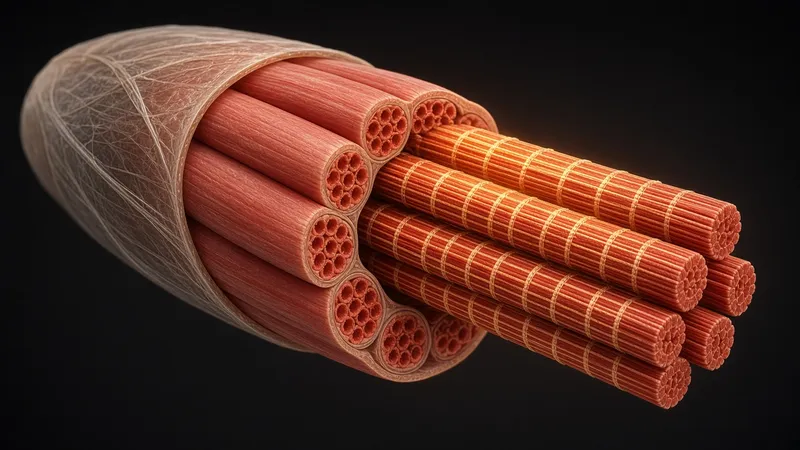
The two actions do grow muscle in different ways. In a 10-week trial in young men, eccentric and concentric training produced similar gains in quadriceps volume (+6% and +8%), but eccentric training lengthened muscle fascicles more (+12% vs +5%), concentric training increased pennation angle more (+30% vs +5%), and eccentric training favoured growth near the knee while concentric favoured the middle of the muscle (Franchi et al., 2014). This trial had only six men per group, so treat the regional details as a hint. Eccentric-only knee extensions with 120% of the concentric 1RM also increased muscle thickness in both women (+13%) and men (+11%) over 8 weeks, without a concentric comparison group (Coratella et al., 2018).
Takeaway: normal training with both phases is the default. Pure negatives are a tool, not an upgrade.
Eccentric overload: clear for strength, mixed for size
Accentuated eccentric loading in trained men. In a 10-week trial, 28 strength-trained men (about 2.6 years of experience) trained leg press and knee extension either normally or with 40% more load on the lowering phase. Muscle mass increased similarly in both training groups. The eccentric-overload group gained more maximal force, eccentric strength and work capacity: isometric torque rose 18% vs 1% in the control group, and reps to failure rose 28% only in the eccentric-overload group (Walker et al., 2016). A follow-up report from the same study found that only the eccentric-overload group lengthened its quadriceps fascicles (+14% vs +1% in the vastus lateralis) (Walker et al., 2020).
How heavy does the lowering need to be? In 27 active university students, 10 weeks of leg training with an electric-motor device used the same light lifting load (30% of 1RM) and either 90% or 120% of 1RM on the lowering. Thigh lean mass rose similarly (2.5% and 4.2%), and only the supramaximal group improved 1RM significantly; the authors concluded supramaximal lowering is not necessary for healthy, active people (Maroto-Izquierdo et al., 2023). A similar trial in 20 recreationally trained women reached the same conclusion (Maroto-Izquierdo et al., 2026).
How often? In 23 strength-trained athletes, 12 weeks of eccentric-overload squats once, twice or three times a week (equal doses per session) produced similar strength, power and growth; quadriceps cross-sectional area rose 3.6% on average (Refsnes et al., 2025).
Flywheel training. A 2017 meta-analysis of nine studies (276 people, athletes and healthy adults) found that flywheel training with eccentric overload beat traditional weight-stack training for strength, power and muscle size (Maroto-Izquierdo et al., 2017). An early trial behind this idea found quadriceps growth of 6.2% with a flywheel vs 3.0% with a weight stack after five weeks, but that difference was not statistically significant (Norrbrand et al., 2008). These studies are small and short, and most of us do not have a flywheel.
The big-picture reviews disagree a little. A 2026 position stand from the American College of Sports Medicine, an overview of 137 systematic reviews, lists eccentric overload, together with higher volumes (10 or more sets a week), as one of the few prescription variables that enhanced hypertrophy, while time under tension did not consistently matter (Currier et al., 2026). A 2026 meta-analysis of advanced training systems in recreationally trained adults found that eccentric overload contributed mainly to strength, and that tempo-controlled training produced adaptations comparable to traditional sets (Tsartsapakis et al., 2026).
Soreness and the repeated-bout effect
Eccentric-heavy training is famous for soreness. The good news is that it fades quickly with exposure. A meta-analysis of 20 studies on multi-joint exercises found that soreness and blood markers of muscle damage were clearly lower after a second bout than after the first, and strength recovered better (Doma et al., 2023). This is why we ease into eccentric methods over one to two weeks.
Evidence grade
- Moderate that tempo within about 0.5–8 seconds per rep makes little difference to growth, and that very slow reps are worse.
- Preliminary and mixed that eccentric overload adds growth. It clearly helps strength. For size, the trials in trained lifters show no extra growth, the position stand and an older flywheel meta-analysis are more positive, and most studies are small, short and focused on the thighs.
- No direct evidence for the 2-up/1-down method itself. We use it because it is a practical way to create the heavier lowering phase that the AEL trials tested.
What the research does not show: that slowing every rep down builds more muscle, or that you need eccentric overload to grow.
Five ways to train the lowering phase
| Method | How to do it | Best for | Our rating |
|---|---|---|---|
| Controlled tempo (default) | Lower in about 2–3 s, lift with intent (about 1 s), no bouncing | Every exercise | Use it everywhere |
| Slow eccentric block | 4 s lowering for 4–6 weeks on 1–2 exercises, slightly lighter loads | Technique, joint-friendly loading, home gyms with light weights | Optional |
| 2-up/1-down | Lift with both limbs, lower with one limb over about 3 s | Leg press, leg extension, leg curl, calf raise, machine chest press, machine row | Our pick for eccentric overload |
| Negatives (eccentric-only) | Get to the top with help (step, jump or partner) and lower slowly | Pull-ups and dips when you cannot yet do full reps | Useful stepping stone |
| Heavy AEL | Weight releasers, a spotter adding load, or a motorised or flywheel device | Advanced lifters with equipment and a spotter | Strength phases |
These protocols, timings and ratings are our conventions built from the studies above, not tested packages.
How 2-up/1-down works
On a leg extension: lift the weight with both legs, take one leg off at the top, and lower with the other leg over about 3 seconds. Alternate legs each rep, or do all reps on one leg and then switch. Each leg now lowers roughly twice the load it lifted with help, which is more than the 40% extra used by Walker et al. (2016); start with a weight you could lift for about 15 reps with both legs, then adjust. The 2× figure is a rough mechanical estimate, not a measured value.
Example: 4-day upper/lower block with eccentric emphasis
This plan follows the structure of our upper/lower split. Every set uses a controlled 2–3 s lowering. One or two exercises per session get a slow eccentric (4 s) or 2-up/1-down; they are marked in the table. Run it for 6–8 weeks.
Lower A
| Exercise | Sets × reps | Effort | Rest | Lowering |
|---|---|---|---|---|
| Back squat | 3 × 6–8 | 2 RIR | 3 min | 3 s |
| Leg extension, 2-up/1-down | 3 × 8–10 per leg | 1–2 RIR | 1–2 min | 3 s, one leg |
| Romanian deadlift | 3 × 8–10 | 2 RIR | 2–3 min | 3 s |
| Leg curl, 2-up/1-down | 3 × 8–10 per leg | 1–2 RIR | 1–2 min | 3 s, one leg |
| Standing calf raise | 4 × 10–15 | 1 RIR | 1 min | 2 s, 1 s pause at the bottom |
Upper A
| Exercise | Sets × reps | Effort | Rest | Lowering |
|---|---|---|---|---|
| Bench press | 3 × 6–8 | 2 RIR | 3 min | 2–3 s, touch, no bounce |
| Pull-up (or negatives) | 3 × 6–10 | 1–2 RIR | 2–3 min | 3 s |
| Incline dumbbell press, slow eccentric | 3 × 8–10 | 1–2 RIR | 2 min | 4 s |
| Seated cable row | 3 × 10–12 | 1–2 RIR | 2 min | 2–3 s |
| Lateral raise | 4 × 12–15 | 1 RIR | 1 min | 2 s |
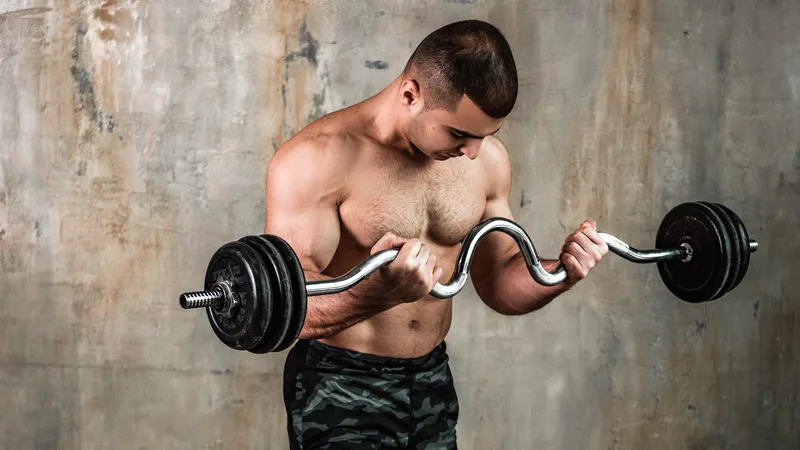
| EZ-bar curl, slow eccentric | 2 × 8–10 | 1 RIR | 1–2 min | 4 s |
| Overhead triceps extension | 2 × 10–12 | 1 RIR | 1 min | 2–3 s |
Lower B
| Exercise | Sets × reps | Effort | Rest | Lowering |
|---|---|---|---|---|
| Leg press | 3 × 10–12 | 1–2 RIR | 2 min | 3 s |
| Bulgarian split squat | 3 × 8–10 per leg | 2 RIR | 2 min | 3 s |
| Leg curl (both legs) | 4 × 10–12 | 1 RIR | 1–2 min | 2–3 s |
| Leg extension (both legs) | 3 × 12–15 | 1 RIR | 1–2 min | 2–3 s |
| Standing calf raise, 2-up/1-down | 4 × 8–12 per leg | 1 RIR | 1 min | 3 s, one leg |
Upper B
| Exercise | Sets × reps | Effort | Rest | Lowering |
|---|---|---|---|---|
| Overhead press | 3 × 6–8 | 2 RIR | 3 min | 2–3 s |
| Lat pulldown | 3 × 8–12 | 1–2 RIR | 2 min | 3 s |
| Machine chest press, 2-up/1-down | 3 × 6–8 per arm | 1–2 RIR | 2 min | 3 s, one arm |
| Barbell row | 3 × 8–10 | 2 RIR | 2 min | 2–3 s |
| Lateral raise | 4 × 12–15 | 1 RIR | 1 min | 2 s |
| Dips (or negatives) | 2 × 6–10 | 2 RIR | 2 min | 3 s |
| Biceps curl (dumbbell) | 2 × 10–12 | 1 RIR | 1 min | 2–3 s |
Week 1 ramp-in (our convention): do only half the sets on the marked exercises in the first week and stop them at 3 RIR, to let the repeated-bout effect work before you push.
Volume audit
We count every set taken to about 1–2 RIR as one hard set for the muscle it mainly trains. For 2-up/1-down, one set per leg (or arm) counts as one set for that limb. Indirect work (for example biceps in rows) is not counted; dips are counted for both chest and triceps.
| Muscle | Direct hard sets per week | Where they come from |
|---|---|---|
| Quadriceps | 15 | Squat 3, leg extension 3 + 3, leg press 3, split squat 3 |
| Hamstrings | 10 | Romanian deadlift 3, leg curl 3 + 4 |
| Chest | 11 | Bench press 3, incline dumbbell press 3, machine chest press 3, dips 2 |
| Back (lats and upper back) | 12 | Pull-up 3, cable row 3, lat pulldown 3, barbell row 3 |
| Side delts | 8 | Lateral raise 4 + 4 (plus overhead press) |
| Biceps | 4 | EZ-bar curl 2, dumbbell curl 2 (plus pulling) |
| Triceps | 4 | Overhead extension 2, dips 2 (plus pressing) |
| Calves | 8 | Calf raise 4 + 4 |
The big muscles land in the 10–20 hard sets per week range we use as a guide (see sets per week); arms get lots of indirect work, so add a set of curls or extensions if they are a priority. We kept volume moderate on purpose: eccentric-heavy sets cost more recovery in the first weeks.
Progression
- Double progression: when you reach the top of the rep range on all sets at the target RIR with the planned lowering time, add the smallest load step (often 2.5 kg on barbells, one plate on machines).
- Do not “progress” by lowering faster. Count the seconds (or use a metronome app) so your numbers stay comparable.
- For 2-up/1-down: progress the load only when the single-limb lowering stays smooth for the full 3 seconds on every rep. If the weight drops in the last third, it is too heavy.
- For negatives: when you can do 3 sets of 5 slow (about 4 s) pull-up or dip negatives, start adding full reps at the beginning of each set and finish with negatives.
- After the block: go back to a controlled 2–3 s lowering on everything for a few weeks, or swap the marked exercises. See progressive overload for more ways to keep gaining, and when and how to deload if performance drops for two sessions in a row.
How the methods compare
| Option | Growth evidence | Strength | Soreness and fatigue | Time per set |
|---|---|---|---|---|
| Self-chosen, controlled tempo | Reference option | Good | Normal | Normal |
| Slow eccentric (about 3–4 s) | Similar to normal tempo on average (Enes et al., 2025) | Similar or slightly better in trained people (Amdi et al., 2025) | Feels harder | Longer |
| Very slow reps (over 10 s) | Looks worse (Schoenfeld et al., 2015) | Worse loads | High | Much longer |
| Eccentric overload (AEL, 2-up/1-down) | Mixed; similar in trained men (Walker et al., 2016) | Better | Higher at first | Similar |
| Flywheel | Favourable in a small 2017 meta-analysis | Better | Higher at first | Similar |
Common mistakes
- Slowing everything down to “feel it more”. Very slow reps cut the load you can use and looked worse for growth. Fix: 2–3 s down, lift with intent.
- Dropping the weight on the way down. A fast, uncontrolled lowering wastes tension and raises injury risk. Fix: control the lowering on every rep, especially near failure.
- Adding eccentric overload everywhere at once. Soreness can wreck your next sessions. Fix: one or two exercises per session, half the sets in week one.
- Heavy negatives on free-weight squats or bench without safeties. Fix: use machines for 2-up/1-down, and only do heavy AEL on barbells with a spotter and safety pins.
- Counting slow reps as extra sets. A slow set is still one set. Fix: count sets and effort (RIR), not seconds.
- Stopping far from failure because the set “feels” hard. Slow reps raise perceived effort (Pearson et al., 2022). Fix: judge RIR by how many more reps you could do, not by the burn.
- Expecting eccentric overload to replace volume. Fix: get to 10–20 hard sets per muscle per week first; eccentric methods are a refinement.
Make it better
- Pair a controlled lowering with a stretch. Lower slowly into the long-muscle position on exercises like incline curls and overhead extensions, and see lengthened partials for adding partial reps there.
- Use 2-up/1-down to make light home machines harder without buying more plates.
- Use negatives to earn your first pull-ups and dips, then keep one negative set as a finisher.
Safety notes
- Eccentric-heavy training causes more soreness and temporary strength loss when it is new. Ramp in over 1–2 weeks and avoid it right before a sport event or a heavy test.
- Use machines, safety pins or a spotter for any supramaximal lowering. Never do heavy negatives alone on a barbell bench press.
- Very severe muscle pain, swelling or dark urine after a hard session needs prompt medical attention.
- If you have a tendon problem, an injury, heart or blood-pressure issues, are pregnant or are under 18, talk to your doctor or physiotherapist before heavy eccentric work.
FAQ
Do slow eccentrics build more muscle?
Not on average. Meta-analyses found similar growth across a wide range of tempos, and a 2025 analysis found tempo has a minimal overall effect. A controlled 2–3 second lowering is plenty for most lifters.
What is the best tempo for hypertrophy?
Any tempo from roughly 0.5 to 8 seconds per rep can work if you train close to failure. Avoid very slow reps of more than 10 seconds. We use about 2–3 seconds down and about 1 second up with full control.
Are negatives good for building muscle?
Eccentric-only training builds muscle about as well as concentric-only training, and eccentric work lengthens muscle fascicles more. For most lifters, normal reps with a controlled lowering are simpler. Negatives are most useful for pull-ups and dips you cannot yet do for reps.
What is eccentric overload training?
Using a heavier load on the lowering phase than on the lifting phase, for example with weight releasers, a flywheel device, a partner pushing on the weight, or 2-up/1-down on a machine. It reliably improves strength; extra muscle growth is possible but not proven.
Why do eccentrics make you so sore?
Unaccustomed eccentric work causes more muscle damage and soreness. The effect shrinks quickly after the first session or two, which is called the repeated-bout effect. Ramp in gradually.
How often should I do eccentric overload?
One or two exercises per session are enough. In one trial, eccentric-overload squats once, twice or three times a week gave similar results when each session had the same dose, so you do not need it every day.
References
- Schoenfeld BJ, Ogborn DI, Krieger JW. Effect of repetition duration during resistance training on muscle hypertrophy: a systematic review and meta-analysis. Sports Med. 2015;45(4):577-85. doi:10.1007/s40279-015-0304-0. PubMed: 25601394 ↩
- Enes A, Piñero A, Hermann T, et al. How Slow Should You Go? A Systematic Review With Meta-Analysis of the Effect of Resistance Training Repetition Tempo on Muscle Hypertrophy. J Strength Cond Res. 2025;39(12):1331-1339. doi:10.1519/JSC.0000000000005302. PubMed: 42709703 ↩
- Amdi CH, King A. The effect of eccentric phase duration on maximal strength, muscle hypertrophy and countermovement jump height: A systematic review and meta-analysis. J Sports Sci. 2025;43(20):2447-2464. doi:10.1080/02640414.2025.2535198. PubMed: 40692176 ↩
- Azevedo PHSM, Oliveira MGD, Schoenfeld BJ. Effect of different eccentric tempos on hypertrophy and strength of the lower limbs. Biol Sport. 2022;39(2):443-449. doi:10.5114/biolsport.2022.105335. PubMed: 35309524 ↩
- Kojic F, Mandic D, Duric S. The effects of eccentric phase tempo in squats on hypertrophy, strength, and contractile properties of the quadriceps femoris muscle. Front Physiol. 2024;15:1531926. doi:10.3389/fphys.2024.1531926. PubMed: 39850448 ↩
- Pearson J, Wadhi T, Barakat C, et al. Does Varying Repetition Tempo in a Single-Joint Lower Body Exercise Augment Muscle Size and Strength in Resistance-Trained Men? J Strength Cond Res. 2022;36(8):2162-2168. doi:10.1519/JSC.0000000000003953. PubMed: 34351728 ↩
- Handford MJ, Bright TE, Mundy P, et al. The Need for Eccentric Speed: A Narrative Review of the Effects of Accelerated Eccentric Actions During Resistance-Based Training. Sports Med. 2022;52(9):2061-2083. doi:10.1007/s40279-022-01686-z. PubMed: 35536450 ↩
- Wilk M, Zajac A, Tufano JJ. The Influence of Movement Tempo During Resistance Training on Muscular Strength and Hypertrophy Responses: A Review. Sports Med. 2021;51(8):1629-1650. doi:10.1007/s40279-021-01465-2. PubMed: 34043184 ↩
- Schoenfeld BJ, Ogborn DI, Vigotsky AD, et al. Hypertrophic Effects of Concentric vs. Eccentric Muscle Actions: A Systematic Review and Meta-analysis. J Strength Cond Res. 2017;31(9):2599-2608. doi:10.1519/JSC.0000000000001983. PubMed: 28486337 ↩
- da Silva LSL, Gonçalves LDS, Alves Campos PH, et al. Comparison Between Eccentric vs. Concentric Muscle Actions On Hypertrophy: A Systematic Review and Meta-analysis. J Strength Cond Res. 2025;39(1):115-134. doi:10.1519/JSC.0000000000004981. PubMed: 39652733 ↩
- Franchi MV, Atherton PJ, Reeves ND, et al. Architectural, functional and molecular responses to concentric and eccentric loading in human skeletal muscle. Acta Physiol (Oxf). 2014;210(3):642-54. doi:10.1111/apha.12225. PubMed: 24387247 ↩
- Coratella G, Longo S, Cè E, et al. Sex-Related Responses to Eccentric-Only Resistance Training in Knee-Extensors Muscle Strength and Architecture. Res Q Exerc Sport. 2018;89(3):347-353. doi:10.1080/02701367.2018.1472734. PubMed: 29889610 ↩
- Walker S, Blazevich AJ, Haff GG, et al. Greater Strength Gains after Training with Accentuated Eccentric than Traditional Isoinertial Loads in Already Strength-Trained Men. Front Physiol. 2016;7:149. doi:10.3389/fphys.2016.00149. PubMed: 27199764 ↩
- Walker S, Trezise J, Haff GG, et al. Increased fascicle length but not patellar tendon stiffness after accentuated eccentric-load strength training in already-trained men. Eur J Appl Physiol. 2020;120(11):2371-2382. doi:10.1007/s00421-020-04462-x. PubMed: 32772246 ↩
- Maroto-Izquierdo S, Martín-Rivera F, Nosaka K, et al. Effects of submaximal and supramaximal accentuated eccentric loading on mass and function. Front Physiol. 2023;14:1176835. doi:10.3389/fphys.2023.1176835. PubMed: 37449014 ↩
- Maroto-Izquierdo S, Lauría-Martínez M, Khoramipour K, et al. Cross-Education Effects After Submaximal and Supramaximal Accentuated Eccentric Loading on Lean Mass and Function in Women. J Funct Morphol Kinesiol. 2026;11(1). doi:10.3390/jfmk11010063. PubMed: 41718191 ↩
- Refsnes PE, Medbø JI, Jakobsen V, et al. One, two, or three times a week? examining the optimal frequency for strength and muscle growth in accentuated eccentric exercise. Eur J Appl Physiol. 2025;125(12):3581-3598. doi:10.1007/s00421-025-05828-9. PubMed: 40580213 ↩
- Maroto-Izquierdo S, García-López D, Fernandez-Gonzalo R, et al. Skeletal muscle functional and structural adaptations after eccentric overload flywheel resistance training: a systematic review and meta-analysis. J Sci Med Sport. 2017;20(10):943-951. doi:10.1016/j.jsams.2017.03.004. PubMed: 28385560 ↩
- Norrbrand L, Fluckey JD, Pozzo M, et al. Resistance training using eccentric overload induces early adaptations in skeletal muscle size. Eur J Appl Physiol. 2008;102(3):271-81. doi:10.1007/s00421-007-0583-8. PubMed: 17926060 ↩
- Currier BS, D’Souza AC, Singh MAF, et al. American College of Sports Medicine Position Stand. Resistance Training Prescription for Muscle Function, Hypertrophy, and Physical Performance in Healthy Adults: An Overview of Reviews. Med Sci Sports Exerc. 2026;58(4):851-872. doi:10.1249/MSS.0000000000003897. PubMed: 41843416 ↩
- Tsartsapakis I, Zafeiroudi A, Kouthouris C. Effects of Advanced Resistance Training Systems on Muscle Hypertrophy and Strength in Recreationally Trained Adults: A Systematic Review and Meta-Analysis. J Funct Morphol Kinesiol. 2026;11(1). doi:10.3390/jfmk11010080. PubMed: 41718208 ↩
- Doma K, Matoso B, Protzen G, et al. The Repeated Bout Effect of Multiarticular Exercises on Muscle Damage Markers and Physical Performances: A Systematic Review and Meta-Analyses. J Strength Cond Res. 2023;37(12):2504-2515. doi:10.1519/JSC.0000000000004628. PubMed: 38015738 ↩