Loaded Stretching and Weighted Stretches Between Sets
Loaded stretching for muscle growth: what inter-set stretch trials and long-stretch studies found, how much time it really takes and four protocols to try.
Key takeaways
- Loaded stretching means holding a muscle in a deep stretch under load, either between sets (inter-set stretch) or as long, separate stretching sessions.
- Adding 20–30 second stretches between sets did not reliably add muscle: three of five trials found no extra growth, including the only one in trained lifters (Wadhi et al., 2022).
- Long, intense stretching can grow muscle, mainly the calves, but the successful protocols took 15–60 minutes a day (Warneke et al., 2022; Wohlann et al., 2024).
- Across all studies, the effect of stretching on muscle size is trivial to small (Arntz et al., 2024; Warneke et al., 2024), far below normal resistance training per minute spent.
- Use loaded stretches as a low-cost add-on for a lagging muscle (calves, chest, lats), keep them to 20–30 seconds, and never let them cost you reps on your working sets.
Loaded stretching has become one of the most talked-about ideas in hypertrophy training. The pitch is simple: muscles grow when they are trained in a stretched position, so why not hold a weighted stretch between sets, or stretch hard for long periods, and squeeze out extra growth for free?
The truth is more modest. There is real research behind stretch-mediated growth, but most of it uses stretching sessions far longer than any lifter will do, and the trials of quick stretches between sets mostly found nothing extra. This guide explains what loaded stretching is, what each line of research found, how much time it really takes, four protocols you can try, and when it is not worth the effort. It is part of our Training Methods section; for the bigger picture of training in the stretch, see our guide to lengthened partials and our pillar on every training split.
Evidence in one line: loaded stretching is not a reliable growth booster in the doses lifters actually use. It is a cheap add-on for a lagging muscle, with weak evidence, and it should never replace hard sets.
What this page covers. This page is about passive stretches held under load: between sets, after sets or as separate sessions. Doing reps in the stretched part of the range is a different method, covered in lengthened partials, and choosing exercises that train muscles at long lengths is covered in our guide to long muscle lengths.
Key terms
- Static stretch: holding a muscle at a long length without moving.
- Loaded stretch (weighted stretch): a static stretch where a weight, a machine or your bodyweight pulls the muscle deeper, for example hanging from a bar or holding the bottom of a dumbbell fly.
- Inter-set stretch: a stretch held during the rest between two sets of an exercise.
- Long-duration stretching: stretching sessions of many minutes, often with a splint (orthosis) or a machine that holds the joint at its end range.
- Muscle thickness: the depth of a muscle measured with ultrasound; the most common growth measure in these studies.
- Fascicle length: the length of the muscle-fibre bundles; stretching can lengthen them slightly.
- RIR (reps in reserve): how many more reps you could have done; see training to failure vs RIR.
Why stretching might build muscle
In animal studies, long periods of stretch made muscles grow, and the idea has been carried over to humans. The proposed mechanism is mechanical tension: a muscle held at a long length is under passive tension, and muscle cells have force sensors that respond to both active contractions and passive stretch (Schoenfeld et al., 2022). Training at long muscle lengths does seem to favour growth in several trials (Maeo et al., 2021; Maeo et al., 2023), which is why the idea of adding extra stretch is appealing.
But “the muscle is under some tension” is not the same as “the muscle grows”. A passive stretch produces much less tension than a hard set, and human muscles may need a lot of it to respond. That is what the research tests.
What the research says
Stretching between sets: mostly no extra growth
Five trials have added stretches to the rest periods of a resistance-training program.
| Study | Who | Length | Stretch protocol | Result for muscle size |
|---|---|---|---|---|
| Evangelista et al. (2019) | 29 sedentary adults | 8 weeks | 30 s passive stretch at maximum range between sets, 6 exercises | Greater growth in the vastus lateralis (17.0% vs 7.3%) and in summed thickness; similar in biceps, triceps and rectus femoris |
| Nakamura et al. (2021) | 16 untrained men, one leg each condition | 5 weeks | Static stretch between flywheel squat sets | No difference in quadriceps growth (8.0% vs 7.3%); more flexibility |
| Van Every et al. (2022) | 21 young untrained men, one leg each condition | 8 weeks | 20 s loaded calf stretch between calf-raise sets | Possible small benefit in the soleus (about 0.7 mm); unclear or no benefit in the gastrocnemius |
| Wadhi et al. (2022) | 26 resistance-trained men | 8 weeks | 30 s loaded stretch at 15% of the working load between sets | No difference in chest thickness or bench-press strength |
| Businari et al. (2024) | 22 recreationally trained men and women | 8 weeks | Static stretch between sets | No difference in elbow-flexor or elbow-extensor strength or size; total training volume was lower with stretching |
Evangelista et al. (2019) is the study most often quoted for inter-set stretching. It did find more growth in one thigh muscle, but the participants were sedentary, and the authors themselves wrote that their data were not sufficient to conclude that inter-set stretching is superior. The only trial in trained lifters, Wadhi et al. (2022), found no effect either way. Businari et al. (2024) adds a warning: the stretching group lifted less total volume, which is the opposite of what you want.
Van Every et al. (2022) used the best-controlled design (each person trained one leg each way) and a properly loaded stretch at the bottom of the calf raise. The soleus may have grown slightly more, but the effect on the gastrocnemius was unclear or absent. One author reported an advisory role with a fitness-equipment maker that did not fund the study.
Long-duration stretching: real growth, huge time cost
A separate set of studies, mostly from one German research group, used very long and intense stretching, usually of the calves.
| Study | Who | Stretching dose | Result |
|---|---|---|---|
| Warneke et al. (2022) | 52 participants (27 stretched) | 1 hour a day, 6 weeks, one calf, with an orthosis | Lateral gastrocnemius cross-sectional area up 15.2% |
| Warneke et al. (2023a) | 45 well-trained participants | 6 × 10 minutes a day, 6 weeks, calves | Increases in muscle thickness and cross-sectional area vs controls (effect sizes d = 0.53–0.6 and 0.16–0.3) |
| Warneke et al. (2023b) | 69 active participants | 1 hour a day of stretching vs calf training 5 × 10–12, 3 days a week, 6 weeks | Similar gains in calf thickness and strength in both groups |
| Wohlann et al. (2024) | 81 active participants | Chest stretch 15 minutes a day, 4 days a week, 8 weeks, vs resistance training 5 × 12, 3 days a week | Similar gains in chest thickness and strength |
| Siegel et al. (2026) | 49 recreationally active participants | 12 sessions of 15-minute hip-flexor stretches over 4–5 weeks | Rectus femoris thickness increased; vastus lateralis inconsistent |
These results are striking: hours of stretching per week matched short calf or chest training programs in people who were not doing serious resistance training. But the authors themselves point out the problem. In Warneke et al. (2023b), up to seven hours of stretching a week was needed to match about three 15-minute training sessions, and Wohlann et al. (2024) concluded that the practical use is limited to special situations, such as rehabilitation when normal training is not possible.
For lifters who already train hard, there is almost nothing. One case study of a competitive bodybuilder who added an hour of calf stretching six days a week for 12 weeks reported calf muscle thickness gains of 7.4–23.4% at different sites (Homer et al., 2025). It is a single person with no control, so it is a curiosity, not evidence.
The big picture: meta-analyses and expert consensus
- A meta-analysis of 42 studies with 1,318 participants found a small effect of static stretching on muscle size (d = 0.20), larger with longer stretching durations, longer programs and higher frequencies; low doses did not reach significance (Warneke et al., 2024).
- A second meta-analysis of 25 studies found an overall trivial and unclear effect on muscle size, with larger effects in trained people and with more time under stretch (Arntz et al., 2024).
- A meta-analysis of 19 studies on muscle architecture found no increase in muscle thickness with stretching, only trivial to small increases in fascicle length (Panidi et al., 2023).
- An earlier review concluded that passive, low-intensity stretching does not change muscle size, while stretching under load or between contractions might (Nunes et al., 2020).
- A 2025 Delphi consensus of 20 stretching researchers agreed that stretch training does not contribute substantively to muscle growth (Warneke et al., 2025).
Evidence grade
Preliminary. Stretch-mediated growth is real in principle, but it needs doses of 15–60 minutes a day to show up, and quick stretches between sets have not reliably added growth on top of normal training. Most studies used untrained or recreationally active people and short programs, and the long-stretch research comes largely from one research group. Data in women and older adults are limited.
How much time does it really take?
This is the part most social-media advice skips.
| Approach | Weekly time | What the evidence suggests |
|---|---|---|
| 20–30 s stretch after each set of one exercise (3–4 sets, twice a week) | About 2–4 minutes | Possibly a small benefit in some muscles; usually nothing measurable |
| 15 minutes a day, 4 days a week, for one muscle | 60 minutes | Similar to a short training program in non-lifters (Wohlann et al., 2024) |
| 1 hour a day for one muscle | 7 hours | Similar to a short training program in non-lifters (Warneke et al., 2023b) |
| 3 extra hard sets for the same muscle | About 6–10 minutes | Reliable growth; more sets per week means more growth up to a point |
If your goal is size, extra hard sets beat stretching per minute spent by a wide margin. See our guide to sets per week.
Four ways to use loaded stretching
The holds and timings below are our conventions, based on the protocols in the studies (20–30 seconds between sets; long stretches of 10–60 minutes).
| Protocol | How it works | When to use it |
|---|---|---|
| Inter-set loaded stretch | After each set, hold the stretched position with the weight (or a lighter one) for 20–30 s, then rest the remaining time | One exercise per session for a lagging muscle, as long as it does not cost reps |
| Last-set stretch hold | After the final set only, hold the stretch for 30–60 s | Simple add-on with no effect on your working sets |
| Daily stretch block | 10–15 min of firm stretching for one muscle, 4+ days a week, outside your workouts | Stubborn calves, rehab or periods when you cannot train a muscle |
| Flexibility-first stretch | Normal static stretches for range of motion | When the goal is mobility, not size |
Where to hold the stretch
| Muscle | Loaded stretch position | Exercise to pair it with |
|---|---|---|
| Calves | Bottom of a calf raise on a step, heels dropped, knees straight | Standing calf raise |
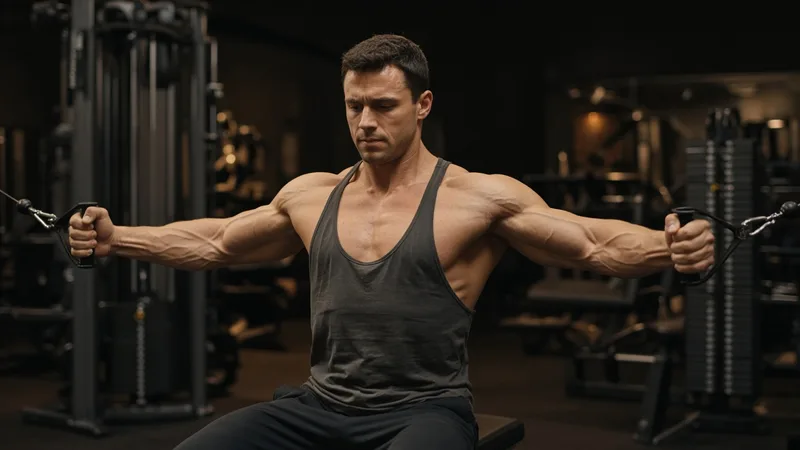
| Chest | Bottom of a dumbbell fly or a supported dip bottom, arms wide | Dips, flyes, incline dumbbell press |
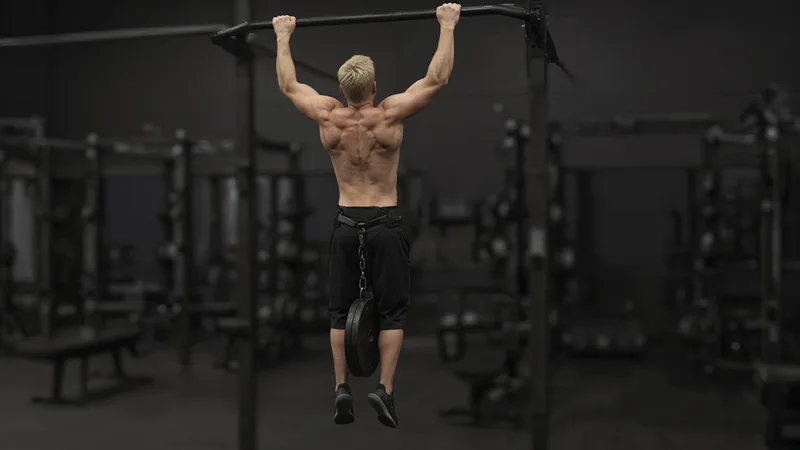
| Lats | Dead hang from a bar, shoulders relaxed up (weighted if you are strong) | Pull-up, lat pulldown |
| Triceps (long head) | Bottom of an overhead extension, elbows by the ears | Overhead triceps extension |
| Hamstrings | Bottom of a Romanian deadlift, held with a light load | Romanian deadlift, leg curl |
| Biceps | Bottom of an incline dumbbell curl, arms hanging behind the body | Biceps curl variations |
Calves and chest are the muscles with the most stretch research (Van Every et al., 2022; Wohlann et al., 2024), so they are the most sensible places to start.
Example: adding loaded stretches to a normal week
You do not need a special program. Pick one or two muscles you want to bring up and add a stretch to one exercise for each, twice a week.
| Day | Exercise | Working sets | Loaded stretch |
|---|---|---|---|
| Lower A | Standing calf raise | 4 × 10–15, 1 RIR | 20–30 s at the bottom after each set |
| Upper A | Dumbbell fly or dips | 3 × 10–12, 1–2 RIR | 30 s in the bottom position after the last set |
| Lower B | Standing calf raise | 4 × 10–15, 1 RIR | 20–30 s at the bottom after each set |
| Upper B | Lat pulldown, then a dead hang | 3 × 8–12, 1–2 RIR | 30–45 s dead hang after the last set |
Rules: keep your normal rest after the stretch (at least 60 seconds more for compound lifts), and drop the inter-set stretch if your reps on the next set fall by more than one or two compared with your usual numbers. Do not count stretches as hard sets.
Progression
- Progress the working sets first. Load and reps on your normal sets drive growth; the stretch is a garnish.
- Deepen the stretch gradually. Add a little range or a little load over weeks, never by forcing a painful position.
- Lengthen the hold before adding weight: 20 s, then 30 s, then 45 s.
- Reassess after 8–12 weeks. Take the same photos or measurements. If nothing has changed, drop it and add a hard set instead.
Loaded stretching compared with other stretch-focused methods
| Method | What you do | Growth evidence | Time cost |
|---|---|---|---|
| Loaded stretching between sets | Passive weighted holds between sets | Mostly no extra growth in trials | Low |
| Long-duration stretching | 15–60 min daily stretching | Growth in non-lifters, mainly calves and chest | Very high |
| Lengthened partials | Reps in the stretched half of the range | Promising (see our guide) | None extra |
| Choosing long-length exercises | For example overhead triceps extensions, seated leg curls | Supported by trials (Maeo et al., 2021; Maeo et al., 2023) | None extra |
The bottom line: if you want more stretch-mediated growth, choosing exercises that load muscles at long lengths and doing lengthened partials costs no extra time and has better evidence than passive stretching.
Common mistakes
- Treating stretches as a replacement for sets. No trial supports that for lifters. Fix: keep your hard sets, add stretches on top.
- Stretching so hard that the next set suffers. Total volume dropped with inter-set stretching in one trial (Businari et al., 2024). Fix: 20–30 s, moderate intensity, extra rest.
- Bouncing in the stretch. Fix: hold still and breathe.
- Loading the shoulders too deep. Deep chest and lat stretches stress the shoulder joint. Fix: build range over weeks and stop at firm tension, not pain.
- Expecting fast results. Even the long-stretch trials ran six weeks or more. Fix: give it 8–12 weeks before judging.
- Believing the hype numbers. The large gains come from hour-a-day stretching in people who were not lifting. Fix: expect small or no added growth.
Make it better
- Combine with lengthened partials. On your last set, finish with a few partial reps in the stretch, then hold the stretch for 20–30 s.
- Use it for muscles that are hard to train often, such as calves, where an extra stretch at the end of the day takes almost no recovery.
- Pair with a stretch-biased exercise (incline curls, overhead extensions, seated leg curls) so the working sets already train the long position.
Safety notes
- Stretch to firm tension, not sharp pain. Stop if you feel tingling, numbness or joint pain.
- Be careful with deep loaded stretches of the shoulders (flyes, dips, dead hangs) if you have had shoulder problems.
- If you have a tendon or muscle injury, ask a physiotherapist before adding loaded stretches.
- Under 18, pregnant, or managing a medical condition? Talk to your doctor before starting a new training method.
FAQ
Does stretching build muscle?
A little, under specific conditions. Very long daily stretching (15–60 minutes) increased muscle size in several trials, but meta-analyses rate the overall effect as trivial to small (Arntz et al., 2024; Warneke et al., 2024), and experts agree it does not contribute substantively to growth (Warneke et al., 2025).
Should you stretch between sets?
You can, but do not expect much. Three of five trials found no extra growth, including the only one in trained lifters (Wadhi et al., 2022). If you try it, keep stretches to 20–30 seconds and make sure your next set does not suffer.
How long should you hold a loaded stretch?
Between sets, the trials used 20–30 seconds. The studies that found clear growth from stretching alone used 15 minutes to an hour a day, which is not practical for most lifters.
Do weighted calf stretches help calves grow?
Possibly a little. One trial found a small extra gain in the soleus with 20-second loaded stretches between calf-raise sets (Van Every et al., 2022), and hour-a-day calf stretching grew the calves in non-lifters (Warneke et al., 2022). Calves are the most sensible muscle to try it on.
Is a dead hang a loaded stretch?
Yes. Hanging from a bar stretches the lats under your bodyweight, and adding a weight belt increases the load. There are no hypertrophy trials on dead hangs, so treat it as an add-on.
Is loaded stretching better than lengthened partials?
The evidence is better for training at long muscle lengths, including lengthened partials, than for passive stretching, and it costs no extra time.
References
- Schoenfeld BJ, Wackerhage H, De Souza E. Inter-set stretch: A potential time-efficient strategy for enhancing skeletal muscle adaptations. Front Sports Act Living. 2022;4:1035190. doi:10.3389/fspor.2022.1035190. PubMed: 36457663 ↩
- Maeo S, Huang M, Wu Y, et al. Greater Hamstrings Muscle Hypertrophy but Similar Damage Protection after Training at Long versus Short Muscle Lengths. Med Sci Sports Exerc. 2021;53(4):825-837. doi:10.1249/MSS.0000000000002523. PubMed: 33009197
- Maeo S, Wu Y, Huang M, et al. Triceps brachii hypertrophy is substantially greater after elbow extension training performed in the overhead versus neutral arm position. Eur J Sport Sci. 2023;23(7):1240-1250. doi:10.1080/17461391.2022.2100279. PubMed: 35819335 ↩
- Evangelista AL, De Souza EO, Moreira DCB, et al. Interset Stretching vs. Traditional Strength Training: Effects on Muscle Strength and Size in Untrained Individuals. J Strength Cond Res. 2019;33 Suppl 1:S159-S166. doi:10.1519/JSC.0000000000003036. PubMed: 30688865 ↩
- Nakamura M, Ikezu H, Sato S, et al. Effects of Adding Inter-Set Static Stretching to Flywheel Resistance Training on Flexibility, Muscular Strength, and Regional Hypertrophy in Young Men. Int J Environ Res Public Health. 2021;18(7). doi:10.3390/ijerph18073770. PubMed: 33916599 ↩
- Van Every DW, Coleman M, Rosa A, et al. Loaded inter-set stretch may selectively enhance muscular adaptations of the plantar flexors. PLoS One. 2022;17(9):e0273451. doi:10.1371/journal.pone.0273451. PubMed: 36048793 ↩
- Wadhi T, Barakat C, Evangelista AL, et al. Loaded Inter-set Stretching for Muscular Adaptations in Trained Males: Is the Hype Real? Int J Sports Med. 2022;43(2):168-176. doi:10.1055/a-1529-6281. PubMed: 34375990 ↩
- Businari GB, Brigatto FA, de Camargo JBB, et al. Chronic Effects of Inter-Set Static Stretching on Morphofunctional Outcomes in Recreationally Resistance-Trained Male and Female. Res Q Exerc Sport. 2024;95(1):10-23. doi:10.1080/02701367.2022.2134547. PubMed: 36638500 ↩
- Warneke K, Brinkmann A, Hillebrecht M, et al. Influence of Long-Lasting Static Stretching on Maximal Strength, Muscle Thickness and Flexibility. Front Physiol. 2022;13:878955. doi:10.3389/fphys.2022.878955. PubMed: 35694390 ↩
- Warneke K, Keiner M, Wohlann T, et al. Influence of Long-Lasting Static Stretching Intervention on Functional and Morphological Parameters in the Plantar Flexors: A Randomized Controlled Trial. J Strength Cond Res. 2023;37(10):1993-2001. doi:10.1519/JSC.0000000000004513. PubMed: 37318350 (cited as 2023a)
- Warneke K, Wirth K, Keiner M, et al. Comparison of the effects of long-lasting static stretching and hypertrophy training on maximal strength, muscle thickness and flexibility in the plantar flexors. Eur J Appl Physiol. 2023;123(8):1773-1787. doi:10.1007/s00421-023-05184-6. PubMed: 37029826 (cited as 2023b)
- Wohlann T, Warneke K, Kalder V, et al. Influence of 8-weeks of supervised static stretching or resistance training of pectoral major muscles on maximal strength, muscle thickness and range of motion. Eur J Appl Physiol. 2024;124(6):1885-1893. doi:10.1007/s00421-023-05413-y. PubMed: 38240811 ↩
- Siegel SD, Sproll M, Lohmann LH, et al. Stretch-mediated hypertrophy and strength increases and their impact on dynamic balance performance - a randomized controlled intervention study. Sci Rep. 2026;16(1). doi:10.1038/s41598-026-43038-1. PubMed: 41796242 ↩
- Homer KA, Helms ER, Spence AJ. The effect of a combined long-duration static stretching and resistance training regimen on a competitive bodybuilder: A case study. Physiol Rep. 2025;13(2):e70156. doi:10.14814/phy2.70156. PubMed: 39825474 ↩
- Warneke K, Lohmann LH, Behm DG, et al. Effects of Chronic Static Stretching on Maximal Strength and Muscle Hypertrophy: A Systematic Review and Meta-Analysis with Meta-Regression. Sports Med Open. 2024;10(1):45. doi:10.1186/s40798-024-00706-8. PubMed: 38637473 ↩
- Arntz F, Markov A, Schoenfeld BJ, et al. Chronic Effects of Static Stretching Exercises on Skeletal Muscle Hypertrophy in Healthy Individuals: A Systematic Review and Multilevel Meta-Analysis. Sports Med Open. 2024;10(1):106. doi:10.1186/s40798-024-00772-y. PubMed: 39340744 ↩
- Panidi I, Donti O, Konrad A, et al. Muscle Architecture Adaptations to Static Stretching Training: A Systematic Review with Meta-Analysis. Sports Med Open. 2023;9(1):47. doi:10.1186/s40798-023-00591-7. PubMed: 37318696 ↩
- Nunes JP, Schoenfeld BJ, Nakamura M, et al. Does stretch training induce muscle hypertrophy in humans? A review of the literature. Clin Physiol Funct Imaging. 2020;40(3):148-156. doi:10.1111/cpf.12622. PubMed: 31984621 ↩
- Warneke K, Thomas E, Blazevich AJ, et al. Practical recommendations on stretching exercise: A Delphi consensus statement of international research experts. J Sport Health Sci. 2025;14:101067. doi:10.1016/j.jshs.2025.101067. PubMed: 40513717 ↩