Key takeaways
- Strength comes back fastest. Older men lost only about 30% of their strength gains after 12 weeks off and regained the rest within 8 weeks of retraining (Taaffe et al., 1997).
- Two weeks off costs almost nothing. Power athletes kept their bench press and squat after 14 days without training (Hortobágyi et al., 1993).
- Muscle size fades over months, but periodic 3-week breaks did not reduce total growth over 24 weeks compared with training without breaks (Ogasawara et al., 2013).
- The popular 'myonuclei never leave' explanation comes from mice. A meta-analysis found that in humans, myonuclei are lost when muscle shrinks (Rahmati et al., 2022).
- To keep muscle on a busy stretch, about one-third of your normal training was enough for young adults in a 32-week trial (Bickel et al., 2011).
- When you come back, start with about half your usual sets and lighter loads for 1–2 weeks, then build up. Most people are back near their old level within weeks to a few months.
You trained for a year, then life happened: an injury, a new job, a baby, a long trip. Now you’re back in the gym and everything feels weak. The good news that lifters call muscle memory is real in one important sense: lost strength, and to some extent lost muscle, comes back faster than it took to build the first time.
This guide explains what the research actually shows about losing and regaining muscle, what is known (and not known) about the cellular “memory” in muscle, how little training it takes to hold on to your gains, and a week-by-week plan for coming back after a break. It’s part of our Science section; for the basics of how growth works, see how muscle grows.
Evidence in one line: strength is kept well and regained fast; muscle size is regained reasonably quickly too, but the idea that muscle “remembers” through permanent extra nuclei is mostly based on mice and is doubtful in humans.
Coming back after injury, surgery or illness? Follow your doctor’s or physiotherapist’s plan first. This page is about healthy lifters returning after a planned or unplanned break.
Key terms
- Detraining: stopping or sharply reducing training, so that adaptations fade.
- Retraining: training again after a period of detraining.
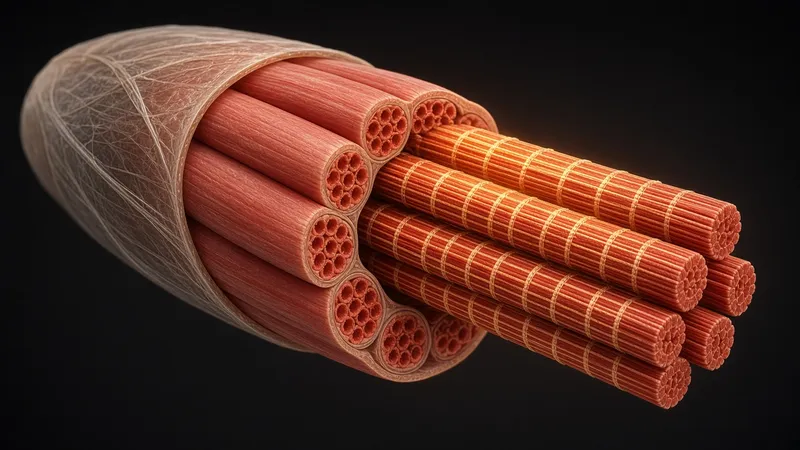
- Myonuclei: the nuclei inside muscle fibres. Muscle fibres are huge cells with many nuclei; each nucleus “serves” a region of the fibre (the myonuclear domain).
- Satellite cells: muscle stem cells that can fuse with fibres and donate new nuclei.
- Epigenetics: chemical marks on DNA (such as methylation) that change how active a gene is without changing the gene itself.
- CSA (cross-sectional area): the size of a muscle or fibre in cross-section, a common measure of growth.
- RIR (reps in reserve): how many more reps you could have done when you stopped a set. See training to failure vs RIR.
Three things people mean by “muscle memory”
- Skill memory. Your nervous system remembers how to squat, press and pull. Coordination comes back within a few sessions.
- Strength memory. Strength drops much more slowly than muscle size during a break, and returns quickly. This is well documented.
- Cellular memory. The idea that the muscle fibre itself “remembers” earlier growth, through extra nuclei or epigenetic marks, so it regrows faster. This is the interesting and disputed part.
What the research says
How fast you lose strength and muscle
Short breaks (up to about 2 weeks): almost nothing is lost. In 12 power athletes who stopped resistance training for 14 days, bench press (−1.7%), squat (−0.9%) and isometric knee strength did not change significantly. Eccentric knee strength fell by 12% and the area of type II (fast) fibres fell by 6.4% (Hortobágyi et al., 1993). A planned week or two off, a holiday or a deload will not cost you meaningful muscle.
Longer breaks (months): muscle size fades, strength much less so. A review of long-term detraining in athletes concluded that force production declines slowly and usually remains above untrained levels for very long periods, while strength athletes’ fibre areas shrink significantly (Mujika & Padilla, 2000).
- In 11 men aged 65–77 who had trained for 24 weeks and then stopped for 12 weeks, only about 30% of the strength gained was lost, even though type I and II fibre size returned to pre-training values (Taaffe et al., 1997).
- In 30 older men who trained for 12 weeks and then stopped for 12 weeks, strength and power fell by only 5–15% (Blocquiaux et al., 2020).
- In 19 men and women who trained one leg for 10 weeks and then stopped for 20 weeks, muscle thickness and fibre size returned to baseline, but strength stayed clearly above baseline (Psilander et al., 2019).
How fast it comes back
- Strength returns quickly. The older men in Taaffe’s study were back to their trained strength after 8 weeks of retraining (Taaffe et al., 1997). In Blocquiaux’s study, less than 8 weeks of retraining were needed to reach the post-training 1RM, and in a small biopsy subset, 12 weeks of retraining grew type II fibres by 29% (Blocquiaux et al., 2020).
- Muscle fibres respond fast after a long break. Six women who had trained for 20 weeks and then stopped for 30–32 weeks retrained for 6 weeks. Detraining had relatively little effect on fibre size, and retraining significantly increased the size of the fast fibres. The authors suggested that some adaptations may be kept for long periods and contribute to a rapid return to form (Staron et al., 1991). But untrained women in the same 6-week phase also adapted quickly, so the study did not show that previously trained muscle grows faster.
- The best direct test found no head start. In Psilander’s study, after 20 weeks off, both legs were trained for 5 weeks. The previously trained leg did not grow more than the untrained leg. The authors noted that the first training phase did not add myonuclei, so the study could not properly test the myonuclear theory (Psilander et al., 2019).
Breaks inside a training block
In 14 young men doing bench press three times a week (3 × 10 at 75% of 1RM), one group trained continuously for 24 weeks while the other did three 6-week blocks separated by 3-week breaks. After 24 weeks, gains in muscle size and strength were similar, because the break group grew faster than the continuous group after its second break (Ogasawara et al., 2013). The study was small and used one exercise in young men, but it suggests short breaks are not something to fear.
The myonuclear theory: strong in mice, weak in humans
The popular explanation for muscle memory goes like this: when a fibre grows, it adds nuclei; when it shrinks, it keeps them; so when you train again, the extra nuclei let it regrow faster.
- In mice, new myonuclei were added before the fibres grew, and both old and new nuclei were kept during severe atrophy lasting a long part of the animal’s life (Bruusgaard et al., 2010).
- In female mice given testosterone for 14 days, myonuclei rose by 66% and fibre size by 77%. Three weeks after the drug was stopped, fibre size was back to normal but the extra nuclei remained for at least 3 months. When these muscles were then overloaded for 6 days, fibre area grew by 31%, while control muscles did not grow significantly (Egner et al., 2013). The authors suggested this could matter for how long doping bans should last.
Human data do not support the same mechanism well:
- A review concluded that “muscle memory by myonuclear permanence” is based mainly on rodent models and that whether it holds in humans remains largely ambiguous (Snijders et al., 2020).
- A meta-analysis of 147 articles found that the extra myonuclei gained with growth were kept in rodents but not in humans during atrophy, and that myonuclei and satellite cells were lower after atrophy in humans. The authors concluded that myonuclei are not permanent and that other mechanisms, such as epigenetics, may matter more (Rahmati et al., 2022).
- In the older men in Blocquiaux’s study, myonuclear number tended to follow fibre size up and down (Blocquiaux et al., 2020).
Epigenetic memory: promising, early
A small study in adults measured DNA methylation at 850,000 sites in muscle after a period of growth (loading), a return to baseline muscle mass (unloading) and a second growth period (reloading). After reloading, far more sites were hypomethylated (18,816) than after the first loading (9,153). Some genes kept their altered methylation even while muscle mass returned to baseline, and some showed the largest increases in methylation change, gene expression and muscle mass after reloading (Seaborne et al., 2018). This is the first human evidence that muscle may carry an epigenetic “memory” of growth, but it comes from a single small study and needs replication.
How little training keeps your muscle
This is the most useful finding for busy lifters. In a trial with 70 adults, 16 weeks of training three times a week was followed by 32 weeks of either no training or a reduced dose of one-third or one-ninth of the original. In young adults (20–35 years), both reduced doses kept the muscle gained, and the one-third dose even added a little fibre growth. Older adults (60–75 years) needed more to keep their size. Strength was largely kept even with no training at all, with only a slight drop at the final time point (Bickel et al., 2011). This fits the long-term review’s conclusion that you can cut training volume a lot as long as you keep the intensity (Mujika & Padilla, 2000). See minimalist training for full low-time plans.
What the research does not show yet
- Whether previously trained muscle regrows faster than new muscle. The one study designed to test this in humans found no difference (Psilander et al., 2019), but it was small and its first training phase did not add myonuclei.
- How long any cellular memory lasts in humans. Mouse data cover a large part of a mouse’s life; human studies cover months, not years.
- Data in trained, long-term lifters. Most detraining studies use beginners or older adults after 10–24 weeks of training. Lifters with years of training probably lose less in relative terms early on, but this has not been well studied.
- Exact “weeks back per week off” rules. No study supports a precise formula.
How much you lose: a rough guide
| Length of break | What tends to happen | Evidence |
|---|---|---|
| Up to 2 weeks | No meaningful loss of strength or size; you may feel rusty or “flat” | Hortobágyi et al., 1993 |
| 3–4 weeks | Some loss is possible, but growth catches up quickly when you resume | Ogasawara et al., 2013 (3-week breaks) |
| 2–3 months | Noticeable loss of size; most strength still there | Taaffe et al., 1997; Blocquiaux et al., 2020 |
| 5–8 months | Size can return to baseline in new lifters; strength still above baseline | Psilander et al., 2019; Staron et al., 1991 |
These are typical patterns from small studies, not precise predictions. Age matters: older adults lose size more easily and need more training to hold on to it (Bickel et al., 2011).
The comeback plan
The goal of the first weeks back is to rebuild work capacity and connective-tissue tolerance without crushing soreness, then return to normal progression. Muscle comes back faster when you can train consistently, and a brutal first week makes that harder.
Week-by-week
| Phase | Sets per muscle per week | Effort | Load |
|---|---|---|---|
| Week 1 | About 50% of your old volume (e.g. 5–6 if you used to do 10–12) | 3–4 RIR | About 70–80% of your old working weights |
| Week 2 | About 60–70% | 2–3 RIR | Add load as long as reps feel smooth |
| Weeks 3–4 | About 80–100% | 1–3 RIR | Back to normal progressive overload |
| Week 5+ | Your normal program | Normal | Normal progression; expect fast gains for a while |
After a break of 2 weeks or less, skip straight to week 2 or 3. After several months, stretch week 1 and 2 to two weeks each. (These percentages are our coaching convention, built on the detraining evidence above; no study has compared comeback protocols.)
Example: first week back (3 full-body sessions)
| Exercise | Sets × reps | Effort | Rest |
|---|---|---|---|
| Back squat or leg press | 2 × 8–10 | 3–4 RIR | 2–3 min |
| Bench press or incline dumbbell press | 2 × 8–10 | 3–4 RIR | 2–3 min |
| Lat pulldown or seated cable row | 2 × 10–12 | 3 RIR | 2 min |
| Romanian deadlift | 2 × 8–10 | 3–4 RIR | 2 min |
| Lateral raise or arm exercise | 2 × 12–15 | 2–3 RIR | 1 min |
Alternate the two options in each row across the three sessions. That gives roughly 4–6 hard sets per major muscle in week 1. If you are completely new to training rather than coming back, use our beginner guide to building muscle instead.
Rules for the comeback
- Expect soreness after the first sessions. The low volume in week 1 is there to limit it. Soreness fades quickly once you train regularly.
- Don’t test your 1RM in the first month. Strength returns faster than tendons and joints are ready for maximal loads.
- Eat enough protein from day one: about 1.6 g per kg of body weight per day; see protein intake.
- Track your old numbers. Compare each week with your pre-break log. Most lifters see rapid week-to-week jumps in the first month back.
- Sleep. It supports every part of recovery; see sleep and muscle growth.
How to avoid losing muscle in the first place
If you know a busy period is coming, a minimal plan is far better than stopping:
| Situation | Minimum plan |
|---|---|
| Busy weeks (time-limited) | 1–2 full-body sessions a week, 1–3 hard sets per major muscle, keep heavy-ish loads (6–12 reps at 1–2 RIR) |
| Travel without a gym | Push-ups, split squats, single-leg Romanian deadlifts, band rows, close to failure, 2–3 times a week |
| Injury to one limb | Keep training everything else; training one limb also keeps some strength in the other (cross-education; see unilateral training) |
This follows the finding that about one-third of the original training dose kept muscle in young adults (Bickel et al., 2011) and that intensity matters more than volume for maintenance (Mujika & Padilla, 2000). Older lifters should keep a bit more (two sessions a week rather than one).
Common mistakes when coming back
| Mistake | Fix |
|---|---|
| Jumping straight back into your old program and loads | Start at about half the volume and 70–80% of old loads for 1–2 weeks. |
| Training to failure in the first sessions | Keep 3–4 RIR in week 1; failure adds soreness, not muscle, at this stage. |
| Testing maxes in week 1 | Wait at least a month before any heavy singles. |
| Comparing yourself with your all-time best every session | Compare week to week; the trend is what matters. |
| Stopping completely during busy periods | Do a minimal plan: one or two short sessions keep most of your muscle. |
| Panicking about a 1–2 week break | Short breaks cost almost nothing; treat it as a deload. |
| Cutting protein while away | Keep protein high during the break; it is one thing you can control. |
Muscle memory compared with building new muscle
| First time building muscle | Regaining lost muscle | |
|---|---|---|
| Skill | Learning the lifts takes weeks | Back within a few sessions |
| Strength | Gained gradually | Largely kept; back within about 8 weeks in studies |
| Muscle size | Slow, steady | Regained reasonably quickly; whether faster than first time is unproven |
| Mechanism | Mechanical tension, protein synthesis, new myonuclei | Neural retention; possibly epigenetic marks; retained myonuclei shown mainly in mice |
FAQ
Is muscle memory real?
Yes, for strength and skill: both are largely kept during breaks and come back fast (Taaffe et al., 1997). For muscle size, regaining is quick, but whether previously trained muscle grows back faster than new muscle grows is not proven in humans (Psilander et al., 2019).
How long does muscle memory last?
Strength stayed above untrained levels after 20–32 weeks off in human studies (Psilander et al., 2019; Staron et al., 1991). Reviews describe force declining slowly over very long periods (Mujika & Padilla, 2000). We don’t have good human data over many years.
Do you lose muscle after 2 weeks off?
Not in any meaningful way. Power athletes kept their squat and bench press after 14 days off; only fast-fibre size and eccentric strength dipped slightly (Hortobágyi et al., 1993).
How long does it take to regain lost muscle?
In studies, strength returned within about 8 weeks of retraining after a 12-week break (Taaffe et al., 1997; Blocquiaux et al., 2020). Muscle size usually takes a little longer than strength. Expect weeks to a few months, depending on how long you were away.
Do steroid users keep muscle memory?
In mice, a short testosterone course left extra myonuclei for months and made later growth easier (Egner et al., 2013). Whether the same happens in humans is not known; human data suggest myonuclei are lost when muscle shrinks (Rahmati et al., 2022).
Does muscle memory work for older adults?
Yes for strength: older men regained their strength within 8 weeks of retraining (Taaffe et al., 1997). Older adults lose size more easily and need more training to keep it (Bickel et al., 2011), so a minimal plan during breaks matters more with age.
The bottom line
A break costs less than it feels like. Strength is largely kept and comes back within weeks; muscle size fades over months but returns reasonably fast once you train again. The famous “myonuclei never leave” story is a mouse finding and is doubtful in humans; an epigenetic memory is possible but early. Practically: during busy times keep about a third of your normal training, and when you come back, start at half volume with lighter loads, then build up over 3–4 weeks.
Next, read how muscle grows, plan your return with progressive overload and sets per week, and pick a program in our pillar on every training split.
References
- Hortobágyi T, Houmard JA, Stevenson JR, et al. The effects of detraining on power athletes. Med Sci Sports Exerc. 1993;25(8):929-35. PubMed: 8371654
- Mujika I, Padilla S. Detraining: loss of training-induced physiological and performance adaptations. Part II: Long term insufficient training stimulus. Sports Med. 2000;30(3):145-54. doi:10.2165/00007256-200030030-00001. PubMed: 10999420
- Taaffe DR, Marcus R. Dynamic muscle strength alterations to detraining and retraining in elderly men. Clin Physiol. 1997;17(3):311-24. doi:10.1111/j.1365-2281.1997.tb00010.x. PubMed: 9171971
- Blocquiaux S, Gorski T, Van Roie E, et al. The effect of resistance training, detraining and retraining on muscle strength and power, myofibre size, satellite cells and myonuclei in older men. Exp Gerontol. 2020;133:110860. doi:10.1016/j.exger.2020.110860. PubMed: 32017951
- Psilander N, Eftestøl E, Cumming KT, et al. Effects of training, detraining, and retraining on strength, hypertrophy, and myonuclear number in human skeletal muscle. J Appl Physiol (1985). 2019;126(6):1636-1645. doi:10.1152/japplphysiol.00917.2018. PubMed: 30991013
- Staron RS, Leonardi MJ, Karapondo DL, et al. Strength and skeletal muscle adaptations in heavy-resistance-trained women after detraining and retraining. J Appl Physiol (1985). 1991;70(2):631-40. doi:10.1152/jappl.1991.70.2.631. PubMed: 1827108
- Ogasawara R, Yasuda T, Ishii N, et al. Comparison of muscle hypertrophy following 6-month of continuous and periodic strength training. Eur J Appl Physiol. 2013;113(4):975-85. doi:10.1007/s00421-012-2511-9. PubMed: 23053130
- Bruusgaard JC, Johansen IB, Egner IM, et al. Myonuclei acquired by overload exercise precede hypertrophy and are not lost on detraining. Proc Natl Acad Sci U S A. 2010;107(34):15111-6. doi:10.1073/pnas.0913935107. PubMed: 20713720
- Egner IM, Bruusgaard JC, Eftestøl E, et al. A cellular memory mechanism aids overload hypertrophy in muscle long after an episodic exposure to anabolic steroids. J Physiol. 2013;591(24):6221-30. doi:10.1113/jphysiol.2013.264457. PubMed: 24167222
- Snijders T, Aussieker T, Holwerda A, et al. The concept of skeletal muscle memory: Evidence from animal and human studies. Acta Physiol (Oxf). 2020;229(3):e13465. doi:10.1111/apha.13465. PubMed: 32175681
- Rahmati M, McCarthy JJ, Malakoutinia F. Myonuclear permanence in skeletal muscle memory: a systematic review and meta-analysis of human and animal studies. J Cachexia Sarcopenia Muscle. 2022;13(5):2276-2297. doi:10.1002/jcsm.13043. PubMed: 35961635
- Seaborne RA, Strauss J, Cocks M, et al. Human Skeletal Muscle Possesses an Epigenetic Memory of Hypertrophy. Sci Rep. 2018;8(1):1898. doi:10.1038/s41598-018-20287-3. PubMed: 29382913
- Bickel CS, Cross JM, Bamman MM. Exercise dosing to retain resistance training adaptations in young and older adults. Med Sci Sports Exerc. 2011;43(7):1177-87. doi:10.1249/MSS.0b013e318207c15d. PubMed: 21131862