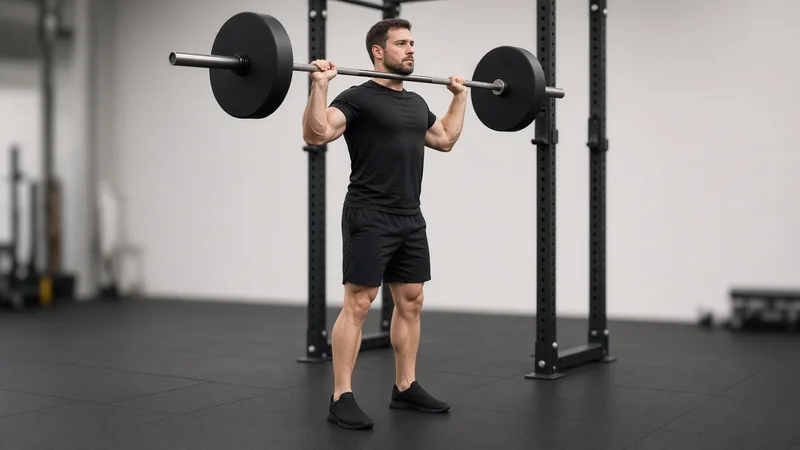
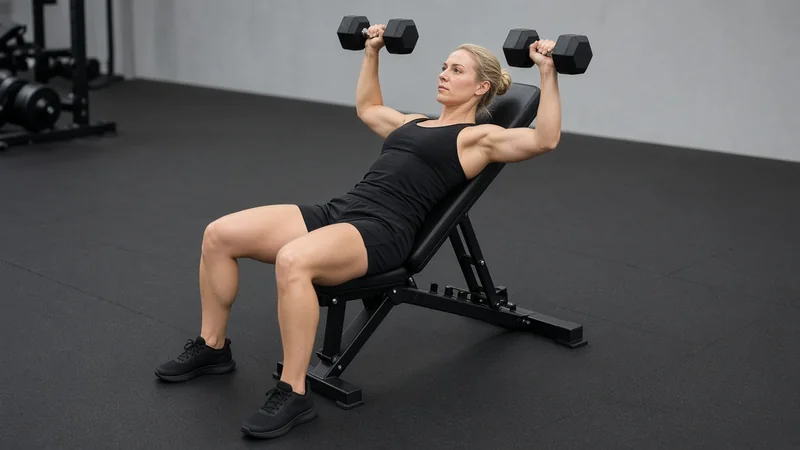
German Volume Training (10×10): What the Studies Found and a Better Version
German Volume Training (10×10) explained: Poliquin's rules, the two trials that tested it, why 5 sets did as well as 10, and a modern 5×10 plan with audit.
Key takeaways
- German Volume Training (GVT) is 10 sets of 10 reps on one big exercise per muscle, with about 60% of your 1RM and short rests, popularised by Charles Poliquin in 1996.
- In the two trials that tested it, 10 sets per exercise did not beat 5. In 19 men over 6 weeks, the 5-set group gained more trunk lean mass and more bench press and lat pulldown strength.
- High weekly volume itself can work. GVT's weak point is how it gets there: one exercise, light loads, short rests and early sets far from failure.
- Our 5 × 10 version keeps the spirit: 5 sets of 10 on the main pair, a load you could lift about 15 times fresh, 90 seconds between alternating exercises, plus accessories to 0–1 reps in reserve.
- Run GVT as a 4–6-week block, not a forever program. Add 2.5 kg (upper body) or 5 kg (lower body) once you complete every set of 10.
German Volume Training, often called GVT or “10 × 10”, is one of the most famous muscle-building programs ever written. The idea is simple and brutal: pick one big exercise for a muscle and do 10 sets of 10 reps with the same weight and short rests. The first sets feel easy. The last ones do not.
GVT is also unusual for another reason. Most named programs have never been tested, but this one has two published trials. Neither of them supports the “10” in 10 × 10. This guide explains the original rules, what the trials found, why more sets did not help, and gives you a modern 5 × 10 version with a full weekly set audit. For how GVT fits among other programs, see our guide to every training split.
Where GVT comes from
Canadian strength coach Charles Poliquin brought the method to bodybuilders in a 1996 article in Muscle Media 2000 titled “German Volume Training: A New Look at an Old Way to Get Big and Strong”. He wrote that the “ten sets method” came from German-speaking countries in the mid-1970s and credited Rolf Feser, then Germany’s national weightlifting coach, with popularising it. According to Poliquin, German weightlifters used it in the off-season to gain lean mass and move up a weight class.
Poliquin also made big promises. He wrote that gains of “ten pounds or more in six weeks are not uncommon, even in experienced lifters”. Keep that claim in mind when you read the research section below.
The original rules
These are the rules as Poliquin described them. We summarise them here; his article is widely reproduced online.
| Rule | Poliquin’s GVT |
|---|---|
| Main work | 10 sets of 10 reps with the same weight on one exercise per bodypart |
| Load | A weight you could lift for about 20 reps, roughly 60% of your 1RM |
| Rest | About 60 s between sets done one exercise at a time; 90–120 s when alternating two exercises (A1, then A2); his sample program uses 90 s |
| Tempo | Lower in 4 s and lift in 2 s on long-range lifts (squats, dips, chin-ups); 3 s down on curls and extensions |
| Exercises | One compound lift per bodypart; “B” exercises for 3 sets of 10–12 |
| Intensity techniques | None: no forced reps, negatives or “burns” |
| Frequency | Each bodypart once every 4–5 days |
| Progression | Once you complete 10 × 10 with the set rest periods, add 4–5% to the bar |
The beginner/intermediate 5-day cycle
| Day | Session | “A” exercises (10 × 10, alternated) | “B” exercises (3 sets) |
|---|---|---|---|
| 1 | Chest and back | Decline dumbbell press + chin-up | Incline dumbbell fly + one-arm dumbbell row |
| 2 | Legs and abs | Back squat + lying leg curl | Low-cable pull-in (abs) + seated calf raise |
| 3 | Off | — | — |
| 4 | Arms and shoulders | Parallel bar dips + incline hammer curl | Bent-over lateral raise + seated lateral raise |
| 5 | Off | — | — |
Poliquin suggested running this for six workouts per bodypart, then switching for three weeks to fewer sets of 6–8 reps, then coming back to a heavier “10 sets of 6” phase.
What 10 × 10 means in practice
If your bench press 1RM is 100 kg, 60% is 60 kg. You do 10 sets of 10 with 60 kg. With a 4-second lowering and a 2-second lift, each rep takes about 6 seconds, so one set of 10 takes about a minute. Alternating two exercises with 90 seconds of rest after each set means one round of A1 and A2 takes about 5 minutes (60 + 90 + 60 + 90 seconds). Ten rounds take about 50 minutes before you start the B exercises. That is our arithmetic from Poliquin’s rules, not a figure from a study, but it explains why GVT sessions feel endless.
Most people do not complete all 10 sets of 10 at first. Reps usually drop in the second half of the session as fatigue builds. Poliquin’s rule is to keep the weight the same and only add load once all 100 reps are done.
What the research says
The two GVT trials
Trial 1: 6 weeks, 19 men. Researchers at the University of Sydney randomly assigned 19 healthy men to 10 sets or 5 sets of 10 reps on the main compound exercises in a split routine done three times a week (Amirthalingam et al., 2017). Both groups gained lean body mass. But the 5-set group gained more trunk lean mass (effect size −0.21), showed a trend toward more arm lean mass (p = 0.083), and improved bench press (effect size −0.43) and lat pulldown strength (effect size −0.54) more than the 10-set group. Neither group improved leg lean mass or muscle thickness significantly. The authors concluded that the modified GVT program was no better than 5 sets per exercise, and suggested 4–6 sets per exercise to maximise hypertrophy.
Trial 2: 12 weeks, 12 men. The same group then ran a 12-week pilot study in 12 men with at least one year of recreational training (Hackett et al., 2018). Both groups did 10 reps at 60–80% of 1RM with 60–90 seconds of rest, took the last set of each exercise to failure, and had a protein supplement after training. Lean mass did not change significantly in either group, and there were no differences between groups. The 10-set group even lost some leg lean mass between weeks 6 and 12. Bench press strength rose in the 5-set group, and the effect size favoured 5 sets for bench press, while a small effect size favoured 10 sets for leg press. The authors concluded that more than 5 sets per exercise did not give greater gains.
What this means. These are the only direct trials of GVT, and both tested a modified version (the loads and rest periods were not exactly Poliquin’s). They are small and short, so they cannot prove that 10 sets are worse than 5. But they give no support to the idea that 10 × 10 is a special size builder. Evidence: preliminary. And neither trial came close to Poliquin’s “ten pounds in six weeks”.
Why more sets did not help here
This is surprising, because weekly volume usually matters. Across 15 studies, more weekly sets meant more growth (Schoenfeld, Ogborn and Krieger, 2017). In 34 trained men over 8 weeks, 5 sets per exercise per session grew more muscle at several sites than 1 or 3 sets (Schoenfeld et al., 2019). In 27 trained men over 8 weeks, 32 weekly sets per muscle gave larger lower-body gains than 16 (Brigatto et al., 2022). And the largest analysis to date found that growth keeps rising with volume, but with diminishing returns (Pelland et al., 2026).
So why did 10 sets fail to beat 5 in the GVT trials? We see four likely reasons. They are our interpretation, not tested in the GVT studies themselves:
- The early sets are far from failure. With a load you could lift 20 times, the first sets of 10 end about 10 reps short of failure. Muscle growth increases as sets end closer to failure (Robinson et al., 2024), so many of GVT’s 100 reps are low-value “warm-up” reps.
- Short rests cut the quality of later sets. Resting more than 60 seconds between sets gives a small hypertrophy benefit over shorter rests (Singer et al., 2024). In 21 trained men, 3-minute rests produced more strength and thigh muscle growth than 1-minute rests (Schoenfeld et al., 2016).
- All the volume is on one exercise. Ten sets of the same movement load the same parts of the muscle in the same way. Splitting the same number of sets across two or three exercises spreads the work.
- Diminishing returns per session. If extra sets add less and less, the 6th to 10th sets in one session add little but still cost recovery.
Light loads are not the problem in themselves. A network meta-analysis of 28 studies with 747 adults found similar growth across light, moderate and heavy loads when sets went to failure, while strength gains were greater with heavier loads (Lopez et al., 2021). GVT’s issue is that most of its sets stop well short of failure.
Weekly volume audit: Poliquin’s original
We count sets the same way as in our other program guides: a compound lift counts 1.0 for its main muscle and 0.5 for each clear helper; an isolation lift counts 1.0 for its target. Because GVT runs on a 5-day cycle, a 7-day week holds 1.4 cycles, so weekly sets are the cycle totals × 1.4. We counted dips as a triceps exercise (Poliquin put them on arm day), with 0.5 for chest and front delts.
| Muscle | How the cycle total is built | Per 5-day cycle | Per 7 days |
|---|---|---|---|
| Chest | Decline press 10 + fly 3 + dips 10 × 0.5 | 18 | 25.2 |
| Back | Chin-up 10 + row 3 | 13 | 18.2 |
| Quads | Squat 10 | 10 | 14 |
| Hamstrings | Leg curl 10 | 10 | 14 |
| Glutes | Squat 10 × 0.5 | 5 | 7 |
| Front delts | Decline press 10 × 0.5 + dips 10 × 0.5 | 10 | 14 |
| Side delts | Seated lateral raise 3 | 3 | 4.2 |
| Rear delts | Bent-over lateral raise 3 + row 3 × 0.5 | 4.5 | 6.3 |
| Triceps | Dips 10 + decline press 10 × 0.5 | 15 | 21 |
| Biceps | Hammer curl 10 + chin-up 10 × 0.5 + row 3 × 0.5 | 16.5 | 23.1 |
| Calves | Seated calf raise 3 | 3 | 4.2 |
On paper this is a lot of volume for chest, arms and back: 18–25 sets a week. But remember that many of those sets end far from failure. Meanwhile, side delts (4.2), calves (4.2), rear delts (6.3) and glutes (7) get very little. A program with 100-rep blocks for the chest and only three sets for side delts is not balanced, whatever the total looks like.
Template: GrowMyMuscles 5 × 10 (modern GVT)
This version keeps what makes GVT fun: alternating pairs, sets of 10, a fixed weight, a big pump. It changes what the trials and the wider evidence suggest: 5 sets instead of 10, a heavier starting load, and accessories to cover the gaps.
Load for the A exercises: a weight you could lift about 15 times when fresh. The first sets will end around 4–5 reps in reserve and the last ones around 1–2 as fatigue builds. This is our choice to bring the sets closer to failure; it is not part of Poliquin’s original. RIR means reps in reserve; see our guide to training to failure vs RIR.
Rest: 90 seconds between A1 and A2, so about 3 minutes pass before you repeat the same exercise. Use a normal, controlled tempo instead of a strict 4-second lowering. Run the same 5-day cycle as the original: three sessions, two rest days.
Day 1: Chest and back
| Exercise | Sets × reps | RIR | Rest |
|---|---|---|---|
| A1. Bench press | 5 × 10 | 4–5 → 1–2 | 90 s, then A2 |
| A2. Seated cable row | 5 × 10 | 4–5 → 1–2 | 90 s, then A1 |
| B1. Incline dumbbell press | 3 × 10–12 | 1–2 | 2 min |
| B2. Lat pulldown | 3 × 10–12 | 1–2 | 2 min |
| C. Standing calf raise | 3 × 12–15 | 0–1 | 60 s |
Day 2: Legs
| Exercise | Sets × reps | RIR | Rest |
|---|---|---|---|
| A1. Back squat | 5 × 10 | 4–5 → 2 | 90 s, then A2 |
| A2. Leg curl (lying) | 5 × 10 | 4–5 → 1 | 90 s, then A1 |
| B. Romanian deadlift | 3 × 8–10 | 2 | 2–3 min |
| C. Leg press | 3 × 12–15 | 1–2 | 2 min |
| D. Standing calf raise | 4 × 10–15 | 0–1 | 60–90 s |
Day 3: Off
Day 4: Arms and shoulders
| Exercise | Sets × reps | RIR | Rest |
|---|---|---|---|
| A1. Dips | 5 × 10 | 4–5 → 1–2 | 90 s, then A2 |
| A2. Incline or hammer dumbbell curl | 5 × 10 | 4–5 → 1 | 90 s, then A1 |
| B1. Seated dumbbell shoulder press | 3 × 10–12 | 1–2 | 2 min |
| B2. Lateral raise | 4 × 12–20 | 0–1 | 60 s |
| C. Face pull or reverse fly | 3 × 12–15 | 0–1 | 60 s |
Day 5: Off, then repeat from Day 1
The A block now takes about 25 minutes instead of 50, and each session has 19–20 sets.
Weekly volume audit (5 × 10 template)
| Muscle | How the cycle total is built | Per 5-day cycle | Per 7 days |
|---|---|---|---|
| Chest | Bench 5 + incline 3 + dips 5 × 0.5 | 10.5 | 14.7 |
| Back | Cable row 5 + pulldown 3 | 8 | 11.2 |
| Quads | Squat 5 + leg press 3 | 8 | 11.2 |
| Hamstrings | Leg curl 5 + Romanian deadlift 3 | 8 | 11.2 |
| Glutes | Squat 5 × 0.5 + RDL 3 × 0.5 + leg press 3 × 0.5 | 5.5 | 7.7 |
| Front delts | Shoulder press 3 + bench 5 × 0.5 + incline 3 × 0.5 + dips 5 × 0.5 | 9.5 | 13.3 |
| Side delts | Lateral raise 4 + shoulder press 3 × 0.5 | 5.5 | 7.7 |
| Rear delts | Face pull 3 + cable row 5 × 0.5 | 5.5 | 7.7 |
| Triceps | Dips 5 + bench 5 × 0.5 + incline 3 × 0.5 + shoulder press 3 × 0.5 | 10.5 | 14.7 |
| Biceps | Curl 5 + cable row 5 × 0.5 + pulldown 3 × 0.5 | 9 | 12.6 |
| Calves | Standing calf raise 3 + 4 | 7 | 9.8 |
Most muscles now land inside the 10–20 weekly set range from our sets per week guide. Calves sit just under it at 9.8, and glutes, side delts and rear delts sit at 7.7. If they are priorities, add 3 sets of hip thrusts on Day 2 and 2 more sets of lateral raises and face pulls on Day 1. Total sets per cycle drop from 75 in the original to 59, yet the weekly totals are better balanced and more of the sets are hard.
Progression and how long to run it
- Add load when you complete 5 × 10. Once you get all 50 reps on an A exercise with the set rest periods, add 2.5 kg to upper-body lifts and 5 kg to squats next time. Poliquin’s original rule was 4–5%.
- Accessories use double progression. Hit the top of the rep range on all sets, then add the smallest load jump. See our progressive overload guide.
- Run it for 4–6 weeks. That matches the length of the 6-week trial and Poliquin’s six workouts per bodypart. Then switch to a heavier, lower-rep block for a few weeks, such as Wendler 5/3/1, or a standard upper/lower split.
- Deload if reps crash. If your total reps on an A exercise fall two sessions in a row, take a lighter week with half the sets.
GVT compared with other high-volume approaches
| Approach | Typical structure | Direct evidence | Best use |
|---|---|---|---|
| Original GVT (10 × 10) | 10 sets on one lift, ~60% 1RM, short rest | Two small trials: no better than 5 sets | A short change of pace if you enjoy it |
| GrowMyMuscles 5 × 10 | 5 sets on the main pair + accessories near failure | None as a package; parts supported | A 4–6-week hypertrophy block |
| Boring But Big (5/3/1) | Heavy main sets + 5 × 10 at 50–60% of the training max | None for BBB itself | Strength plus size over months |
| Standard hypertrophy (3–4 × 8–12) | 2–4 exercises per muscle, 0–3 RIR | Strong for the principles | Most lifters, most of the time |
If you want the classic bodypart feel with more normal set counts, see our guide to the bro split.
Common mistakes
- Starting too heavy. Fix: if you cannot get at least 7–8 reps on the last sets, the weight is too heavy. Keep it until you complete all sets.
- Stretching the rests because the last sets hurt. Fix: use a timer. Changing rest times makes progress impossible to judge. If you need more rest, choose more rest from the start (our version uses 90 seconds between alternating exercises).
- Using complex lifts for high-rep, short-rest work. Fix: technique on heavy deadlifts and Olympic lifts breaks down under this kind of fatigue. Choose stable lifts (machine presses, leg press, cable rows) if form slips.
- Running GVT for months. Fix: treat it as a 4–6-week block, then change the stimulus.
- Skipping side delts, rear delts and calves. Fix: the original gives them only 3 sets per cycle. Add accessories as in our template.
- Expecting magazine results. Fix: the only trials found modest or no lean mass gains in 6–12 weeks. Judge your progress by your logbook and measurements over a couple of months.
Make it better
- Turn the last A-set into a myo-rep set. After the last set of 10, rest 15–20 seconds and do 3–5 more reps, repeated 2–3 times. It adds hard reps without adding 5 more sets. Our planned page on myo-reps will cover the evidence.
- Pick long-length exercises for the A pair. Deep squats, incline curls and overhead triceps work load the muscle in a stretched position. Our guide to long muscle lengths explains why this is a promising idea.
- Log every set in the GrowMyMuscles training log. GVT progress is about total reps at a fixed weight, so a log is essential.
Safety notes
High-rep squats and dips with short rests are very demanding. Expect heavy breathing, a racing heart and, for some people, nausea or light-headedness. Use safety bars on squats and bench presses, and stop a set if your technique breaks down. Anyone with a heart condition, high blood pressure, joint pain, a current injury, pregnancy or who is under 18 should talk to a doctor or a qualified coach before starting a program like this. Eat enough protein to support the volume; our protein intake guide has the details.
FAQ
Does German Volume Training work?
It can build muscle: lean mass rose in the 6-week trial. But there is no evidence that it beats more normal set counts. In the only two trials, 10 sets per exercise was no better than 5 sets, and in the 6-week trial the 5-set group gained more trunk lean mass and upper-body strength (Amirthalingam et al., 2017). In the 12-week pilot, neither group gained significant lean mass (Hackett et al., 2018).
Is 10 × 10 better than 5 × 10?
Not according to the evidence we have. Both GVT trials found 5 sets per exercise did at least as well as 10 (Amirthalingam et al., 2017; Hackett et al., 2018). The trials were small, but they point the same way.
How much weight should I use for German Volume Training?
Poliquin’s rule is about 60% of your 1RM, a weight you could lift for about 20 reps. In our 5 × 10 version, we use a weight you could lift about 15 times so the sets end closer to failure.
How long should I run German Volume Training?
Four to six weeks is a sensible block. Poliquin suggested six workouts per bodypart before changing phases, and the first trial lasted 6 weeks. After that, switch to a heavier, lower-rep program for a while.
Is German Volume Training good for beginners?
It is not the best choice. Beginners grow on much less volume and need to learn technique, which is hard under heavy fatigue. A full-body program is a better start.
Should I go to failure on GVT sets?
Not on every set. The early sets are meant to be submaximal, and fatigue brings the later ones close to failure. Growth does increase as sets end closer to failure (Robinson et al., 2024), which is why our version uses a heavier load and accessories taken to 0–1 reps in reserve.
References
- Amirthalingam T, Mavros Y, Wilson GC, Clarke JL, Mitchell L, Hackett DA. Effects of a Modified German Volume Training Program on Muscular Hypertrophy and Strength. J Strength Cond Res. 2017;31(11):3109-3119. doi:10.1519/JSC.0000000000001747. PubMed: 27941492 ↩
- Hackett DA, Amirthalingam T, Mitchell L, Mavros Y, Wilson GC, Halaki M. Effects of a 12-Week Modified German Volume Training Program on Muscle Strength and Hypertrophy-A Pilot Study. Sports (Basel). 2018;6(1):7. doi:10.3390/sports6010007. PubMed: 29910312 ↩
- Schoenfeld BJ, Ogborn D, Krieger JW. Dose-response relationship between weekly resistance training volume and increases in muscle mass: A systematic review and meta-analysis. J Sports Sci. 2017;35(11):1073-1082. doi:10.1080/02640414.2016.1210197. PubMed: 27433992 ↩
- Schoenfeld BJ, Contreras B, Krieger J, et al. Resistance Training Volume Enhances Muscle Hypertrophy but Not Strength in Trained Men. Med Sci Sports Exerc. 2019;51(1):94-103. doi:10.1249/MSS.0000000000001764. PubMed: 30153194 ↩
- Brigatto FA, Lima LEM, Germano MD, et al. High Resistance-Training Volume Enhances Muscle Thickness in Resistance-Trained Men. J Strength Cond Res. 2022;36(1):22-30. doi:10.1519/JSC.0000000000003413. PubMed: 31868813 ↩
- Pelland JC, Remmert JF, Robinson ZP, Hinson SR, Zourdos MC. The Resistance Training Dose Response: Meta-Regressions Exploring the Effects of Weekly Volume and Frequency on Muscle Hypertrophy and Strength Gains. Sports Med. 2026;56(2):481-505. doi:10.1007/s40279-025-02344-w. PubMed: 41343037 ↩
- Robinson ZP, Pelland JC, Remmert JF, et al. Exploring the Dose-Response Relationship Between Estimated Resistance Training Proximity to Failure, Strength Gain, and Muscle Hypertrophy: A Series of Meta-Regressions. Sports Med. 2024;54(9):2209-2231. doi:10.1007/s40279-024-02069-2. PubMed: 38970765 ↩
- Singer A, Wolf M, Generoso L, et al. Give it a rest: a systematic review with Bayesian meta-analysis on the effect of inter-set rest interval duration on muscle hypertrophy. Front Sports Act Living. 2024;6:1429789. doi:10.3389/fspor.2024.1429789. PubMed: 39205815 ↩
- Schoenfeld BJ, Pope ZK, Benik FM, et al. Longer Interset Rest Periods Enhance Muscle Strength and Hypertrophy in Resistance-Trained Men. J Strength Cond Res. 2016;30(7):1805-1812. doi:10.1519/JSC.0000000000001272. PubMed: 26605807 ↩
- Lopez P, Radaelli R, Taaffe DR, et al. Resistance Training Load Effects on Muscle Hypertrophy and Strength Gain: Systematic Review and Network Meta-analysis. Med Sci Sports Exerc. 2021;53(6):1206-1216. doi:10.1249/MSS.0000000000002585. PubMed: 33433148 ↩