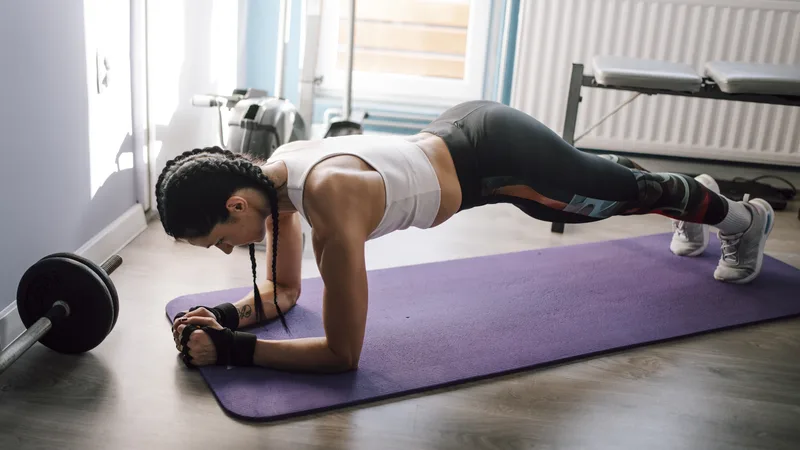
Isometric Training for Hypertrophy: Do Static Holds Build Muscle?
Isometric training for muscle growth: what studies show on static holds, joint angle and long muscle lengths, plus how to dose holds and when to use them.
Key takeaways
- Static holds do build muscle. A systematic review of 26 studies found clear hypertrophy after isometric training, even at moderate intensities (Oranchuk et al., 2019).
- Hold at long muscle lengths. Holds in the stretched position grew muscle faster (about 0.9–1.7% per week) than holds at short lengths (about 0.1–0.8% per week) in the same review.
- In trained lifters, 6 weeks of long-length isometric knee extensions built about as much quad muscle as full-range reps (Varovic et al., 2025). Isometrics are a valid tool, not a replacement for normal lifting.
- Sustained holds beat short bursts for size: 3-second holds at 75% effort grew the quads more than 1-second explosive contractions (8.1% vs 2.6%) (Balshaw et al., 2016).
- Practical dose: 3–5 holds of 15–30 seconds at a hard effort per muscle, 2–3 times a week, mostly in the stretched position. Our sample block below uses holds as an add-on to normal training.
An isometric contraction is one where your muscle produces force without the joint moving: pushing against a wall, holding a plank, or pausing a dumbbell halfway through a curl. Isometrics have a long history in strength training and rehab, and they are popular again because of a simple idea: if the muscle works hard while staying at one length, why bother moving at all?
This guide looks at what the research says about isometric training and muscle growth, why the joint angle you hold at matters so much, how to dose holds, and where they fit into a normal hypertrophy program. It is part of our Training Methods section and connects closely to our guides on lengthened partials and range of motion.
Evidence in one line: isometric holds build muscle, especially when held at long muscle lengths, but most studies are small, short and done on the thigh muscles, so we use holds as a tool alongside normal lifting, not instead of it.
Key terms
- Isometric contraction: the muscle produces force but its length (and the joint angle) stays roughly the same.
- Overcoming (pushing) isometric: you push or pull against something that can’t move, such as a bar locked in a rack or a strap. Effort is set by how hard you push.
- Yielding (holding) isometric: you hold a weight still and stop it from moving, for example holding a dumbbell at the bottom of a split squat. Effort is set by the load and how long you hold.
- MVC (maximal voluntary contraction): the hardest you can push. Studies often prescribe holds as a percentage of MVC, for example 70%.
- Long vs short muscle length: a muscle is long when it is stretched (the quads with the knee bent at 90° or more) and short when it is contracted (the quads with the knee almost straight).
- Angle specificity: strength gains from isometrics tend to show up mostly at or near the angle you trained.
Types of isometric training at a glance
| Type | Example | Main use |
|---|---|---|
| Yielding hold, long length | Bottom of a Bulgarian split squat with dumbbells, held still | Hypertrophy add-on, joint-friendly loading |
| Overcoming push, long length | Pushing a leg extension against the pins with the knee bent about 90° | Strength at a weak point, high force with little fatigue |
| Yielding hold, short length | Holding the top of a leg curl or lateral raise | Technique (“feel the squeeze”); weaker for growth |
| Explosive isometric | Pushing as fast and hard as possible for about 1 second | Rate of force development for sport |
| Sustained isometric | Gradually ramping to a hard effort and holding for 3–30 seconds | Strength and size |
What the research says
Isometric training builds muscle
Isometrics are not just a rehab tool. The best summary is a 2019 systematic review of 26 studies that ran isometric training for at least 3 weeks. Muscle size and maximal force improved substantially regardless of training intensity, and higher intensities (70% of maximum or more) were needed to improve tendon structure and function (Oranchuk et al., 2019).
The finding is old. In a classic 12-week study, isometric training of the quadriceps increased force by 35% and thigh muscle cross-sectional area by 5% (measured by CT scans). Dynamic concentric and eccentric training in the same paper produced a similar, roughly 5% increase in muscle area (Jones & Rutherford, 1987). Each group had just six people, but the study shows that holds can grow muscle about as much as normal reps over a few months.
Joint angle matters: train the muscle long
The most useful finding for lifters is about where you hold. In the 2019 review, isometric training at longer muscle lengths produced greater hypertrophy (about 0.86–1.69% per week) than equal volumes of training at shorter lengths (about 0.08–0.83% per week). Long-length training also carried over better to dynamic performance (Oranchuk et al., 2019).
Individual trials show the same pattern:
- Long beats short for growth. Sixteen men trained isometric knee extensions 3 times a week for 6 weeks, either at a short muscle length (knee bent about 38°) or a long one (about 88°). Only the long-length group increased quadriceps volume and cross-sectional area on MRI. The short-length group got about 13% stronger near the training angle, but through nervous-system changes rather than muscle growth (Noorkõiv et al., 2014).
- Thicker muscle at long lengths. In an 8-week study of 28 people, training the knee extensors at 90° of knee bend increased vastus lateralis thickness by 9–14%, compared with 5–9% at 50°. Only the long-length group gained isokinetic strength (23.5%) (Alegre et al., 2014).
- Not every study agrees. Nine men trained one leg at 50° and the other at 100° of knee bend for 12 weeks (6 sets of 15 seconds at 70% MVC). Muscle volume increased similarly in both legs, but only the long-length leg got stronger at all joint angles and developed a stiffer tendon (Kubo et al., 2006).
So long-length holds were better or equal for growth in these trials, never worse, and they produce strength that carries over to more of the range of motion. This fits the wider evidence on training at long muscle lengths and lengthened partials.
Isometrics vs normal reps in trained lifters
Most isometric studies used untrained people. One newer trial asked the question lifters actually care about. Twenty-three resistance-trained men and women trained one leg with long-length isometric knee extensions and the other with full range-of-motion knee extensions, twice a week for 6 weeks. Quadriceps growth was similar with both methods. The isometric leg may have grown slightly more near the hip (proximal thigh), but the uncertainty was too large to be sure (Varovic et al., 2025).
That is encouraging, but it is one 6-week study of one muscle group, measured as muscle thickness. It shows isometrics are a credible alternative for a muscle; it doesn’t show they are better than lifting through a full range.
Hold length and intent: sustained beats explosive for size
How you contract matters:
- Long holds vs short pulses. Seven people trained one leg with 4 sets of ten 3-second contractions (2 seconds of rest between) and the other with four continuous 30-second contractions, both at 70% MVC, 3 times a week for 14 weeks. The 30-second holds increased isometric strength more (55% vs 32%) and were the only protocol that significantly increased muscle cross-sectional area (Schott et al., 1995). The authors linked this to the greater metabolic stress during longer holds.
- Sustained vs explosive. Young men did 40 isometric knee extensions 3 times a week for 12 weeks, either as fast, hard, roughly 1-second “explosive” contractions or ramping up to 75% of maximum and holding for 3 seconds. The sustained group gained more maximum strength (23% vs 17%) and much more quadriceps volume (8.1% vs 2.6%). The explosive group improved rapid force more (Balshaw et al., 2016).
For muscle growth, then, use sustained holds with real effort, not brief taps.
Pushing vs holding
Is it better to push against something immovable or to hold a weight still? A small 2026 trial compared the two in 10 adults (each leg did one method) over 6 weeks: four to six 20-second contractions at 70% of maximum, at an 80° knee angle. Both methods increased muscle thickness. Holding a weight (yielding) increased total quadriceps and especially rectus femoris thickness more, while pushing (overcoming) improved concentric and eccentric strength more (Lum et al., 2026). With 10 people and 12 sessions, this is preliminary, but it supports using weighted holds when growth is the goal.
Beyond muscle: blood pressure and pain
Two side effects of isometric training are worth knowing about, though neither is the focus of this guide:
- Blood pressure. A network meta-analysis of 270 randomised trials (15,827 participants) found that every exercise type lowered resting blood pressure, and isometric training lowered it the most (about 8/4 mmHg). The wall squat was the most effective single exercise for systolic pressure (Edwards et al., 2023). If you have high blood pressure, ask your doctor before starting.
- Pain relief is less certain than often claimed. Isometrics are popular for tendon pain, but in a randomised crossover trial of 21 people with patellar tendinopathy, a single session of heavy isometrics reduced pain only slightly, the effect was gone after 45 minutes, and dynamic exercise worked just as well (Holden et al., 2020). A systematic review of 13 studies found no consistent pain-relieving effect of isometric exercise in people with local musculoskeletal pain (Bonello et al., 2021). Holds are well tolerated, which makes them useful for training around an injury, but they are not a proven painkiller.
Summary of the evidence
| Question | What the research shows | Evidence |
|---|---|---|
| Do isometrics build muscle? | Yes, across 26 studies, even at moderate intensities | Moderate |
| Long or short muscle length? | Long lengths grew muscle faster or equally; never worse | Moderate (small trials) |
| Isometrics vs full-range reps in trained lifters? | Similar quad growth over 6 weeks | Preliminary (one trial) |
| Long holds or short pulses? | Sustained holds (3–30 s) beat short or explosive contractions for size | Preliminary (two small trials) |
| Push or hold? | Both grow muscle; holding may grow slightly more | Preliminary (one trial of 10 people) |
| Do isometrics relieve tendon pain? | Small, short-lived effect, no better than dynamic exercise | Moderate |
How to program isometrics for muscle growth
The studies give clear direction on angle and contraction type, but they don’t define a perfect dose. The ranges below reflect the protocols that built muscle in the trials (for example 6 × 15 s at 70% MVC, 4 × 30 s at 70% MVC, 4–6 × 20 s at 70% MVC) translated into gym terms. Treat them as our evidence-informed starting point, not tested optimums.
| Variable | Recommendation | Why |
|---|---|---|
| Position | Long muscle length (the stretched part of the movement) | Greater or equal growth vs short lengths (Oranchuk et al., 2019) |
| Contraction | Sustained, ramp up over 1–2 s then hold | Sustained holds grew more muscle than explosive ones (Balshaw et al., 2016) |
| Hold length | 15–30 s per hold | Range used in most hypertrophy trials |
| Effort | Hard: the last 5 seconds should be a struggle (about 1–2 RIR equivalent) | Studies used around 70% of maximum; high effort matters for growth |
| Sets per session | 3–5 holds per muscle | Roughly 1–2 minutes of hard work per muscle, as in the trials |
| Frequency | 2–3 times per week per muscle | Trials trained 2–3 times weekly |
| Rest | 60–120 s between holds | Enough to repeat a hard effort |
| How to count volume | One hard 20–30 s hold ≈ one hard set | Our convention for weekly set counting |
Choosing the load for a weighted hold
- Pick a weight you could lift for about 8–15 reps on the same exercise.
- Lower it to the stretched position and hold it still with good form.
- If you can hold more than 30 seconds, add load next time. If you can’t reach 15 seconds, reduce it.
- Use the same position every time (mark the pin, the depth or the angle) so progress is comparable.
Pushing isometrics without a strength gauge
Push against pins, a strap or a loaded bar you can’t move, ramp up to a hard but controlled effort over 1–2 seconds, and keep pushing for the set time. Without a force gauge you can’t measure “70%”, so use the feel: hard enough that your breathing and form start to strain by the end. Breathe out slowly instead of holding your breath for the whole set.
Best exercises for isometric holds
| Muscle | Long-length hold | Notes |
|---|---|---|
| Quads | Bottom of a Bulgarian split squat or leg extension at about 90° knee bend | The best-studied muscle by far |
| Glutes and adductors | Bottom of a deep split squat or goblet squat | Keep the torso upright and knees tracking over toes |
| Hamstrings | Romanian deadlift held just above the stretch point | Flat back; stop before your lower back rounds |
| Chest | Bottom of a dumbbell fly or a deep push-up between handles | Shoulders down and back; don’t sink into pain |
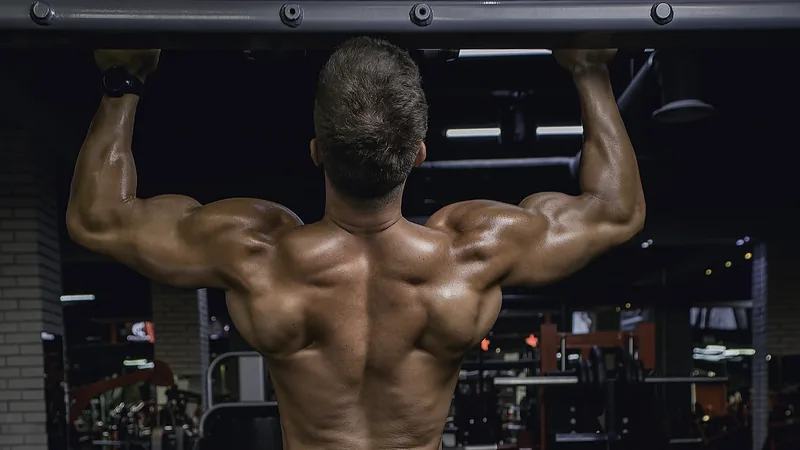
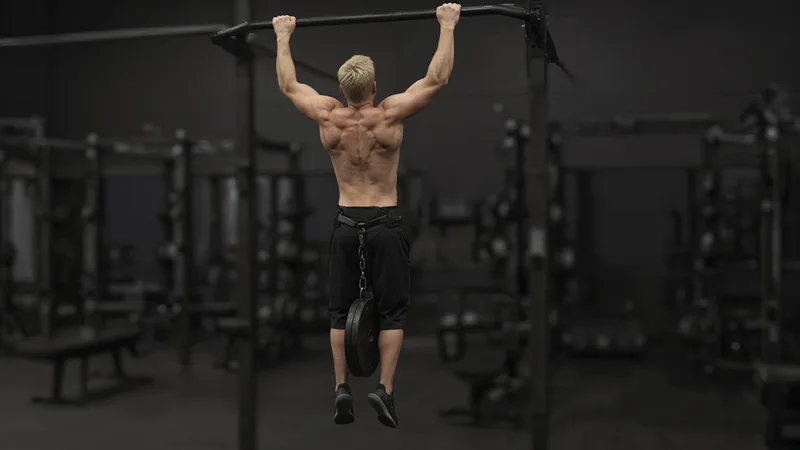
| Lats | Dead hang or weighted hang from a pull-up bar | Shoulders active, not shrugged to the ears |
| Calves | Bottom of a standing calf raise, heels down | Keep the heels low for a full stretch; no bouncing |
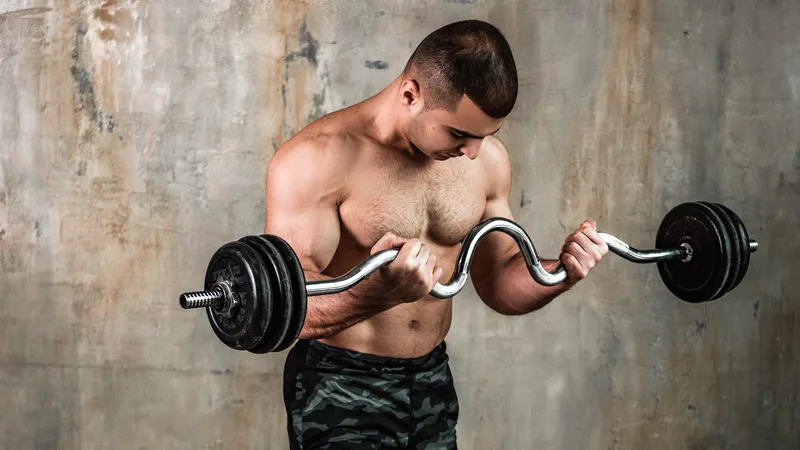
| Biceps | Bottom of an incline curl or a curl held just above full extension | Keep the elbow still |
| Triceps | Bottom of an overhead triceps extension | Elbows pointed forward, controlled depth |
When isometrics are most useful
- Training around an injury or sore joint. Holds let you load a muscle hard at a pain-free angle. Get pain or injury assessed by a doctor or physiotherapist first.
- Travelling or home training. A wall, a doorframe, a towel or a backpack is enough for hard pushes and holds. See minimalist training.
- Adding stimulus with less soreness. Holds involve no lowering phase under load, which is the part of a rep most linked to soreness, so they are a gentle way to add a few hard sets (our reasoning; not tested head to head).
- Strengthening a sticking point. A pushing isometric at the weakest angle of a lift (for example a pin press just off the chest) can build strength there, though gains are largely specific to that angle.
- Learning to feel a muscle. A short hold in the stretched position teaches you where the muscle works hardest; see mind-muscle connection.
Limits
- Strength is angle-specific, especially at short lengths. You get strongest at the angle you train (Noorkõiv et al., 2014). That is why we recommend long-length holds and normal lifting alongside them.
- Harder to track progress. Without a force gauge, pushes are hard to measure. Weighted holds solve this.
- Mostly thigh data. Almost every hypertrophy study used the knee extensors. Holds for other muscles are a reasonable extension, not a proven one.
- No evidence they beat normal lifting. The best trial in trained people found a tie, not a win (Varovic et al., 2025).
- Blood pressure rises during hard holds. People with heart disease or uncontrolled high blood pressure should get medical advice first and avoid long breath-holding.
Sample isometric add-on block (6 weeks)
Keep your normal program (see how to choose a split) and add 1–2 holds at the end of a session for the muscles you want to bring up. Each hold counts as one hard set, so remove one normal set for that muscle if your weekly volume is already high.
| Day | Exercise | Holds × time | Effort | Rest |
|---|---|---|---|---|
| Lower A | Leg extension at about 90° knee bend (weighted hold) | 3 × 20–30 s | Hard; last 5 s a struggle | 90 s |
| Lower A | Standing calf raise, heels down in the stretch | 3 × 20–30 s | Hard | 60 s |
| Upper A | Deep push-up hold between handles or bottom of a dumbbell fly | 3 × 20–30 s | Hard | 90 s |
| Lower B | Bulgarian split squat, bottom position, dumbbells | 3 × 15–25 s per leg | Hard | 90 s |
| Upper B | Weighted dead hang from a pull-up bar | 3 × 20–30 s | Hard | 90 s |
| Upper B | Overhead triceps extension, stretched position | 2 × 20–30 s | Hard | 60 s |
Progression
- Weeks 1–2: learn the positions with a load you can hold for about 30 seconds with 1–2 seconds in reserve.
- Weeks 3–6: when you can hold 30 seconds on all sets, add 5–10% load and drop back to 20 seconds. Add one hold per exercise if recovery is good.
- After 6 weeks: keep the holds that felt productive, rotate the others out, and check your progress on normal lifts. Take a deload if joints or performance drop.
Home version
- Quads: wall sit with the thighs parallel or slightly deeper, holding a backpack for load.
- Chest and triceps: deep push-up hold just above the floor, or hands on two chairs for a bigger stretch.
- Back: towel row against a doorframe (pushing isometric), or a dead hang from a sturdy bar.
- Hamstrings: single-leg Romanian deadlift hold with a backpack.
Common mistakes
| Mistake | Fix |
|---|---|
| Holding at the easy, short end of the movement | Hold in the stretched position, where growth was greater or equal (Oranchuk et al., 2019). |
| Easy, comfortable holds | Make the last 5 seconds a real struggle; add load when 30 seconds feels easy. |
| Very short taps or “flexing” for a second or two | Use sustained 15–30 s holds; brief explosive contractions built less muscle (Balshaw et al., 2016). |
| Holding your breath for 30 seconds | Breathe steadily; exhale slowly against the effort. |
| Replacing all normal lifting with holds | Use isometrics as an add-on or for specific situations; full-range lifting remains the default. |
| Changing the angle each session | Mark the position so you can compare and progress. |
| Holding into sharp joint pain | Shift to a pain-free angle and get persistent pain checked. |
How isometrics compare with other methods
| Method | Muscle growth | Fatigue and soreness | Best use |
|---|---|---|---|
| Full-range reps | Strong evidence; the default | Moderate | Main training |
| Long-length isometrics | Similar to full-range reps in one trial of trained lifters | Low soreness | Add-on, injuries, travel |
| Lengthened partials | Promising, especially at the end of a set | Moderate | Extending sets past full-range failure |
| Loaded stretching | Mixed evidence | Low to moderate | Between-set add-on |
| Eccentric overload | Mixed for size, good for strength | High soreness at first | Strength-focused blocks |
What the research does not show yet
- Whether isometrics add growth on top of a full program. Trials compare isometrics with nothing or with dynamic training, not “normal training plus holds”.
- Upper-body and smaller muscles. Data are dominated by the quadriceps.
- Long-term results in advanced lifters. The only trained-lifter trial lasted 6 weeks (Varovic et al., 2025).
- The ideal hold length and effort. Studies used 3–30 second holds at about 70–75% of maximum; nobody has mapped the dose-response.
- Holding vs pushing. Only one small trial has compared them directly (Lum et al., 2026).
FAQ
Can isometric exercises build muscle?
Yes. A systematic review of 26 studies found clear muscle growth after isometric training (Oranchuk et al., 2019), and long-length holds matched full-range reps for quad growth in trained lifters over 6 weeks (Varovic et al., 2025).
How long should you hold an isometric for hypertrophy?
Most studies that built muscle used holds of about 15–30 seconds at a hard effort, repeated 3–6 times. Continuous 30-second holds grew more muscle than repeated 3-second contractions in one study (Schott et al., 1995).
Are isometrics better at long or short muscle lengths?
Long. Holds in the stretched position produced greater or equal growth compared with short-length holds, and strength carried over to more joint angles (Oranchuk et al., 2019; Kubo et al., 2006).
Can isometrics replace weight training?
Not fully. They are a good tool and can work as well as normal reps for one muscle in the short term, but almost all evidence comes from the thigh muscles and short studies. Use them alongside regular lifting.
Is the plank good for building muscle?
A plank is a useful trunk exercise, but we found no studies showing it builds ab size. It holds the abs at a fairly short length with only body-weight load, so we’d expect a weak growth stimulus for most people. For abs, add weighted, long-length exercises such as cable crunches with a full stretch.
Do isometric exercises lower blood pressure?
Yes. In a meta-analysis of 270 trials, isometric training produced the largest drop in resting blood pressure of all exercise types, about 8/4 mmHg (Edwards et al., 2023). Check with your doctor first if you have high blood pressure.
The bottom line
Isometric training builds muscle, and the position matters most: hold in the stretched position, use sustained holds of 15–30 seconds, and make them hard. In trained lifters, long-length holds matched normal reps for quad growth over 6 weeks, which makes them a strong option for injuries, travel and low-fatigue extra volume. They are best used as an add-on to full-range training, not a replacement.
Next steps: learn how to use the stretched position during normal sets with lengthened partials, choose your range of motion, and make sure your total weekly sets are on target.
References
- Oranchuk DJ, Storey AG, Nelson AR, Cronin JB. Isometric training and long-term adaptations: Effects of muscle length, intensity, and intent: A systematic review. Scand J Med Sci Sports. 2019;29(4):484-503. doi:10.1111/sms.13375. PubMed: 30580468
- Jones DA, Rutherford OM. Human muscle strength training: the effects of three different regimens and the nature of the resultant changes. J Physiol. 1987;391:1-11. doi:10.1113/jphysiol.1987.sp016721. PubMed: 3443943
- Noorkõiv M, Nosaka K, Blazevich AJ. Neuromuscular adaptations associated with knee joint angle-specific force change. Med Sci Sports Exerc. 2014;46(8):1525-37. doi:10.1249/MSS.0000000000000269. PubMed: 24504427
- Alegre LM, Ferri-Morales A, Rodriguez-Casares R, Aguado X. Effects of isometric training on the knee extensor moment-angle relationship and vastus lateralis muscle architecture. Eur J Appl Physiol. 2014;114(11):2437-46. doi:10.1007/s00421-014-2967-x. PubMed: 25099962
- Kubo K, Ohgo K, Takeishi R, et al. Effects of isometric training at different knee angles on the muscle-tendon complex in vivo. Scand J Med Sci Sports. 2006;16(3):159-67. doi:10.1111/j.1600-0838.2005.00450.x. PubMed: 16643193
- Varovic D, Zganjer K, Wolf M, et al. The effects of long muscle length isometric versus full range of motion isotonic training on regional quadriceps femoris hypertrophy in resistance-trained individuals. Appl Physiol Nutr Metab. 2025;50:1-14. doi:10.1139/apnm-2025-0238. PubMed: 40911904
- Schott J, McCully K, Rutherford OM. The role of metabolites in strength training. II. Short versus long isometric contractions. Eur J Appl Physiol Occup Physiol. 1995;71(4):337-41. doi:10.1007/BF00240414. PubMed: 8549577
- Balshaw TG, Massey GJ, Maden-Wilkinson TM, et al. Training-specific functional, neural, and hypertrophic adaptations to explosive- vs. sustained-contraction strength training. J Appl Physiol (1985). 2016;120(11):1364-73. doi:10.1152/japplphysiol.00091.2016. PubMed: 27055984
- Lum D, Oranchuk DJ, Chen SE, Kong PW. Comparing the Effects of Push and Hold Isometric Training on Strength and Musculotendinous Adaptations: A Within-Subject Randomized Controlled Trial. J Strength Cond Res. 2026;40(9):1050-1058. doi:10.1519/JSC.0000000000005475. PubMed: 42647753
- Edwards JJ, Deenmamode AHP, Griffiths M, et al. Exercise training and resting blood pressure: a large-scale pairwise and network meta-analysis of randomised controlled trials. Br J Sports Med. 2023;57(20):1317-1326. doi:10.1136/bjsports-2022-106503. PubMed: 37491419
- Holden S, Lyng K, Graven-Nielsen T, et al. Isometric exercise and pain in patellar tendinopathy: A randomized crossover trial. J Sci Med Sport. 2020;23(3):208-214. doi:10.1016/j.jsams.2019.09.015. PubMed: 31735531
- Bonello C, Girdwood M, De Souza K, et al. Does isometric exercise result in exercise induced hypoalgesia in people with local musculoskeletal pain? A systematic review. Phys Ther Sport. 2021;49:51-61. doi:10.1016/j.ptsp.2020.09.008. PubMed: 33601254