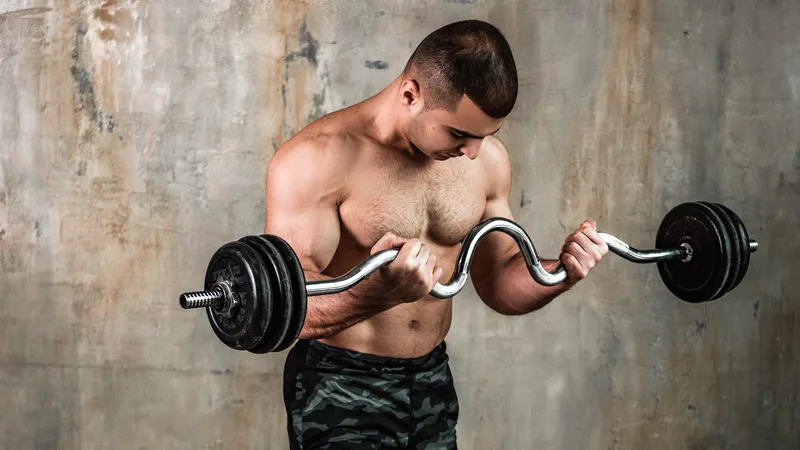
Rep Tempo: Does Lifting Speed Matter for Muscle Growth?
Rep tempo for muscle growth: what studies show about slow vs fast reps, time under tension and eccentric speed, plus the tempo that works best for size.
Key takeaways
- Tempo matters less than you think. A meta-analysis found similar muscle growth with rep durations from 0.5 to 8 seconds when sets went to failure (Schoenfeld et al., 2015).
- Superslow is a step too far. Reps longer than about 10 seconds looked worse for growth, and women on a superslow program gained much less strength (for example 7% vs 33% on the leg press) (Schoenfeld et al., 2015; Keeler et al., 2001).
- Time under tension is not a magic number: 3-second and 6-second reps matched for total time built the same muscle in 10 weeks (Martins-Costa et al., 2022). The 2026 ACSM review found time under tension didn't consistently change results (Currier et al., 2026).
- Practical default: lift with control in 1–2 seconds, lower in 2–3 seconds, no bouncing. Use slower lowering as a tool for technique, joint comfort or lighter loads.
- Effort beats tempo. A slow tempo with a light weight only works if the set still ends close to failure (Tanimoto & Ishii, 2006).
Walk into any gym and you’ll hear tempo advice: “lower it for 4 seconds”, “explode up”, “keep the muscle under tension for 40 seconds”. Some programs write tempo into every exercise as codes like 3-1-1-0. Do these details actually change how much muscle you build?
This guide covers how tempo is written, what the research says about slow vs fast reps, time under tension, and the speed of the lowering (eccentric) phase, when changing tempo is a useful tool, and a ready-to-use tempo plan. It’s part of our Training Methods section and builds on our guides to training to failure and RIR and the best rep range for hypertrophy.
Evidence in one line: almost any controlled tempo between about half a second and 8 seconds per rep builds similar muscle if you train hard enough; very slow “superslow” reps are worse, and effort and progressive overload matter far more than the stopwatch.
Key terms
- Tempo: how fast you perform each phase of a rep.
- Repetition duration: the total time of one rep (lowering + pause + lifting). A 2-second lift plus a 2-second lowering is a 4-second rep.
- Concentric phase: the lifting part, where the muscle shortens (curling the bar up).
- Eccentric phase: the lowering part, where the muscle lengthens under load (lowering the bar).
- Time under tension (TUT): total time the muscle works during a set. 10 reps at 4 seconds = 40 seconds.
- Superslow: training with very long reps, typically 10 s up and 5–10 s down, popularized as a low-load method.
- Isokinetic: training on a machine that controls the speed of movement. Common in lab studies, rare in gyms.
How tempo is written
Coaches often write tempo as four numbers, for example 3-1-1-0:
| Position | Phase | Example (3-1-1-0) |
|---|---|---|
| 1st | Eccentric (lowering) | 3 seconds down |
| 2nd | Pause at the bottom (stretched position) | 1 second pause |
| 3rd | Concentric (lifting) | 1 second up |
| 4th | Pause at the top | No pause |
An “X” in the third position means “lift as fast as you can with control”. Note that for pull-ups and rows the order still starts with the lowering phase.
What the research says
A wide range of tempos builds the same muscle
The best summary of tempo and growth is a meta-analysis of eight studies that trained sets to muscle failure for at least 6 weeks. Muscle growth was similar with rep durations from 0.5 to 8 seconds. Very slow training (over about 10 seconds per rep) seemed to be worse for hypertrophy, although few controlled studies have tested it (Schoenfeld et al., 2015).
A 2021 review of tempo research agreed that the evidence is mixed and that most hypertrophy guidelines simply assume a normal, self-chosen tempo. The authors noted that almost no studies have changed the eccentric and concentric phases separately, which makes firm recommendations hard (Wilk et al., 2021).
The newest big-picture source is the 2026 American College of Sports Medicine position stand, an overview of 137 systematic reviews with more than 30,000 participants. Time under tension did not consistently affect training outcomes, while more weekly sets (10 or more per week) and eccentric overload did enhance hypertrophy (Currier et al., 2026).
Newer trials: 2-, 3- and 6-second reps
Two newer studies from the same research group tested tempo directly in untrained men:
- 2 s vs 6 s reps to failure. Ten men trained one leg with 2-second reps and the other with 6-second reps on the knee extension for 14 weeks (3–4 sets, 50–60% of 1RM, to failure). Quadriceps growth and 1RM gains were the same. The 6-second leg got stronger in isometric strength at a short knee angle, a small, position-specific difference (Lacerda et al., 2021).
- 3 s vs 6 s reps with matched time under tension. Men did bench press for 10 weeks with either 12 reps of 3 seconds or 6 reps of 6 seconds (36 seconds per set in both, same load and rest). Chest and triceps growth and strength gains were the same (Martins-Costa et al., 2022).
Together these say: when total effort is similar, the tempo you pick within a normal range doesn’t change much.
Superslow training falls short
Very slow reps reduce how much load and how many reps you can do. In trained men squatting at 60% of 1RM, a 10-second up and 10-second down tempo cut reps from 24 to 5, and peak force and power were far lower than at a self-chosen speed (Hatfield et al., 2006). That is an acute study, but it explains why superslow training tends to underperform.
Long-term results agree. Sedentary women on 10 weeks of superslow machine training gained much less strength than those using traditional speed, for example 7% vs 33% on the leg press and 11% vs 34% on the bench press. Lean body mass didn’t change in either group, so this study can’t tell us about muscle growth directly (Keeler et al., 2001). In another 6-week study in untrained women, slow-speed training (10 s up, 4 s down) grew fewer fibre types than traditional training at a heavier load at normal speed, which produced the greatest overall fibre response (Schuenke et al., 2012).
Slow and light can work, if the set is hard
Slow tempo isn’t useless. In a 12-week study, young untrained men did knee extensions at about 50% of 1RM with 3-second lowering, 3-second lifting and no rest at the top. They grew their quads as much as a group lifting about 80% of 1RM at normal speed. A third group using the same light load at normal speed, with the same amount of work, did not grow significantly (Tanimoto & Ishii, 2006). The slow group’s sets lasted until about 8 reps were all they could do, just like the heavy group. The lesson: slow tempo can make a light weight effective because it makes the set hard, not because slowness is special.
Muscle protein synthesis: a short-term hint
When eight young men did knee extensions at 30% of 1RM with 6-second lifting and lowering phases to failure versus a work-matched 1-second tempo, myofibrillar protein synthesis was higher with the slow tempo 24–30 hours later (Burd et al., 2012). This is a short-term signal, not muscle growth, and the slow sets were taken to failure while the fast sets weren’t. It mostly shows again that effort matters.
Fast eccentrics: preliminary and lab-only
Two small isokinetic studies found more growth with fast lowering:
- Twelve young men trained one arm with fast (3.66 rad/s) and the other with slow (0.35 rad/s) maximal eccentric contractions for 8 weeks. Type II fibres grew more in the fast arm; whole-muscle growth showed only a trend (Shepstone et al., 2005).
- In 24 untrained adults, fast eccentric training (180°/s) produced the greatest gains in muscle thickness and strength in the elbow flexors, and eccentric training overall beat concentric training (Farthing & Chilibeck, 2003).
These machines control speed and force in a way normal free weights can’t, so don’t take this as an instruction to drop your weights. With a barbell, a “fast” eccentric usually means losing control. We grade this as preliminary.
Summary of the evidence
| Tempo question | What the research shows | Evidence |
|---|---|---|
| Does rep duration matter for size (0.5–8 s)? | No clear difference when sets go to failure | Moderate to strong |
| Is superslow (≥10 s per rep) better? | No; probably worse for size and clearly worse for strength | Moderate (few small trials) |
| Does more time under tension mean more growth? | Not on its own; matched-TUT tempos gave the same result | Moderate |
| Can a slow tempo make light loads effective? | Yes, if sets end near failure | Preliminary (one 12-week trial) |
| Is a fast eccentric better? | Possibly on isokinetic machines; untested with free weights | Preliminary |
So which tempo should you use?
The research gives you freedom. Pick a tempo that lets you control the weight, use a full range of motion and push close to failure. For most lifters that means:
| Phase | Default | Why |
|---|---|---|
| Lowering (eccentric) | 2–3 seconds, controlled | Keeps tension on the target muscle, safer on joints, easier to keep good form |
| Bottom (stretched position) | No bounce; brief pause (0–1 s) on exercises that tend to bounce | Removes the stretch reflex “help” and protects joints |
| Lifting (concentric) | 1–2 seconds, as fast as you can with control | Lets you use more load and reps; reps naturally slow down near failure |
| Top | No rest, except where you need to reset (e.g. deadlift) | Keeps the set continuous |
Don’t slow down your lifting phase on purpose. Near failure your reps will slow down by themselves, even if you push as hard as you can. That’s normal and is part of what makes the last reps effective (see velocity-based training).
When changing tempo is a useful tool
- Learning technique: a 3–4-second lowering and a 1-second pause in the bottom help beginners find the right path and position.
- Joint comfort or injury rehab: slower lowering and lighter loads let you train hard with less joint stress (common after 40; see building muscle after 40).
- Home or light-equipment training: when your heaviest dumbbell is too light, slow the lowering and add a pause to reach failure in a useful rep range, as in the slow-and-light study above (Tanimoto & Ishii, 2006). See minimalist training.
- Emphasising the stretch: a pause at the long muscle length on exercises like Romanian deadlifts, incline curls and deep split squats. See lengthened partials and range of motion.
- Eccentric emphasis blocks: heavier-than-normal lowering phases are a separate method; see eccentric overload.
When tempo becomes a problem
- When a slow tempo forces you to use a load so light that you can’t get close to failure in a sensible number of reps.
- When counting seconds distracts you from effort and progression.
- When a “controlled” eccentric turns into a 6–8-second lowering on every set, making sessions long and painful without extra benefit.
A practical tempo plan
Use the default tempo on all exercises, with a few exercise-specific tweaks.
| Exercise | Tempo (down-pause-up-pause) | Sets × reps | Effort | Note |
|---|---|---|---|---|
| Back squat | 2-0-1-0 | 3 × 6–10 | 1–3 RIR | Controlled descent, drive up hard |
| Romanian deadlift | 3-1-1-0 | 3 × 8–10 | 2 RIR | Pause in the stretch, don’t touch the floor |
| Bench press | 2-1-1-0 | 3 × 6–10 | 1–2 RIR | Brief touch-pause on the chest, no bounce |
| Pull-up | 2-0-1-1 | 3 × 6–10 | 1–2 RIR | Full hang at the bottom, chest to bar |
| Leg press | 2-1-1-0 | 3 × 10–15 | 1 RIR | Pause at the bottom, keep the hips down |
| Biceps curl | 3-0-1-1 | 2–3 × 10–15 | 0–1 RIR | No swinging; squeeze at the top |
| Lateral raise | 2-0-1-0 | 2–3 × 12–20 | 0–1 RIR | Don’t drop the dumbbells |
Progression with tempo
- Keep the tempo the same from week to week, so your logbook compares like with like.
- Use double progression: when you hit the top of the rep range on all sets with the target RIR and the planned tempo, add load.
- Don’t “progress” by slowing the tempo instead of adding load or reps. It makes the set harder, but it also makes your numbers hard to compare.
- If you change tempo (for example from 2 s to 4 s lowering), expect to lose a few reps and reset your loads.
Home version
With light dumbbells or bands, use a 4-1-1-0 tempo with a full stretch, take sets to 0–1 RIR, and use 15–30 reps when needed. Light loads build muscle when sets end close to failure (see the best rep range).
Common mistakes
| Mistake | Fix |
|---|---|
| Dropping the weight on the way down | Control a 2–3 s lowering on every rep. |
| Bouncing out of the bottom of squats, bench or curls | Use a brief pause or controlled turnaround. |
| Lifting slowly on purpose with heavy loads | Lift as fast as you can with control; reps slow down near failure naturally. |
| Chasing a target time under tension (e.g. 40 s) | Track reps, load and RIR instead. TUT alone didn’t change results (Martins-Costa et al., 2022). |
| Superslow sets with tiny weights | Keep reps under about 8 s each and sets close to failure. |
| Changing tempo every session | Keep tempo stable so you can measure progress. |
| Using tempo to hide a stall | Add reps or load, or take a deload. |
How tempo compares with other variables
| Variable | Impact on muscle growth | Priority |
|---|---|---|
| Weekly hard sets (sets per week) | Large; 10+ sets/week enhanced growth in the ACSM overview | High |
| Effort / proximity to failure (RIR) | Large; light loads only work near failure | High |
| Progressive overload | Essential over months | High |
| Range of motion | Moderate; full or long-length emphasis | Medium |
| Rep tempo (0.5–8 s per rep) | Small to none in this range | Low |
What the research does not show yet
- Trained lifters: most tempo studies used untrained young adults for 6–14 weeks.
- Separate phases: we have very few studies that change only the eccentric or only the concentric speed with normal free weights (Wilk et al., 2021).
- Pauses: pause reps are popular, but we found no long-term hypertrophy trials isolating them.
- Superslow vs normal with matched effort: the older superslow studies didn’t always measure muscle size directly.
FAQ
Is it better to lift slow or fast for muscle growth?
Neither clearly wins within a normal range. Rep durations from 0.5 to 8 seconds gave similar muscle growth when sets went to failure (Schoenfeld et al., 2015). Lift with control and focus on effort.
What is the best tempo for hypertrophy?
A practical default is a 2–3 second controlled lowering and a 1–2 second lift without bouncing. There’s no proven “best” tempo; very slow reps (over about 10 seconds) seem worse (Schoenfeld et al., 2015).
Does time under tension build muscle?
Not on its own. Programs matched for time under tension but using different tempos built the same muscle (Martins-Costa et al., 2022), and the 2026 ACSM review found that time under tension didn’t consistently affect results (Currier et al., 2026).
Should I do slow eccentrics?
A controlled 2–3 second lowering is a good habit for form and joint comfort. Much slower lowering isn’t proven to add growth, and lab studies even found more fibre growth with fast eccentrics on isokinetic machines (Shepstone et al., 2005).
Is superslow training effective?
It builds some strength but less than normal-speed training: women on a 10-week superslow program gained 7% on the leg press versus 33% with traditional speed (Keeler et al., 2001). It’s a poor choice if growth is your goal.
Do I need to count seconds on every rep?
No. Count a few sets to learn what a 2–3 second lowering feels like, then lift by feel. Effort, sets and progression matter more.
The bottom line
Tempo is a minor variable for muscle growth. Use a controlled 2–3 second lowering and lift with intent, avoid bouncing and superslow reps, and use slower tempos as a tool for technique, joint comfort or light home equipment. Put your energy into what matters more: hard sets close to failure, enough weekly volume and steady progression.
Next steps: learn how hard to push in training to failure vs RIR, set your weekly sets, and see how to use the lowering phase on purpose with eccentric overload.
References
- Schoenfeld BJ, Ogborn DI, Krieger JW. Effect of repetition duration during resistance training on muscle hypertrophy: a systematic review and meta-analysis. Sports Med. 2015;45(4):577-85. doi:10.1007/s40279-015-0304-0. PubMed: 25601394
- Wilk M, Zajac A, Tufano JJ. The Influence of Movement Tempo During Resistance Training on Muscular Strength and Hypertrophy Responses: A Review. Sports Med. 2021;51(8):1629-1650. doi:10.1007/s40279-021-01465-2. PubMed: 34043184
- Currier BS, D’Souza AC, Singh MAF, et al. American College of Sports Medicine Position Stand. Resistance Training Prescription for Muscle Function, Hypertrophy, and Physical Performance in Healthy Adults: An Overview of Reviews. Med Sci Sports Exerc. 2026;58(4):851-872. doi:10.1249/MSS.0000000000003897. PubMed: 41843416
- Lacerda LT, Marra-Lopes RO, Lanza MB, et al. Resistance training with different repetition duration to failure: effect on hypertrophy, strength and muscle activation. PeerJ. 2021;9:e10909. doi:10.7717/peerj.10909. PubMed: 33665031
- Martins-Costa HC, Lacerda LT, Diniz RCR, et al. Equalization of Training Protocols by Time Under Tension Determines the Magnitude of Changes in Strength and Muscular Hypertrophy. J Strength Cond Res. 2022;36(7):1770-1780. doi:10.1519/JSC.0000000000004004. PubMed: 34932279
- Hatfield DL, Kraemer WJ, Spiering BA, et al. The impact of velocity of movement on performance factors in resistance exercise. J Strength Cond Res. 2006;20(4):760-6. doi:10.1519/R-155552.1. PubMed: 17194227
- Keeler LK, Finkelstein LH, Miller W, et al. Early-phase adaptations of traditional-speed vs. superslow resistance training on strength and aerobic capacity in sedentary individuals. J Strength Cond Res. 2001;15(3):309-14. PubMed: 11710656
- Schuenke MD, Herman JR, Gliders RM, et al. Early-phase muscular adaptations in response to slow-speed versus traditional resistance-training regimens. Eur J Appl Physiol. 2012;112(10):3585-95. doi:10.1007/s00421-012-2339-3. PubMed: 22328004
- Tanimoto M, Ishii N. Effects of low-intensity resistance exercise with slow movement and tonic force generation on muscular function in young men. J Appl Physiol (1985). 2006;100(4):1150-7. doi:10.1152/japplphysiol.00741.2005. PubMed: 16339347
- Burd NA, Andrews RJ, West DW, et al. Muscle time under tension during resistance exercise stimulates differential muscle protein sub-fractional synthetic responses in men. J Physiol. 2012;590(2):351-62. doi:10.1113/jphysiol.2011.221200. PubMed: 22106173
- Shepstone TN, Tang JE, Dallaire S, et al. Short-term high- vs. low-velocity isokinetic lengthening training results in greater hypertrophy of the elbow flexors in young men. J Appl Physiol (1985). 2005;98(5):1768-76. doi:10.1152/japplphysiol.01027.2004. PubMed: 15640387
- Farthing JP, Chilibeck PD. The effects of eccentric and concentric training at different velocities on muscle hypertrophy. Eur J Appl Physiol. 2003;89(6):578-86. doi:10.1007/s00421-003-0842-2. PubMed: 12756571